Excellent write up and I appreciate you taking the time to share your knowledge.That works, I call that the "Simple Rick"
One stone, one strop
Execution and proper abrasives will be more important than pure stone progression and mirror finish anyways.
The secret has always been getting a crisp, low fatigue, burr free edge.
Like Burt said, whether that works for all steels depends on what you are trying to do.
One of my conversations with Murray Carter,
He told me "there are things you cut to keep and there are things you cut to throw away."
Things that you cut to keep for example, when you are shaving your face with a straight razor you want the edge to slide along your skin without irritating it and snagging into it.
The objective is to cleanly cleave the hairs off your face.
Keep your face; cuts to keep.
Or if you are making delicate cuts for sashimi, that is also an example of cuts to keep.
Cuts to throw away like tearing down cardboard. You're not so focused on the quality of the cut as much as the ability for it to slice and shred with low cut forces.
That's an example of cutting things to throw away.
As a sharpener, you are in control of teeth and angles.
So you can modify these behaviors to synergize the use case or preference.
As far as if specific steels require specific finishes or if one steel likes one finish or another,
My experience has been a lot of that specifically for matching finish to steel is at the mercy of the sharpening ability of the sharpener and their equipment, along with most importantly the heat treatment.
(HT is not in the consumer's control)
There is certainly a range of performance in sharpening behavior in the same steel depending on the heat treatment but that's another subject.
The end takeaway is that the higher the polish with a clean apex, the less force it takes for a pure push cut.
The coarser the edge, the less force it takes to slicing, saw like draw cut.
The pitfalls to a polished edge is it is extremely difficult to make a clean apex at high finish without the apex being rounded over microscopically resulting in a edge that has "no bite" and is completely slick with "no grab"
Folks have probably noticed they can have an edge that cuts receipt paper cleanly but does not grab or slice elastic material like tissue very well which by the way is perfect for face shaving.
The secret benefit to a polished edge is that it is more stable and durable since the stress risers from deeper scratches and deformation stress from coarser abrasive grains plowing through the steel have been removed.
A polished edge is a tougher edge.
A coarse edge (especially medium grit ) is easier to get to a crisp apex since it is less prone to burnishing and rounding over with more defined cutting from the coarse stone.
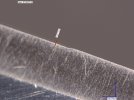
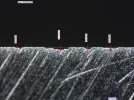
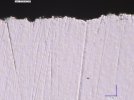
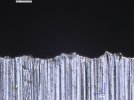
If we look at the work of Dr Todd Simpson he shows that we are essentially making a strong, straightened out residual burr at low grit which can be pretty effective depending on use despite being such a taboo. Of course, there are different kinds of burrs like explained by Dr Vadim (RIP) but that's another subject.
With a coarse edge, it will always take less force to draw cut and slice through things than it ever will for the most polished edge to.
It should also be noted that push cutting (cleaving) no matter how good or polished will always take more force than draw cutting (slicing) regardless.
That is a fundamental feature difference; drawing and sawing in a slicing motion will always take less force than pushing and cleaving regardless of edge finish.
It's just that the edge finish will maximize either feature better.
So, in use, there is certainly a pleasant experience with a coarse edge doing a light touch and draw whenever cutting with things and it will require the least amount of force to function Just as there is a pleasant euphoria in use with a very crisp, polished edge push cutting with quiet ease.
The main problem with coarse edges is that it is extremely difficult if not impossible to fully remove the burr like I mentioned above.
So, high sharpness coarse edge can be especially short-lived depending on how it's processed by the sharpener. However, hair shaving sharpness is fleeting regardless but it is certainly maximized with higher polish.
Coarser edges are also fundamentally more prone to chipping failure due to coarse scratches acting as stress risers and deformation buildup creating fatigue, especially if the apex is just a reinforced straightened out residual burr.
Which is best between coarse and polish?
You'll find folks on either end of the spectrum sometimes they are just trapped by their ability to execute.
For example.
Some people are stuck with coarse edges due to not being able to make a crisp polished edge due to lack of execution, equipment and understanding of how to avoid rounding over the apex.
"I can't get a sharp polished edge like I can with a coarse finish"
Or you will have people in the other camp who cannot make a coarse edge to save their life without massive floppy burr. This results in them relying on higher polish as a crutch in order to get a crisper edge and remove burr.
Avoid these camps of thinking and think of either option as a tool in your toolbox.
My general preference has always been a polished toothy edge like what Dave Martell and Eytan Zias taught.
So, IMHO the best of both worlds for general use is a medium grit edge with a 1 micron strop unless a specialized use dictates what is needed.
Keep in mind,
Geometry however is one of the greatest factors for performance.
You then tune the geometry to what you need.
If you want a ferrari go 15° per side.
If you want a monster truck 25° per side.
So, we don't want to be the guys whining about not having Ferrari performance because we were unaware we created a monster truck geometry and vice versa.
Mastering all of that and you can make your edges customized for whatever you need within reason.
Hope that was clear as mud.

-
The BladeForums.com 2024 Traditional Knife is available! Price is $250 ea (shipped within CONUS).
Order here: https://www.bladeforums.com/help/2024-traditional/
Rex 121 sharpening finish?
- Thread starter JBoone
- Start date