Rough or smooth against tang with Micarta?

Joined
Dec 11, 2011
Messages
72
I hope you bladesmiths don't mind a newbie question from an amateur. I'm about to make my second (ever) handle for a knife. My first was an Ipe handle for a Spyderco M390 Mule. What I'm working on now is a Spyderco Woodcraft mule and I (ironically enough) will be using Micarta. I got some green canvas Micarta scales from Texas Knife and am wondering which side of the scales I should adhere to the tang. One side is extremely smooth and glossy. The other side is a lot more rough and feels like bare canvas. Thanks in advance for any advice.
 
regardless of which side you use, hit it with some coarse sandpaper on a flat sanding surface. You can fresh sharp scratches for the adhesive to grab. There's really no difference if you prep the surface properly. You'll be scratching the smooth side up enough they'll look the same once ready.
 
my pleasure. Remember to wear respiratory protection while working with the stuff and cleaning up afterward. it's not particularly good for your lungs or those around you.
 
Use the smooth side in, and rough side out. The difference is sometimes not really noticeable when finished, but there is a "grain" to some laminates, and you want both sides of the handle the same.

As Remyrw said, sand the tang and Micarta before glue-up. There is a section in the "How to Make a Knife" sticky on how to properly glue up the scales.
 
Stacy, that grain still matters after grinding/sanding into them? I'm talking about a normal block of single color stuff, industrially produced rather than the boutique stuff or something with a pattern in it. I was unaware there was a difference with the plain jane stuff once you'd ground past the surface.
 
I just read through the tutorial, Stacy. One thing I hadn't thought of was drilling more holes into the tang to give the epoxy space to pool. The first Mule I did had a bunch of holes in it already, but this Woodcraft Mule has only three 3/16" holes (and I'll be using three pins). I think I'll drill some more holes in the tang like you suggest in your tutorial. Is there anything I need to be mindful of when drilling the tang as far as RPM goes? Also, in the tutorial you say the knife shouldn't be stored in it's sheath. Why is that?
 
Storing in their sheath can hold moisture against them (and other chemicals from the sheath) that can rust, discolor, even etch the blade. It's best (in my opinion) to store lightly oiled, separate from the sheath.

For drilling the holes in the tang, rule of thumb is slow, steady, and firm. Good luck drilling through if the tang hasn't been softened; unless you have access to a machine shop or lots of carbide bits you're going to have a tough time drilling through the tang...
 
Hmmm...I don't have access to a machine shop and the blade is hardened. I will be using a drill press, though. If I'm having trouble drilling the tang, I may just use two pins and leave one of the holes open.
 
If you can't drill the tang, just make a lot of small dimple holes in the underside of the scales. Those will hold some epoxy to assure a good grip. Or,you can use a Dremel tool and grind the tang center out as well as the bottom of the scales. This is usually called an epoxy reservoir. A carbide or diamond burr will do it nicely. You may be able to pierce holes through the tang with the same carbide burr while making the shallow depression in the tang.
 
I got my handle glued up and I'm now just waiting for the epoxy to cure. I'm using just two pins so that I have an open 3/16" hole for the epoxy to pool in. I also bought a tungsten carbide cutter bit for my Dremel tool and cut 6 shallow trenches on each side of the tang to allow for more spots for the epoxy to pool. I got an idea of how hard the steel is when I tried to do this with a Dremel bit I already had. All I was doing was making polished lines on the tang and probably ruining the bit.
 
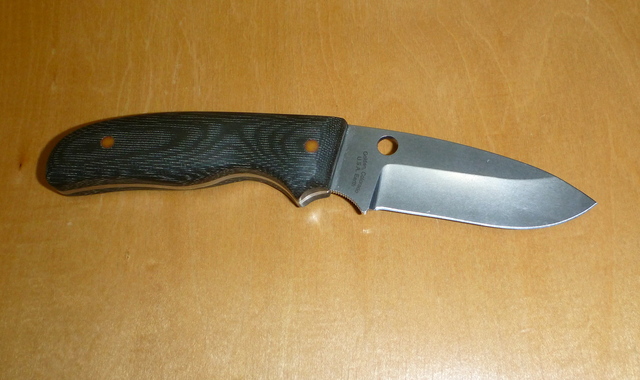
I finished the Mule and wanted to share it with you guys. Thank to everyone who gave me advice in making the handle scales for this.

P1010280.jpg
 
A delayed answer to your question about the look after grinding:

Yes it can matter. Take a piece of coarse woven cloth and look at one side, now, turn it over. If it is woven with a warp and woof, there will be a difference in the look. This is easily seen on a Persian rug. When the Micarta is laminated, the cloth is layered all one way. It is best that the same sides and direction of the sheet stock be observed on the handle. It may not show much, or at all in some cases, but it can show at times with a noticeably different sheen.
 
Back
Top