
rust on knife

You are all quick to say the knifemaker has no responsibility. However, how many knifemakers include a short statement with their knife on the care of their knives? How many dealers sell along with their knives their favorite oil or wax for maintenance?

I recently bought a brand new tacticool knife from a "major maker" for no small amount of money and it came with no instruction as to care. In contrast, 10 years ago I bought a New Livesay knife for $45 and although it came in a plactic bag and he's now a GB&U citizen, he included a very nice statement about care and feeding of the blade.

For the life of me, I cannot understand why makers don't provide more information about the care of their knives. Can anyone tell me why? If you ask 10 makers, you'll get at least 5 different general statements on care and sharpening, so why wouldn't a knifemaker want to give his opinion to his customers? Even if it is going to be a safe queen, a knife still needs some care.
 
You are all quick to say the knifemaker has no responsibility. However, how many knifemakers include a short statement with their knife on the care of their knives? How many dealers sell along with their knives their favorite oil or wax for maintenance?

I recently bought a brand new tacticool knife from a "major maker" for no small amount of money and it came with no instruction as to care. In contrast, 10 years ago I bought a New Livesay knife for $45 and although it came in a plactic bag and he's now a GB&U citizen, he included a very nice statement about care and feeding of the blade.

For the life of me, I cannot understand why makers don't provide more information about the care of their knives. Can anyone tell me why? If you ask 10 makers, you'll get at least 5 different general statements on care and sharpening, so why wouldn't a knifemaker want to give his opinion to his customers? Even if it is going to be a safe queen, a knife still needs some care.

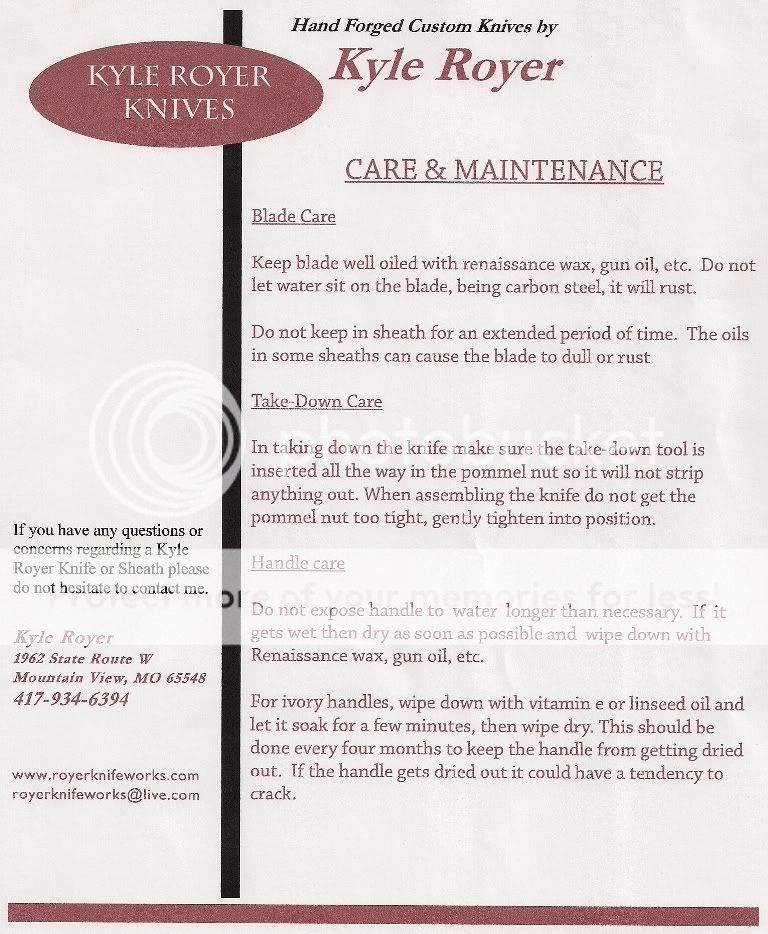
I can think of a few makers and one web dealer who provides a care/maintenance document along with purchase. However I agree probably not enough do.

Here's a couple examples I was immediately able to put my hand on:
scan0001-6.jpg


scan0002-3.jpg
 
Last edited:
Thanks for everyone's input. The blade steel is CPM-154 and the bolsters and liners are 416 stainless and the rust is on both. The maker cleaned it up once and sent it back and the rust is back again. He said more than likely someone has handled the knife with something on their hands and was not cleaned. This is the only knife I have in my collection with rust. I have ask for a refund, am I being unreasonable?
 
The word is "Stainless" not "Stainproof". We would clean it up and probably send you a little can of Renaissance wax when we returned the knife. Sometimes stain "resistant" steels like D2 pit deeply when it rusts and is difficult to remove completely without ruining the knife. It is best to keep it from rusting than try to clean it up after it rusts.

We used to provide instructions on the care and maintenance of the knives we make, but found that no one was interested in it and they left them on our table or asked us to throw it away. Now we just tell them to take care of it like they would their favorite shotgun or rifle. People seem to understand that.

We live in an area with pretty high humidity and have a problem with rust on some steels. Carbon steels like 1095, 1084, and 5160 are a real pain and I can't wait to get a knife made from one of those out of the shop. We had some problems with a particular batch of D2 rusting and pitting but most of the stainless steels don't cause any problems at all.

I have knives in my collection that are over thirty years old, made of 154CM and are as clean as the day they were made. It is hard for me to picture a knife made of 154CM rusting, much less the 416 stainless, without something serious causing it. Like a salt atmosphere or salty fingerprint. I have seen some materials, like felt, that would hold moisture or salts and cause rust on metals that stayed in contact with them.

If it was just the 154CM in the blade that was rusting or just the 416 in the bolsters, I could question the steel, but with both rusting it sounds like to me something else is going on with this knife
.
 
I have ask for a refund, am I being unreasonable?

far from it. because you were ripped off. under no circumstances 154cm rusts. never ever. and steel legs of oil platforms are made of 416 stainless. sue the crook.

hans
 
I say you demand the knife be chromed (handle and all) and sent back to you for free + some fruit or possibly a hat of some sort.

Seriously though, yes. That is highly unreasonable. Send it back maybe, but don't expect a full refund. Maybe the knife should be in better hands.

good luck,
Brook
 
Pictures would really help.

I have seen bolsters and guards that were soldered on have flux trapped in a bad solder joint and cause corrosion to stain both the guard and the blade. This can show up a long time after the knife was made and is a defect in the workmanship. Cleaning the rust off the outside is not going to stop what is going on under the bolster and it will come back. I am not saying that is what is what is going on here, but if it is, and we had made the knife you would either get your money back or a new knife. Your choice.

If that is not happening here, I can't think of anything that a maker could do that would cause your knife to rust while it is in your posession.
 
^ I purchased a folder from a dealer some months ago made by a VERY popular and well known maker and noticed a little rust/corrosion inside on the liner and back-spring. The reputable dealer recommended that he arrange for me to send the piece to the maker (at no charge to me) for the condition to be immediately corrected. I declined as I was concerned that the unsightly condition may return. After reading this thread, I feel I definitely made the right decision in returning the piece to the dealer even though I have no doubt that the maker would have removed the rust multiple times if necessary.
 
Last edited:
I had 3 different knives that had handling or storage marks. Each was purchased from 3rd parties and probably not the original buyer. I contacted each maker and they all offered to clean the knife up if I paid the shipping costs.

They eagerly wanted to do the right thing and were polite and gracious about it. I contacted them asking to pay to have the work done but they refused any payment and wanted to make me happy.

To me that’s what makes custom knives special and why I enjoy participating. There’s something truly special about having a human being take pride in and personally stand behind their work.


Mitch
 
Each was purchased from 3rd parties and probably not the original buyer. I contacted each maker and they all offered to clean the knife up if I paid the shipping costs.

Try that with a car and see what the dealer says! :D

We had a guy in Florida send a knife back that he had thrown against a tree and broken. He was honest about it and said that he had screwed up. We sent him another and recommended that he throw a knife that is designed to be thrown. We heard about it from three different people within two months. It is easier and cheaper to keep a good customer than it is to find a new one. That guy in Florida is a good one.
 
far from it. because you were ripped off. under no circumstances 154cm rusts. never ever. and steel legs of oil platforms are made of 416 stainless. sue the crook.

hans

In defense of the maker he did not charge me postage when he cleaned it up. He did express that he felt that it had been handled by someone with maybe salt, etc. on their hands. He has agreed to clean it up, make a new folder or refund my money.

Yes, stainless will rust. Hans are you an attorney wanting to sue...?
 
In defense of the maker he did not charge me postage when he cleaned it up. He did express that he felt that it had been handled by someone with maybe salt, etc. on their hands. He has agreed to clean it up, make a new folder or refund my money.

Yes, stainless will rust. Hans are you an attorney wanting to sue...?

in plain text: yes, i think it is unreasonable to ask for a refund, unless you have reason to believe that it is a flux/solder issue. otherwise it's your responsibility to take care of your knives well and truly, even without the maker's care instructions. in my opinion it all boils down to common sense.

no, i am not a lawyer, i am a watchmaker, and quite familiar with the problem. standard dialogue twice a year: me: "i am terribly sorry sir, but there's water inside the case." customer: "are you kidding? this is a rolex submariner! it's waterproof!" me: "out of the box, yes. but this watch is twenty years old and i guess it hasn't been serviced for two decades. and look here, the inside of the bezel is heavily corroded, therefore..." customer: "corroded? where the hell did you get your diploma? this is stainless steel!!!" and so on. we usually send the watch to geneva to get an estimate. it's always an expensive service. and shipping and handling costs are not borne by rolex.

hans
 
Aw guys, leave the makers alone. My opinion is that if someone is willing to drop big bucks on a custom, then that person should be enough of a knife nut to know about how to care for that knife. If that person buys a production knife (whether online or at a store), most of those retailers have maintenance/care instructions/products. Just my thoughts. I just think that it's difficult today, with the Internet, to not be informed about anything and everything.

Plus, most makers that I am friends with will happily take the knife back and give it a free fluff and buff, regardless of its conditions.
 
Last edited:
I sadly found the evidence of flux under the guard of one of my knives.

So I wrote the maker an email outlining my suspicions, with a couple of close up pictures, and he told me to send it back to him for a look-see, and offered to clean it up or otherwise take care of it.

This is and should be the standard response. However, what are the chances that flux under the guard can be repaired?
 
jop91, I put a pistol in a plastic bag and pulled a vacuum on it for long term storage once. It didn't work too well. I'm glad it was a less expensive pistol and made of something similar to stainless steel. The pistol survived but if I hadn't checked on it not long after I had sealed it up, it might have been a disaster. It might work if you put them in a container and evacuated the air and replaced it with a gas like nitrogen. They are just hard to play with stored like that.

I still think that the best thing to do is wipe things like knives and guns down with a lightly oiled, clean cloth, don't store them in their sheath or case and check them often. I have my knives displayed in my office in a rack that keeps them in view and easy to play with.
 
Back
Top