
-
The BladeForums.com 2024 Traditional Knife is available! Price is $250 ea (shipped within CONUS).
Order here: https://www.bladeforums.com/help/2024-traditional/
You are using an out of date browser. It may not display this or other websites correctly.
You should upgrade or use an alternative browser.
You should upgrade or use an alternative browser.
Rusty H1?
- Thread starter Seanski
- Start date
- Joined
- Jul 5, 2009
- Messages
- 305
I have not seen this. Do you have a link?
Paul
Paul

- Joined
- Oct 20, 2004
- Messages
- 4,704
I would like to see the picture as well. Many people have tried their hardest to get H1 to rust including using chemicals without much luck. Sometimes the laser etching can look rusty but it will come off and I think is a discoloration from the laser (could be wrong on that).
I know mine has seen a ton of salt water and not rinsed and looks fine so I find it a little hard to believe unless they put it in some type of acid. Even then I doubt it.
I know mine has seen a ton of salt water and not rinsed and looks fine so I find it a little hard to believe unless they put it in some type of acid. Even then I doubt it.

- Joined
- Apr 27, 2003
- Messages
- 5,738
What was it exposed to, and for how long? I know tonydahose managed to severely mess up an Atlantic by leaving it wet in a bucket of chlorine tablets. Pictures here. All that really proves is that no metal is totally immune to corrosives at high enough concentrations. Don't recall the exact details, but IIRC, the Caspian you're referring to suffered similar abuse.
Paul

My Personal Website ---- Beginners Guide to Spyderco Collecting ---- Kiwimania ---- Spydiewiki
Dead horses beaten, sacred cows tipped, chimeras hunted when time permits.
WTC # 1458 - 1504 - 1508 - Never Forget, Never Forgive!
It's easy to grin when your ship comes in and good fortune and fame are your lot, but the man worthwhile is the man who can smile with his shorts twisted up in a knot. - Morey Amsterdam
Paul
My Personal Website ---- Beginners Guide to Spyderco Collecting ---- Kiwimania ---- Spydiewiki
Dead horses beaten, sacred cows tipped, chimeras hunted when time permits.
WTC # 1458 - 1504 - 1508 - Never Forget, Never Forgive!
It's easy to grin when your ship comes in and good fortune and fame are your lot, but the man worthwhile is the man who can smile with his shorts twisted up in a knot. - Morey Amsterdam

- Joined
- Mar 19, 2010
- Messages
- 570
High grade stainless steels can appear to rust from a surface contamination of carbon steel. Common sources include, grinders, steel racks, handling equipemtn, flapper wheels, carbon steel wire brushes, etc. Engineering specifications for welding stainless steels often contain strict requirements for stainless and carbon steel tool segregation.

- Joined
- Aug 22, 2002
- Messages
- 28,647
I guess this in what you are refering to?
http://www.candlepowerforums.com/vb/showthread.php?p=3229534#post3229534
http://www.candlepowerforums.com/vb/showthread.php?p=3229534#post3229534
- Joined
- Jul 5, 2009
- Messages
- 305
I guess this in what you are refering to?
http://www.candlepowerforums.com/vb/showthread.php?p=3229534#post3229534
According to Spyderco H-1 is 100% rust free. I would guess that the knife in this thread has either had contact with some sort of chemical, or, has maufacturing defect. If it is a defect, it should be covered by Spyderco. Personally, I do not think it is a defect.
Paul
- Joined
- Oct 20, 2004
- Messages
- 4,704
Not being able to see the knife in person it is hard to say. If it has lived in the salt water for an extended amount of time then it might not necessarily be rust. It mainly looks like it is raised up from the surface and there are different kinds of algae and plant material that can attach itself and look brown like that. He said it cleaned off and there was some pitting of the steel which doesn't make since to me. I have taken a plastic scotch bright pad to rust before and it doesn't do a whole lot to it so the fact it came off also makes me question if it is actually rust. I have spent a lot of time around the ocean and have seen plastic that has been in the water for extended periods of time have a similar look. I wish he would post a picture of what it looks like after it was cleaned up.

TLR
Gold Member
- Joined
- Oct 5, 1998
- Messages
- 1,574
I'm just spitballing here but that doesn't really look like rust to me. Especially that middle picture. It looks like some contaminant on the surface of the knife. Reminds me of my grill at the end of the summer. Not calling this guy a liar but something just isn't right in my opinion. Having spent some time around the coast and on salt and brackish water there are some other things that will adhere to and look like rust. FlaMtnBkr you may be on to something.

- Joined
- Oct 5, 2005
- Messages
- 2,400
Maybe that's one of the new limited edition 1095 Caspian Salts?

riz_aaroni
Gold Member
- Joined
- Feb 7, 2007
- Messages
- 1,931
Looks like something hit the blade and that rusted, not the knife. Seems like if you hit it with a wire brush on a grinder it'd all come off. Not sure though, pretty intense in any case.

- Joined
- May 1, 2004
- Messages
- 1,240
I think it was chemical corrosion:
Quote from post #38 of the CPF thread.
And this from tondayhose:
http://spyderco.com/forums/showthread.php?t=39008
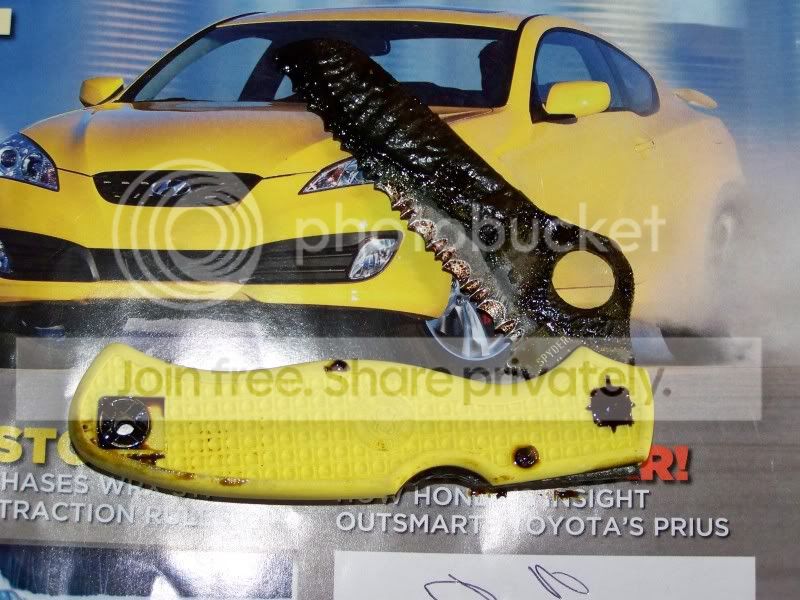
Quote from post #38 of the CPF thread.
I would be happy to send the knife in to Spyderco but only if they want to see it. Unfortunately I did take some scotch brite to it and removed the majority of bloom. I don't know if the pitting I seem to be seeing could result from corrosion growth on the surface but it wouldn't surprise me. If the growth limited the flow of oxygen as well as trapped some free chlorine ions (presuming I have my chemistry right) pitting is common on many steels otherwise not prone to corrosion. Well at least I know this can be a killer of 316.
And this from tondayhose:
http://spyderco.com/forums/showthread.php?t=39008
i took the knife nice and wet and threw it into the chlorine container,
H1 is great stuff. I am a diver and can attest to that. However, My salt one did start to corrode lightly around the logo and around the washer on the blade pivot. nothing much, a little WD and good as new. But I do think that the photos are genuine. H1 is heads and tails over regular stainless, wich starts rusting as soon as you get out of the water, but it still has to be rinsed once in a while.

- Joined
- Oct 28, 2005
- Messages
- 742
yep...that was me..it wasnt the brightest thing i ever did but it is what it is. as for rusting on the logo that rust was probably from the stamp that made the logo, thats what i have read on the subject.
- Joined
- Oct 20, 2004
- Messages
- 4,704
I think it was chemical corrosion:
Quote from post #38 of the CPF thread.
I would be happy to send the knife in to Spyderco but only if they want to see it. Unfortunately I did take some scotch brite to it and removed the majority of bloom. I don't know if the pitting I seem to be seeing could result from corrosion growth on the surface but it wouldn't surprise me. If the growth limited the flow of oxygen as well as trapped some free chlorine ions (presuming I have my chemistry right) pitting is common on many steels otherwise not prone to corrosion. Well at least I know this can be a killer of 316.
I don't buy it. Why would there be chlorine in the ocean? There wouldn't. He might have meant chloride ions which there would be lots of from the dissolved salt (NaCl) in the water. But chloride ion wouldn't do anything to H1 as evident by the many people who have left a H1 knife in a jar of salt water for a year.
I still don't think it is rust and is some type of algae growth on the blade. Rust goes into the blade and then makes layers of less densely packed iron oxide which can then grow out. On the knife it doesn't look like it has etched into the blade but is on top of the steel in a layer of gunk. Ocean gunk to be exact.


- Joined
- Apr 21, 2006
- Messages
- 5,613
I say the metal snap or fastner in the sheath was rusted onto the blade. If not that something metal and subjected to a corrosive. You can see the location of where it was, and the effect of gravity on it as it spread the oxidation/moisture. The other areas of the blade not contaminated are just as you would expect to see from H1.
Whatever caused it almost electroplated the rusted metal onto the H1. I'd suggest something acidic that actually caused a current in a battery like situation.
Whatever caused it almost electroplated the rusted metal onto the H1. I'd suggest something acidic that actually caused a current in a battery like situation.
- Joined
- Apr 9, 2008
- Messages
- 1,319
If i'm not mistaken, H1 still has carbon in it?
- Joined
- Oct 20, 2004
- Messages
- 4,704
Don (McGizmo) is rather well respected and makes flashlights and other items from titanium, I highly doubt he is faking something to discredit Spyderco....
Sverre
No one said he is faking anything or trying to fool or discredit anyone. All that was posted was a link to a picture and then there was speculation what happened to the blade. If it all wiped off rust doesn't do that. The only thing that could be said about the thread is that it was implied McGizmo was mistaken about the substance on his knife. I don't know what him making flashlights or what they are made of have anything to do with anything.