Sal Glesser
Moderator
- Joined
- Dec 27, 1998
- Messages
- 11,730
Lets talk about SPOTs
One could say this is a sharing of the history and philosophy of this particular design.
For several years, knowledgeable knife users, whom I respect, would speak with me at shows or write to me and ask that Spyderco build a neck knife. My earlier opinions were against neck knives. I thought that it was a dangerous place to carry and deploy a knife from, especially a large knife.
As a result of those requests, (we can better serve our customers if we listen) we investigated further and found that there were already more than 20 neck knives on the market. Why would the market need another one? In spite of that, the requests continued so I yielded and decided to create a Neck knife model that would hopefully offer enough features to make it worthwhile producing. If we couldnt come up with something unique and effective, we would not make it.
The mission was to create a model that:
1. Would be an effective last ditch high performance self defense tool if attacked. (Assuming a spray or other deterrent failed)
2. Easily accessed
3. Absolutely secure in use. The worst thing that can happen to a defensive tool is that you drop it when you need it.
4. Absolutely safe in the stored position
5. Light
6. Relatively invisible
7. Politically friendly and legal
8. Highly effective, requiring no skill
I have a Fred Perrin LaGriffe (a serrated custom made by Fred) and I felt the Perrin hole would be pretty hard to improve upon with regards to security. Once the index finger is securely in the hole, the tool is not likely to be dropped or taken out of your grip.
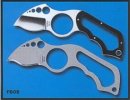
With Freds permission, we redesigned the LaGriffe. The blade was shaped into an effective cutter or poker, similar to the Cricket blade. The placement of the blade is for the best ergonomic use while using the index finger hole. The blade is only 1-3/8 (35mm) long, hardly a deadly weapon, but effective.
The handle was shaped to provide the most ergonomic grip possible. Many protos were made and refined and put into scores of hands before the handle shape was finalized. The blade and handle were skeletonized to reduce weight.
The high line version is hollow ground VG-10, satin finished with a thin black Micarta scale pinned to both sides of the handle. The Micarta version has a fitted lanyard pipe. The MSRP is about $110. The standard version is hollow ground AUS-6, bead blasted with no scales, and a drilled lanyard hole. MSRP is about $70. Both models have a ball-chain necklace covered by a thin paracord. An interesting feature (from Mike Janich) for comfort and security.
The Kydex sheath was a critical to me. The thought of having a sharp pointy thing hanging upside down under my shirt was, to say the least, disconcerting.
The sheath took quite a while to refine to our satisfaction since it had to be secure, accessible. We use the Janich/Snody concept of a wide necklace tunnel so the knife wont accidentally twist and there is a push off for the thumb so one doesnt have to snap the knife out. This permits a very secure fit.
The delay in delivery was due to the many minor refinements that we felt important in the sheath.
Well, now that Ive worn a neck knife for months (I test our own designs), I must say that my opinion has changed about neck knives at least our own neck knives. The neck position has also proved to be useful access while sitting.
The Self Protection Option Tool (SPOT) has been and will continue to be a most interesting project.
We began shipping the SPOT Neck-knife last week to collectors. We hope you like it and your comments are welcome.
Spyderco and I would like to extend a personal thank you to Fred Perrin for his assistance in this project.
sal
One could say this is a sharing of the history and philosophy of this particular design.
For several years, knowledgeable knife users, whom I respect, would speak with me at shows or write to me and ask that Spyderco build a neck knife. My earlier opinions were against neck knives. I thought that it was a dangerous place to carry and deploy a knife from, especially a large knife.
As a result of those requests, (we can better serve our customers if we listen) we investigated further and found that there were already more than 20 neck knives on the market. Why would the market need another one? In spite of that, the requests continued so I yielded and decided to create a Neck knife model that would hopefully offer enough features to make it worthwhile producing. If we couldnt come up with something unique and effective, we would not make it.
The mission was to create a model that:
1. Would be an effective last ditch high performance self defense tool if attacked. (Assuming a spray or other deterrent failed)
2. Easily accessed
3. Absolutely secure in use. The worst thing that can happen to a defensive tool is that you drop it when you need it.
4. Absolutely safe in the stored position
5. Light
6. Relatively invisible
7. Politically friendly and legal
8. Highly effective, requiring no skill
I have a Fred Perrin LaGriffe (a serrated custom made by Fred) and I felt the Perrin hole would be pretty hard to improve upon with regards to security. Once the index finger is securely in the hole, the tool is not likely to be dropped or taken out of your grip.
With Freds permission, we redesigned the LaGriffe. The blade was shaped into an effective cutter or poker, similar to the Cricket blade. The placement of the blade is for the best ergonomic use while using the index finger hole. The blade is only 1-3/8 (35mm) long, hardly a deadly weapon, but effective.
The handle was shaped to provide the most ergonomic grip possible. Many protos were made and refined and put into scores of hands before the handle shape was finalized. The blade and handle were skeletonized to reduce weight.
The high line version is hollow ground VG-10, satin finished with a thin black Micarta scale pinned to both sides of the handle. The Micarta version has a fitted lanyard pipe. The MSRP is about $110. The standard version is hollow ground AUS-6, bead blasted with no scales, and a drilled lanyard hole. MSRP is about $70. Both models have a ball-chain necklace covered by a thin paracord. An interesting feature (from Mike Janich) for comfort and security.
The Kydex sheath was a critical to me. The thought of having a sharp pointy thing hanging upside down under my shirt was, to say the least, disconcerting.
The sheath took quite a while to refine to our satisfaction since it had to be secure, accessible. We use the Janich/Snody concept of a wide necklace tunnel so the knife wont accidentally twist and there is a push off for the thumb so one doesnt have to snap the knife out. This permits a very secure fit.
The delay in delivery was due to the many minor refinements that we felt important in the sheath.
Well, now that Ive worn a neck knife for months (I test our own designs), I must say that my opinion has changed about neck knives at least our own neck knives. The neck position has also proved to be useful access while sitting.
The Self Protection Option Tool (SPOT) has been and will continue to be a most interesting project.
We began shipping the SPOT Neck-knife last week to collectors. We hope you like it and your comments are welcome.
Spyderco and I would like to extend a personal thank you to Fred Perrin for his assistance in this project.
sal