S30V machinability

Joined
Jun 23, 2016
Messages
28
Hi, I am starting a S30V fixed blade project and have plans to approach from a machinist standpoint. My plan is to 3D surface the blade with the only handwork being the final edge grind. I am curious to see how the aesthetic of the toolpath looks till its complete. I also have plans on doing a few that have been been smoothed over to look like a belt grind job.

My question is related to the machinability of the material. The datasheet likens it to D2, which I have next to no experience with. I had been planning on using flood coolant.

Is this material prone to work hardening in a way that will compromise the life of the blade?

I don't know how common an approach like this is, but I would be happy to chronicle it here if there is interest in seeing how it goes.

Thanks,
Wizzer
 
It is like D2. It work hardens and is abrasive so tool life isn't great, and it has trouble with BUE, but there are certainly worse materials to machine.

One problem I see is facing it and taking a light finish pass puts the skin into compression which can distort the work piece. I use a fairly large FPT for this reason, ~.006 when decking it. Sharp inserts helps. I've started using the F40M grade from Seco because it isn't burnished. Solid carbide designed for stainless elsewhere.

Yeah, please document your project here, I'd love to see it. I like seeing other people's approach to machining. :thumbup:


Edit to add: now that I think about it, I think S30V is actually a little worse than D2, and that's really saying something. It cuts okay but getting a good milled finish is a bear, partially because cutters do dull quickly. A good cutting fluid helps reduce BUE.
 
Last edited:
I'd love to see your progress as well. I've debated doing this a few times and I get to the point of trying to decide how to do the work holding and invariably decide it would be faster to simply grind by hand. I'd like to see your workholding plan especially. I was just going to make a little tooling plate that clamped the blade similar to how those who use filing jigs do, with some miniature toe clamps.
 
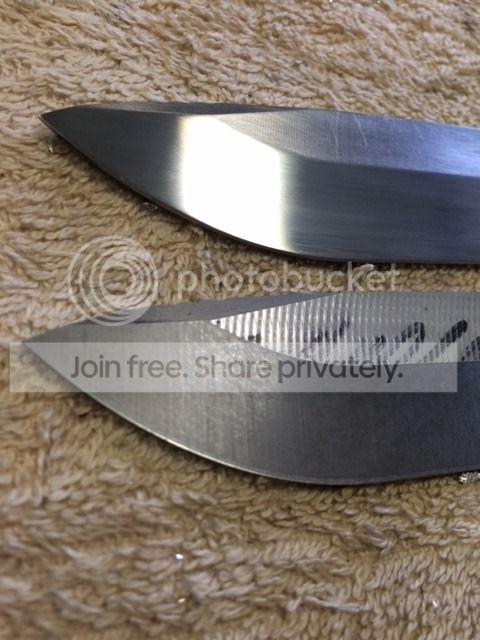
I made up a few blanks over the weekend with what I believe to be Ok success. As a whole, It machined a bit better than I was anticipating. I utilized High speed machining to rough the blank down with air blast. I only cut 4 blanks but had no noticeable tool wear issues on my roughing or finishing end mills. When It came down to the actual surfacing I got mixed results, both less than perfect.

As I was expecting, when surfaced with just air blast it appeared to "tear" the material rather than cut. This is certainly in part due to a previously used tool. When I tried to surface with flood coolant the finish was noticeably better but It appeared to have started to work harden.

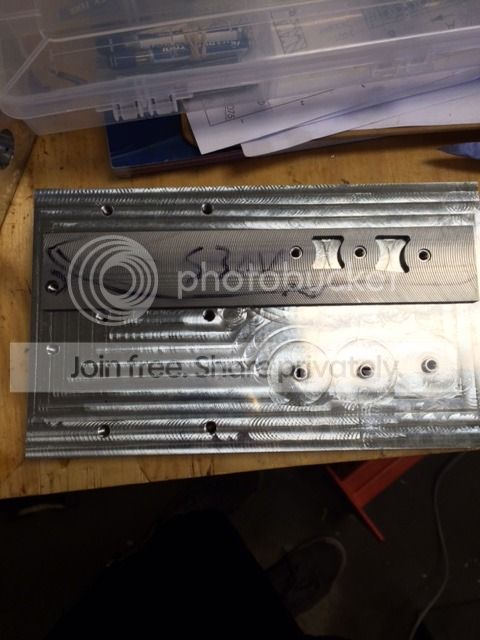
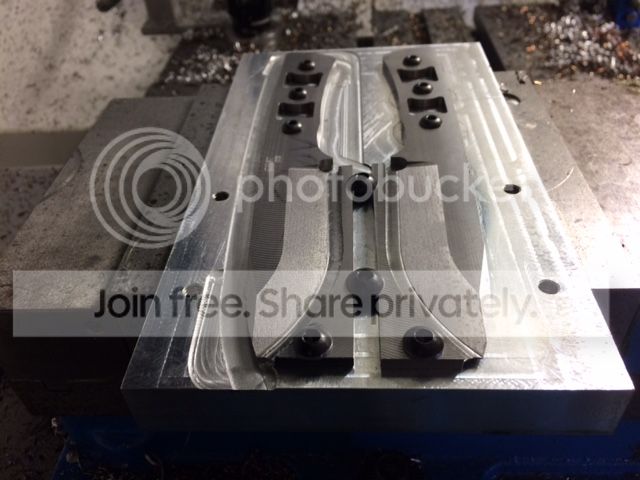
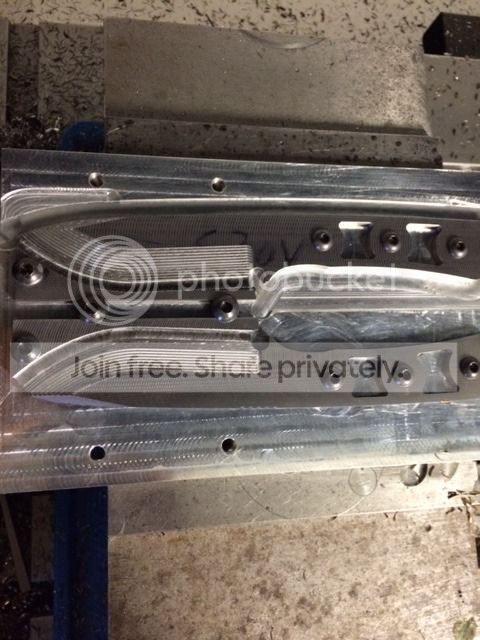
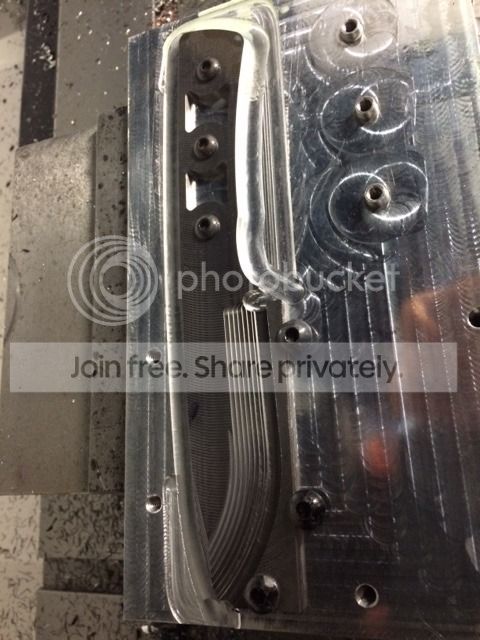
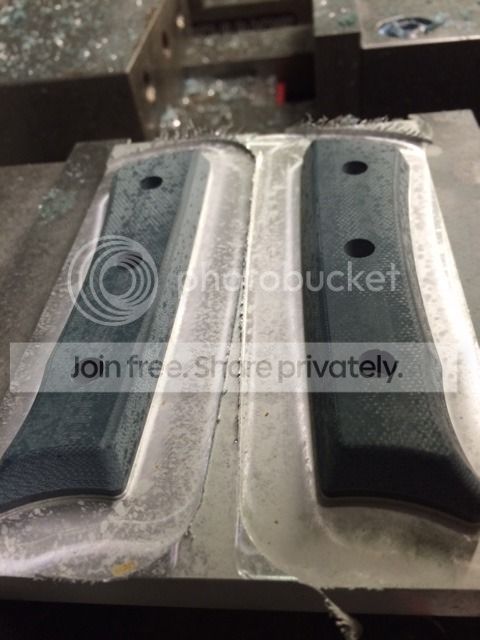
my fixture is made of aluminum since it is the first iteration which will certainly need revised once I see what kind of results I am getting. The holes in the tang are reamed which are a very close slip fit to the fixture. The hole near the blade tip is body bound to the button head in the fixture which locates the blades repeatably from one side to the next. Once both sides were machined I used toe clamps from the back to secure it as I mill thru the .03 web to separate the tab from the blade.

I was very pleased with the flatness of the blades after they came out. I wasn't sure if the stresses would neutralize. The Stock was very good going in FWIW.

IMG_1344_zpstfgezcra.jpg


IMG_1357_zpsk86monvm.jpg


IMG_1354_zps2h0iuv3y.jpg


IMG_1350_zpsubnrqmgv.jpg


IMG_1348_zpsq4waffnr.jpg


I am certainly expecting to have to finish theses blanks with some hand word, but both of the results listed above will need more than I was hoping for. I have a few more approaches to try.

Stay tuned. Any suggestions or comments would be appreciated.
 
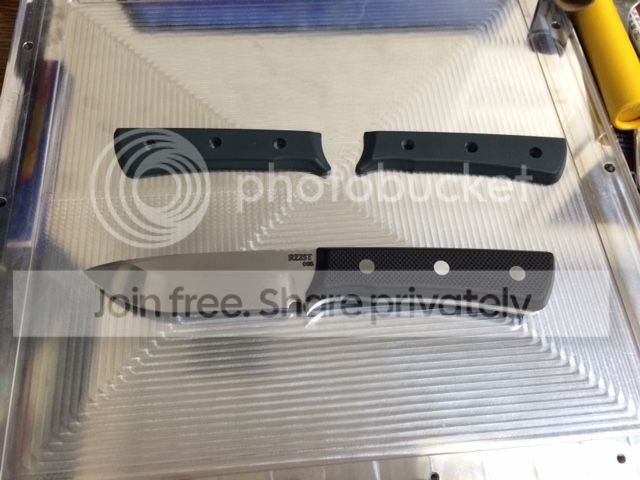
Back again, this time with better pictures.

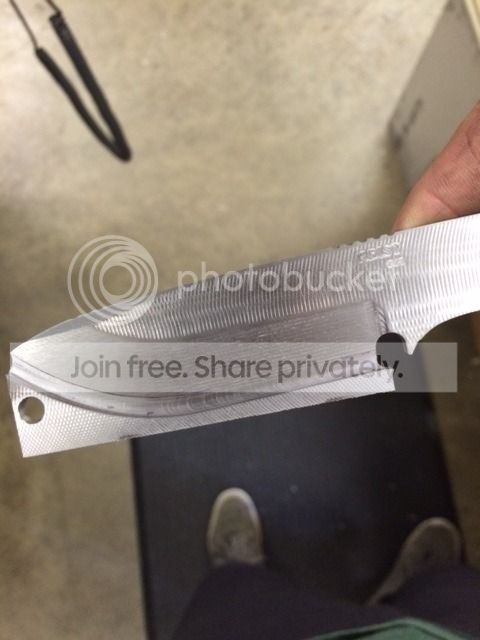
I changed my finishing tool path and cutter to a .25 bull end mill. It was set to finish with a constant Z but I found a climb milling linear tool path to provide a cleaner surface. It makes for a slightly longer run time but the finish is, in my opinion, worth it.

With just a small amount of hand work I am able to get a pretty good shine.


IMG_1414_zpsclxb3lda.jpg


IMG_1419_zps222gdffl.jpg


IMG_1442_zpsv49whvgu.jpg
 
Last edited:
Hey, that turned out very nice! What are you using for software? Another issue I've had when contemplating doing this was getting the blade geometry of my solid model correct in Inventor.

Maybe I missed it, but these were in an annealed or normalized state when you machined, or were they hard? If they were hard, what were you using for feeds and speeds?
 
These were machined annealed. They will head out for heat treat in a few days.

I use Solidworks and SolidCam for design and programming.
 
Is that parametric? Meaning you draw a sketch and extrude from that sketch to get a solid? How are you modeling your bevel? I get a blank drawn up and then try to loft or chamfer and it always comes out screwy.
 
create a sketch perpendicular to the profile of the blade, draw your bevel then extrude cut around the sweep of the blade.
 
I think I'm getting there. The other issue I've had is on complex surface geometry like this, Inventor inevitably leaves these parting lines that always show up in my CAM program, even if there is no dimensional deviation. But, I'm not opposed to a bit of hand finishing.

2zsmyjo.jpg
 
Back
Top