S30V or D2 for a custom fixed blade?

All of the info is wonderful. Even the highly technical parts are useful for me since I'm that type of person.

Bottom line.....
After looking more closely at the handle of the knife I was going to order and talking with the knifemaker, I found out that it was designed for a "forward grip". Meaning that my first finger is on the choil. If I only hold onto only the handle, about an inch of my hand would stick out the back. This does not seem very secure (I talk about this on another thread concerning the Strider SNG).

Therefore, I have decide to order the Dozier Model 6 so the steel will be in D2 since that is all they use.

Thank you all for your valuable time and all the great feedback. Learning is a constant.
 
bladeprince, ask Dozier if you really want something other than D2. He's a great guy, and his wife is a lovely lady. They're willing to do their knives in other steel than D2, although his D2 is near legendary.
 
Ok, I don't have a horse in this race, but the talk of S30V being a better choice than D2 for acute edges is getting me confused. Aren't there even more pages about S30V edges chipping out than there are about "D2 Sucks"? I've even been afraid to use my Ritter Grip! So, c'mon Cliff, which is it?

I don't currently have any D2, but plan on getting a Dozier soon- as SpyderJon says, Dozier's D2 is legendary, so personally, I couldn't see getting a Dozier blade in anything else.
 
MVF said:
Ok, I don't have a horse in this race, but the talk of S30V being a better choice than D2 for acute edges is getting me confused. Aren't there even more pages about S30V edges chipping out than there are about "D2 Sucks"? I've even been afraid to use my Ritter Grip! So, c'mon Cliff, which is it?

I don't currently have any D2, but plan on getting a Dozier soon- as SpyderJon says, Dozier's D2 is legendary, so personally, I couldn't see getting a Dozier blade in anything else.

Off the main subject but I have a Ritter Grip I used for an afternoon to dig out weeds from my yard. I know I hit and scraped against plenty of rocks during that time. The blade was REALLY dull when I got finished but not one chip. After sharpening, it was as good as new again.

Regards
 
Just because a blade has a choil doen't mean you have to use it.It is there for fine cutting chores.Personally I like the choil on some of my knives and feel very comfortable using it.Just my 2 cents.
 
mmarkh said:
Just because a blade has a choil doen't mean you have to use it.It is there for fine cutting chores.Personally I like the choil on some of my knives and feel very comfortable using it.Just my 2 cents.

Completely agree. It's just that some designs are made primarily for the forward grip and the use of the choil is, in some cases, almost a requirement. If it has a choil (like the Manix), I just also want it to have a handle long enough for a good hammer grip as well.

I also have the Rat-3 which is also designed for a forward grip. When using it in hammer grip, it has barely enough handle for my taste. Anything less and my little finger would almost be dangling in the air. If the hammer grip on the Strider is similar, then that would be enough (barely). Anything less, however, then no thanks.

We are all different. That's what makes this forum so interesting and informative.

Regards to all
 
Joe Talmadge said:
If, however, you tend to leave your edge at, say, 15 degrees per side (which many people think is a performance edge but for Cliff is obtuse and non-performant for this type of knife), then you'll find no problems with D2.

I would not go that far, but you won't get the extreme problems reported by Sodak. In general though, if you are buying a high end small custom knife I would think that you may want to put an edge on it which is less obtuse than is necessary to use on a felling axe. Spyderco is now pushing at around ten in thier cutting optomized blades like the Calypso Jr. and it really isn't sensible to have them be outcutting custom blades costing several times their price. Five degrees per side is probably a bit too low in general as this means you have to cut to the primary and this will influence aesthetic issues, but around ten per side can be done very clean and not marr the primary.

MVF said:
Ok, I don't have a horse in this race, but the talk of S30V being a better choice than D2 for acute edges is getting me confused.

As I noted this should be the case given the inherent finer carbide distribution of powder metallurgy of S30V and enhanced further by the reduced dependance on chromium rich carbides due to the higher vanadium. However like you said, the user feedback doesn't seem to support it. I cut my Sebenza in S30V way down and the edge fell apart and wasn't even as durable as Spyderco's H1 and it was totally outclassed by O1 at 63.5 HRC. I plan to recheck this with Wilson's S30V as his heat treatment is far more optimal than Reeves for that type of use.

-Cliff
 
This may sound simplistic after all the technical sharpening discussion, but what is wrong with the 20% (40% total) edge that is provided by the Spyderco Shapemaker? I can make an edge that could dry shave my whole body and still be sharp (with S30V or some other good steel). The so call "micro edge" seems like it wouldn't last very long and not really be that necessary. This is a knife, not a razor blade. Right? Wrong?

Regards
 
your edges are coarse

I like coarse edges. I have a D2 stryker and it seems to be alright. I'd go with S30V, but I think D2 is great for a skinner, but I don't know what you're using or want o use it for.
 
bladeprince said:
This may sound simplistic after all the technical sharpening discussion, but what is wrong with the 20% (40% total) edge that is provided by the Spyderco Shapemaker?

I don't think that anyone is saying that 20 degrees per side is a wrong choice. It's just that 15 per side is going to cut better, and if your blade can have this angle without chipping, why not go with the lower angle? The same things can be said about 15 versus 10 degrees per side. It's just a matter of optimizing performance even though that level of performance may not be necessary. Making unnecessary performance modifications is half the fun of knife tinkering.:D
 
bladeprince said:
The so call "micro edge" seems like it wouldn't last very long ...

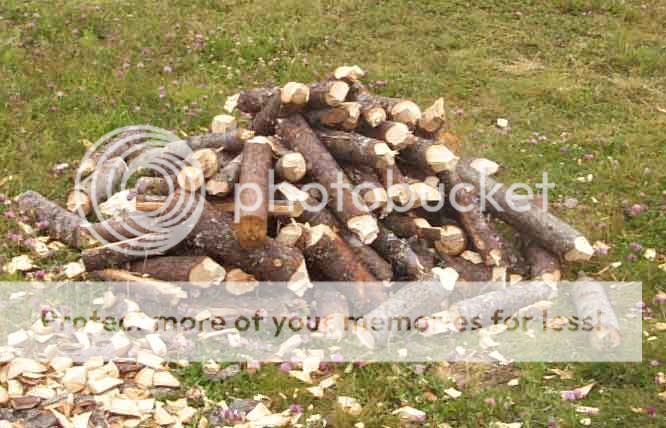
cs_shovel_bucking.jpg


Half of that pile of wood was chopped with a Cold Steel shovel with a 30 degree included edge and it still sliced newsprint readily. An actual knife steel can actually go more acute still. These were heavy chops, full power from the shoulder with the wood being cut on average in 10-20 chops per section.

In general as you reduce the edge angle the cutting ability, edge retention increases and ease of sharpening increases. At some point you will go so far that you pass the durability of the edge but this is *way* more acute than common sharpening angles and can usually be addressed with a suitable micro-bevel or light convexing.

I don't actually know if that is the limit of the shovel, I just can't grind it any lower on a belt sander due to the curvature.

-Cliff
 
beefangusbeef said:
I like coarse edges. I have a D2 stryker and it seems to be alright. I'd go with S30V, but I think D2 is great for a skinner, but I don't know what you're using or want o use it for.

Because it's my only custom and the fact that I have many other knives for different purposes (cutting boxes, hunting, etc), this one is mostly for everday use like opening a package, etc. but mostly it will be my "fast access" self defense knife, along with my ever present kubaton.

Regards
 
bladeprince said:
This may sound simplistic after all the technical sharpening discussion, but what is wrong with the 20% (40% total) edge that is provided by the Spyderco Shapemaker? I can make an edge that could dry shave my whole body and still be sharp (with S30V or some other good steel). The so call "micro edge" seems like it wouldn't last very long and not really be that necessary. This is a knife, not a razor blade. Right? Wrong?

Regards

Both. That's what makes this discussion so much fun! The hard part is not getting wordy...

First of all, if you are getting a Dozier, the 40 deg total edge is a little thick, but not horrible, due to Dozier making the primary grind so thin (on his hollow ground blades). Even though it is a little more obtuse, the blade is thin enough where it will be a very efficient cutter. For example, if you draw your hand across the edge of sheet metal, which has NO edge (or 180 total), it will still cut you to the bone. After a while, however, you will find yourself thinking, I wonder how good it will cut at 30? Then you find out, and then start dropping down until you start to see damage, then back off. What you can do is use a sharpie to mark the edge, and try both sharpmaker angles to see which comes closest to how the knife left the factory, and go with that.

On the other extreme, take a CS Trailmaster. At 40 deg total, the primary grind is so thick, you've basically got a splitting maul, and it won't work well. So there is no one magic formula, it's all like a bunch of dominos - it's part of a system.

Go with what works best for you. Experiment a little. I like to push the edge on thin, and am will to live with pretty gross damage to the knife when it doesn't work, as Cliff noted. But hey, it's my knife, and I like to learn. And no, it wasn't a Dozier that I took the huge scallops out of - I'm not that brave...
 
There's nothing wrong with 20 degrees per side, other than that you're giving up a ton of performance for nothing (again, making some assumptions about what you're using the knife for). I've always felt that if you're going to keep a huge obtuse edge, no sense in spending on expensive steels, since soft crappy steels will perform for you just fine. Ultimately, a knife is about cutting something (or chopping, or whatever your preferred expression of matter separation), so I feel that a "better" steel should give me better cutting performance. And that means that the better steel should allow me to thin the edge, otherwise I don't need a better steel. I can't remember anymore how you described the knife, but it was something like a 3.5" blade, you obviously won't be chopping cinderblocks with it. IMO If your knife can't handle 15 degrees per side, sell it and get a better knife. Even 15 should be easy.

That, of course, is just one point of view, and until I'm crowned czar, everyone is still free to go around with small expensive knives made from high performance steel, sharpened at 20 degrees per side. Once I'm czar, there will be strict penalties for this type of outrageous behavior :)

Joe
 
Joe Talmadge said:
IMO If your knife can't handle 15 degrees per side, sell it and get a better knife. Even 15 should be easy.

Yes, I have used a knife made out of mild steel with the edge at 12-14 degrees per side with no problems. I tried at ten and under but the edge would collapse readily even on ropes and such.

-Cliff
 
I didn't get it at first. Going to 15 degrees per side seems quite reasonable. I thought that the term "micro edge" was referring to 5 degrees or so. Since the Sharpmaker has a 20 and a 15, I'll give it a go.

Regards
 
"Micro" refers to how wide your bevel is. You put a microbevel (say 15 degrees per side) at the edge of your regular bevel (10). You only establish the microbevel with the fewest passes possible, hence retaining the bulk of benefits of the thin regular bevel while enjoying most of the damage resistance of the 15 degree edge.
 
Back
Top