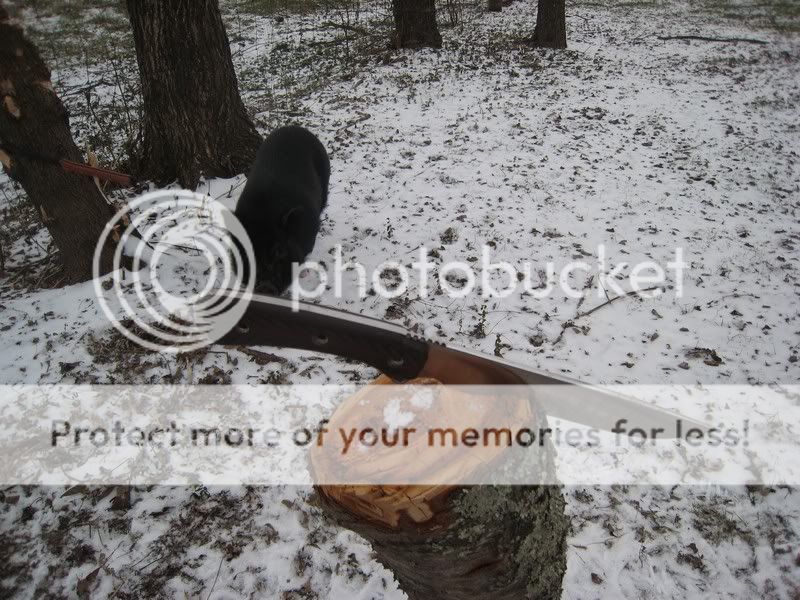
Let it be known that this model--whose blade looks by comparison to other Busse knives of similar length to be narrower from edge to spine, slender and light--that here is no shrinking violet of a knife. My usual fixed blade, a KA-BAR, is whimpering in the corner with its tail between its legs, refusing to confront this newcomer out of sheer terror at the scale difference.
Neither is 0.22 inches insignificant. It is my suspicion that Busse hogs lose some degree of sense of scale due to overexposure to the tree-cutters which Mr. Busse generally designs, so allow me to offer a reminder: Anything over 0.20" of thickness is FAT by normal human knife standards.
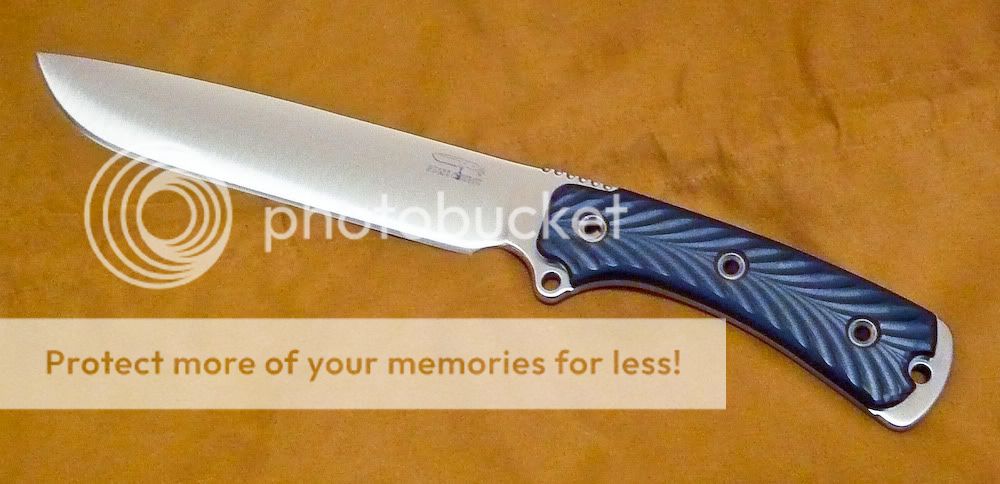
All of that said, I wouldn't want it any other way. The thickness feels exactly right for the blade design. The blade design is beautiful. Normally I prefer a more pronounced drop point shape, but the SAR-8's tip is a definite penetrator, the edge converging with the spine at about 45 degrees at the point. The spine, meanwhile, drops ever so subtly, beginning about half way down the length of the blade, placing the focus of the thrust high but not uncomfortably high in the grip. Near perfect alignment with the wrist for a straight thrust. The blade has no discernible edge bevel, but is as advertised a full symmetrical convex grind curving smoothly (but with steadily decreasing radius of curvature) from spine to edge, with a final angle of convergence of around 30 degrees according to my eyeball. It is a robust cross-sectional geometry, but out of the box it easily shaves hair (and dead skin) from my arm.
The handle feels narrow. I have large hands which would probably encompass a fatter grip (what I believe you all call "magnum" handles) easily, but the handle thickness is not uncomfortable. There's still more than enough volume there for a solid grip. Moreover, the smooth, arcing profile of the handle (which stands in contrast to swelling shape more typical of Busse and other knives) feels magnificent in the hand and promotes a sense of finesse. In combination with the choil, this handle shape is ready for a variety of grips suitable to a variety of tasks such as peeling, whittling, and so forth, in addition to chopping. The swell of the handle's profile toward the butt provides more than enough anchorage for vigorous chopping, but overall this is a multipurpose knife, and the design of the handle mirrors the design of the blade in their common contrast with the more usual Busse design doctrine extant in knives like the Battle Mistress and Steel Heart.
The finish is excellent. The knife is a little dirty and dusty from storage and shipment, but the satin finish is beautiful and unmarred. The Busse logo is similarly unmarred and very crisp (and small, which I like). The black paper micarta handles are nearly flawless, and the texture has a hand-carved look to it. (They are very elegant when matched with a black sheath, such as the simple fitted kydex sheath which the Company Store offers for this knife.) The scales feel welded to the tang.
The "meltdown" treatment, where it is applied, eliminates the satin finish, and the rounded edges are all mirror-polished. Aesthetically, I think these edges add attractive highlights to an otherwise subdued, low-glare finish, though that's a personal opinion. The melted edges themselves are perfectly uniform, free of defect, and very gentle on the hand. The choil is so treated as well, which is a gift to the index finger when holding the knife with a "choked up" grip.
Last but not least, the thumb-notches are an unusual and effective design. Rather than simply cutting rounded teeth across the blade, the designer has elected to cut quarter-spherical divots into the opposing edges of the blade's back. The result is that the top of the blade's profile is a smooth, uninterrupted line, but the protruding corners between the divots bite aggressively against the pad of the thumb, providing a great deal of friction. Again, unusual and very effective.
All in all, I find myself handling a beautiful and very robust knife that is much larger and heavier than knives to which I am accustomed but which seems nonetheless maneuverable and not lacking in finesse. It is obviously crafted with care and an eye for aesthetics, but it displays the sort of oversized proportions I expected from a Busse knife and promises to be the equal of any challenge it might face in the field. I am very pleased with my purchase and, no doubt to the disappointment of hogs everywhere, entirely satisfied for the time being.
Thanks to Mr. Busse, the Company Store personnel, and you Busse fans and forumites who helped to inform this purchase.
Neither is 0.22 inches insignificant. It is my suspicion that Busse hogs lose some degree of sense of scale due to overexposure to the tree-cutters which Mr. Busse generally designs, so allow me to offer a reminder: Anything over 0.20" of thickness is FAT by normal human knife standards.
All of that said, I wouldn't want it any other way. The thickness feels exactly right for the blade design. The blade design is beautiful. Normally I prefer a more pronounced drop point shape, but the SAR-8's tip is a definite penetrator, the edge converging with the spine at about 45 degrees at the point. The spine, meanwhile, drops ever so subtly, beginning about half way down the length of the blade, placing the focus of the thrust high but not uncomfortably high in the grip. Near perfect alignment with the wrist for a straight thrust. The blade has no discernible edge bevel, but is as advertised a full symmetrical convex grind curving smoothly (but with steadily decreasing radius of curvature) from spine to edge, with a final angle of convergence of around 30 degrees according to my eyeball. It is a robust cross-sectional geometry, but out of the box it easily shaves hair (and dead skin) from my arm.
The handle feels narrow. I have large hands which would probably encompass a fatter grip (what I believe you all call "magnum" handles) easily, but the handle thickness is not uncomfortable. There's still more than enough volume there for a solid grip. Moreover, the smooth, arcing profile of the handle (which stands in contrast to swelling shape more typical of Busse and other knives) feels magnificent in the hand and promotes a sense of finesse. In combination with the choil, this handle shape is ready for a variety of grips suitable to a variety of tasks such as peeling, whittling, and so forth, in addition to chopping. The swell of the handle's profile toward the butt provides more than enough anchorage for vigorous chopping, but overall this is a multipurpose knife, and the design of the handle mirrors the design of the blade in their common contrast with the more usual Busse design doctrine extant in knives like the Battle Mistress and Steel Heart.
The finish is excellent. The knife is a little dirty and dusty from storage and shipment, but the satin finish is beautiful and unmarred. The Busse logo is similarly unmarred and very crisp (and small, which I like). The black paper micarta handles are nearly flawless, and the texture has a hand-carved look to it. (They are very elegant when matched with a black sheath, such as the simple fitted kydex sheath which the Company Store offers for this knife.) The scales feel welded to the tang.
The "meltdown" treatment, where it is applied, eliminates the satin finish, and the rounded edges are all mirror-polished. Aesthetically, I think these edges add attractive highlights to an otherwise subdued, low-glare finish, though that's a personal opinion. The melted edges themselves are perfectly uniform, free of defect, and very gentle on the hand. The choil is so treated as well, which is a gift to the index finger when holding the knife with a "choked up" grip.
Last but not least, the thumb-notches are an unusual and effective design. Rather than simply cutting rounded teeth across the blade, the designer has elected to cut quarter-spherical divots into the opposing edges of the blade's back. The result is that the top of the blade's profile is a smooth, uninterrupted line, but the protruding corners between the divots bite aggressively against the pad of the thumb, providing a great deal of friction. Again, unusual and very effective.
All in all, I find myself handling a beautiful and very robust knife that is much larger and heavier than knives to which I am accustomed but which seems nonetheless maneuverable and not lacking in finesse. It is obviously crafted with care and an eye for aesthetics, but it displays the sort of oversized proportions I expected from a Busse knife and promises to be the equal of any challenge it might face in the field. I am very pleased with my purchase and, no doubt to the disappointment of hogs everywhere, entirely satisfied for the time being.
Thanks to Mr. Busse, the Company Store personnel, and you Busse fans and forumites who helped to inform this purchase.

 And the handles are a departure from the norm, but I like them (I've got a SAR 4, but not an 8).