Sawzall Sanding Machine

Joined
Nov 23, 2013
Messages
306
Over on this thread http://www.bladeforums.com/threads/mechanical-sanding-machine.1488832/#post-17122364 JG Custom Metal Works asked about making a sanding machine out of a sawzall to reduce the amount of hand sanding time. Well, I can say that it does work, and works well. I managed to sand first grit (120) on a 6.5" santoku of hardened AEB-L in just over 30 min. If my grinding skills were better (aka- if I wasn't sanding numerous facets out of my blades) I'm sure it would be even faster. Hand sanding these blades usually takes me 1.5-2 hours per side. I'm not posting pics yet because it's a bit of a deathtrap of a machine and I need to address some safety issues before posting them. But it does work quite well, especially for a guy with no disk sander to help smooth out the flats of a blade.
 
Why not use an orbital hand sander? That's what they are for.
 
I don't have one to try it with, and I was under the impression that they had a habit of pitting your metal. Maybe I should reconsider?
 
I have never had a problem with mine pitting anything. Don't see how it could.
 
I use an orbital sander with a mycarta block epoxied to the base, contact spray and sheet sand paper, use WD40 as lube. Makes clean up a lot easier, of course then I have to hand sand all the little fish hooks out, but it's still faster than doing it all by hand.
 
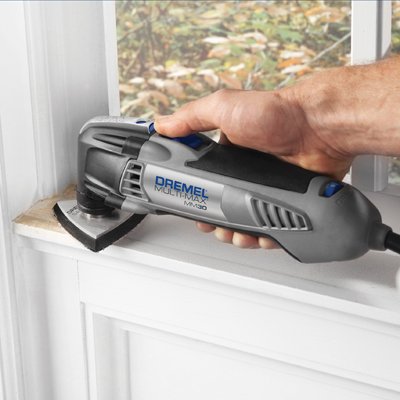
I never thought to try my Dremel Oscillating Tool on blade . I use it for wood on handle but never try to sand blade ? Anybody try this ?

7NwoHnT.jpg
 
Over on this thread http://www.bladeforums.com/threads/mechanical-sanding-machine.1488832/#post-17122364 JG Custom Metal Works asked about making a sanding machine out of a sawzall to reduce the amount of hand sanding time. Well, I can say that it does work, and works well. I managed to sand first grit (120) on a 6.5" santoku of hardened AEB-L in just over 30 min. If my grinding skills were better (aka- if I wasn't sanding numerous facets out of my blades) I'm sure it would be even faster. Hand sanding these blades usually takes me 1.5-2 hours per side. I'm not posting pics yet because it's a bit of a deathtrap of a machine and I need to address some safety issues before posting them. But it does work quite well, especially for a guy with no disk sander to help smooth out the flats of a blade.

Have you got any pix yet (or even some basic info to let us try it out without worrying your insurance company) to share about how you use a sawzall as a sanding machine? I'd love to try it. (Or, well, anything, please! - anything to cut down on hand sanding! :-))

TIA! Andrew
(PS - very amused about comment re: fixing the problem earlier in grinding / 'sanding numerous facets out of my blades' -- I'm with you there, brother. :-))
 
Have you got any pix yet (or even some basic info to let us try it out without worrying your insurance company) to share about how you use a sawzall as a sanding machine? I'd love to try it. (Or, well, anything, please! - anything to cut down on hand sanding! :))

TIA! Andrew
(PS - very amused about comment re: fixing the problem earlier in grinding / 'sanding numerous facets out of my blades' -- I'm with you there, brother. :))
I'm not really worried about insurance, just worried just concerned about someone "red-necking" the idea further than I have and getting hurt on it. I haven't done anything to the contraption since initial use because it's really only useful for plungeless blades, and I don't do many. I'm in process of moving, so my shop isn't set up. When I'm done with the move, I'll try to get the thing set up, fix some safety concerns and then do a brief write-up and pictures, but I may need a reminder to get that done.
 
A sawzall isn't the right tool. An orbital sander works pretty good up to 400 grit. From there, drop back to 220 grit with hand sanding and go up the grits. I occasionally use one on a sword when I would wear my arms out long before I was ready for the finer togi.
 
Thanks! and understand fully. So: I DO do only plungeless blades, i.e. chef knives - which are rather a lot of real estate to level. :-)

I've been elbow-greasing a 210mm (about 8.2") gyuto that's about 2" at the heel, from a 120 grind (across) to just a satin 120-then-180 finish (lengthwise) - for about 3 hours today. I can actually grind the damn blade from raw to HT-ready, and then hard-grind it to time-to-hand-sand, in about that time, now. And I'm real tired of changing out sheets of 3M SandBlaster on my hand sanding pads. (Yeah, I know, I know - "work as if abrasives were free" - but still, y'know?...)

So - please! - at least throw me a bone, here.... :-) Couple of sentences? I'm pretty handy and have rigged up at least a few purpose-built machines -- I don't need to actually copy yours so much as just get some inspiration and a starting path. If it goes anywhere I'll share back to the community. Cheers, and TIA - Andrew
 
I haven't really looked at any instructional vids since I watched Nick's hand sanding 101 years ago.
But I can tell you, I start at 320 grit min and often 400 when I start hand sanding. If you work on getting better on the grinder, you will save yourself a lot of toil.
Also, do you guys actually strap your sanding sheets to some kind of block? I never have. I cut about 2 inch wide strips and just move the strip along to a new section as one wears.
I can do a video of that.
It would be pretty interesting to explore what everyone is doing. There is probably efficiency to be gained....
The orbital sander sounds kind of interesting, but if it's only good to 400, well, that's about where I start... :\
 
I haven't really looked at any instructional vids since I watched Nick's hand sanding 101 years ago.
But I can tell you, I start at 320 grit min and often 400 when I start hand sanding. If you work on getting better on the grinder, you will save yourself a lot of toil.
Also, do you guys actually strap your sanding sheets to some kind of block? I never have. I cut about 2 inch wide strips and just move the strip along to a new section as one wears.
I can do a video of that.
It would be pretty interesting to explore what everyone is doing. There is probably efficiency to be gained....
The orbital sander sounds kind of interesting, but if it's only good to 400, well, that's about where I start... :\

I get all your thoughts, but you nailed it with the grit stuff -- I actually tend to finish up with a (lengthwise) satin finish of about 180. I find that a more mirror-finish on a gyuto makes things stickier; and with carbon steel, things generally end up patina'd enough that shiny isn't a long-term feature. I think the problem is that, with my preferred final finish, getting from cross-blade scratches in the 120-180 range from the belt grinder, to having everything run lengthwise, is just maybe a too-difficult approach? Maybe I should belt-grind to a finer grit first, then go back and just satin-it-up in the hand-sand?

That all said, is why I like the idea of being able to, say, random-orbit from 120 belt grind scratches using non-elbow-power -- and then hand-sand to my satin finish (I like to finish with ScotchBrite - love those things).
 
What about a straigt line air sander

Never heard of these until now. I'd LOVE one - if I could find an electric (vs. air) model. (Too much hassle to be running compressor/air lines in addition to the whole electric & vacuum infrastructures already in place!)
 
I get all your thoughts, but you nailed it with the grit stuff -- I actually tend to finish up with a (lengthwise) satin finish of about 180. I find that a more mirror-finish on a gyuto makes things stickier; and with carbon steel, things generally end up patina'd enough that shiny isn't a long-term feature. I think the problem is that, with my preferred final finish, getting from cross-blade scratches in the 120-180 range from the belt grinder, to having everything run lengthwise, is just maybe a too-difficult approach? Maybe I should belt-grind to a finer grit first, then go back and just satin-it-up in the hand-sand?

That all said, is why I like the idea of being able to, say, random-orbit from 120 belt grind scratches using non-elbow-power -- and then hand-sand to my satin finish (I like to finish with ScotchBrite - love those things).

I should say I have a rotary platen that I finish my kitchen knives up on, and I'm going above 400. That is what makes the hand finishing much easier. Rotary is far more forgiving than a hard flat platen.
I love lengthwise grinding when it's appropriate in the process. But it becomes more difficult, and not a great finisher if you do convexing. I use it to keep me on track center-wise, and for a couple other reasons.
 
Also, do you guys actually strap your sanding sheets to some kind of block? I never have. I cut about 2 inch wide strips and just move the strip along to a new section as one wears.
I can do a video of that.
It would be pretty interesting to explore what everyone is doing. There is probably efficiency to be gained....

I suggest to try this way............. take something round.....wood , steel or plastic tube..... and put some rubber hose on it....hand sanding contact wheel ;) When I try that I start to like hand sanding again :) It is much faster,very much faster then with block because the surface of the paper on contact with the steel is small . And utilization ..... ? ...... of paper is almost 100 % .The problem is only around the plunge line an the tip, you need to be careful to not rounded ....

4RQsR2p.jpg

r6EoPQ0.jpg
 
Last edited:
Back
Top