
scale formation on 1084 quench

Joined
Jan 10, 2010
Messages
1,818
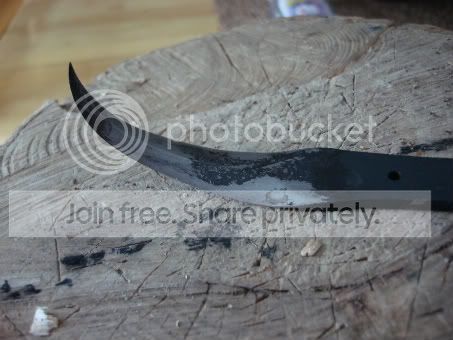
I just quenched a 1084 hook knife using an electric kiln for heating. I took it to non-magnetic... pyrometer read 1500 and quenched in 130F canola oil. This is the first time I've used either the kiln or vegetable oil for quenching and there seemed to be less scale and whatever there was comes off real easy. It just seems like there is something wrong for some reason... I'm still pretty new at this, but my other blades using woodfire and transmission oil there was a lot more scale and it was hard to get off. I've heard that using electric kilns produce MORE scale. But it seems like the hardening went well based on taking a file to the edge....Any thoughts?
DSC01185.jpg
 
Your blade looks fine, well except it's bent :)

If the scale stays on and is hard to remove after quench, it probably didn't harden.
 
Some scale will pop off in the quench when the blade is hot enough to harden.

I've found that the scale on 1084 doesn't come off by itself when an oven is used for the HT. It looks like a sleek black coating, it's very protective though it does scratch under hard use.
 
That is what I was expecting (a sleek black coating) which is why I asked the question. hmmm.... I dunno. Are they supposed to bend like that? :)

I'm still trying to get a feel for testing... when you guys skate a file over the edge...do you use the sharp edge of a triangular file? How much pressure? I feel like the sharp edge of one of those files will cut through anything...
 
Soak your blade in vinegar over night. If there is any scale left, it will come off with steel wool or a kitchen scotch pad.
 
If you keep a piece of scotch brite near your quench tank, and as soon as you pull it out the scale will wipe right off if you use the scotch brite but only as soon as its done quenching, with little to no trouble. if you don't believe me try it.
 
the other thing about this that I thought strange was the quench itself. It was a very 'disappointing' quench... no flames ups, very boring. This is the first time I've used Canola oil... is this typical? Or it might have been because it's a pretty small blade... 3" That is probably it.... anyway... the sucker was non-magnetic and red as a cherry when it went in...

anyway... i've tempered it twice and today I will hack on some hickory with it to see if it holds an edge....
 
In my experience, if you have heavy scale after HT of simple carbon steels, you probably go too hot. The austenization temperatures of simple carbon steels are a bit below where scale begins to aggressively form. From the photo it looks like everything went just fine.

As for file testing, I generally use a slightly dull file with light to moderate pressure. Take a piece of annealed steel and run the file across the edge, then do it on the hardened piece. You'll feel and hear a difference. Just don't count on a file skating as an indicator of a proper heat treatment, just as an indicator that something happened in the quench. There are most definitely ways to make a file skate on an improperly heat treated piece of steel.

Now, go finish grinding that knife and put it to some use! :)

-d
 
thanks... now I'm wondering if my earlier attempts using woodfire coals just got my steel too hot?

okay... now the hard part... trying to get a razor edge on that curved blade.
 
That blade looks fine to me just visually. Most of my scale pops right off in the quench for 1084. Some of it I have to wipe away after it's out of the quench.

And boring quenches are a GOOD thing. I never once had a big flare-up with canola oil or the formulated oils I use now. But I do a full quench on almost everything now. When I first started and edge quenched some O1, I did have very small flames at the surface right at the blade, but they went out quickly. Canola isn't all that flash sensitive when it's in bulk liquid form.

--nathan
 
Back
Top