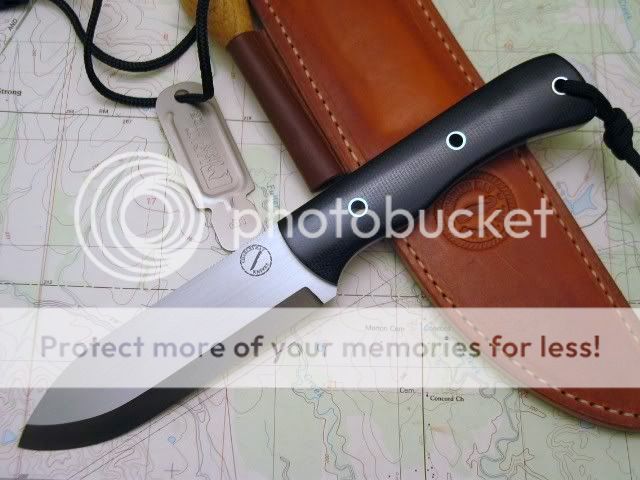
Scandi knives strength

Joined
Feb 3, 2006
Messages
8,250
I was wondering if I could tap into the experience of some of you guys who run scandi grinds knives. I'm looking to get a custom but I'm not sure what thickness to go for. I'm looking at the Brian Andrews bushcrafter and anorexic terrasaur. I'd prefer to go as thin as possible but I've never really put a scandi through it's paces so I'm not sure what would be right for me. Options are 3/32, 1/8, or 5/32 and steels are O1 and A2. What I want is a knife that can do fire prep and emergeny shelter building, aka batoning 3 inch diameter branches and smaller. This will be used in conjunction with a saw and a back up mora so breaking the knife would suck but wouldn't be the end of the world if in a survival situation. Would 3/32 do or should I go thicker? What steel do you think would perform better?


Also, anyone know if he's still making knives or what his wait time is? I've sent a couple of emails to him with no response.
 
3/32" without question ! If you've never used a thin scandi then your in for a real treat !!!
 
I don't baton with anything thinner than 1/8, otherwise I get a lot of binding. This could be due to the operator and not necessarily the tool. A 1/8 is also the thickest blade that I have in scandi. Anything thicker, I like a high flat grind. A lot of this is based on experience and skill level. I'm no Jedi at either :) Happy Thanksgiving!
 
3/32" without question ! If you've never used a thin scandi then your in for a real treat !!!
You're thinking there's no strength issues? Scandis are hard for me to judge because they carry more mass through the width then a smiliar sized flat or convex grind knife. And yeah I'm digging my mora. I just don't feel comfy batoning it. More of the plastic on the handle then the steel though.
 
You're thinking there's no strength issues? Scandis are hard for me to judge because they carry more mass through the width then a smiliar sized flat or convex grind knife. And yeah I'm digging my mora. I just don't feel comfy batoning it. More of the plastic on the handle then the steel though.

No a 3/32" is plenty thick on a scandi. With Scandi's there is always a chance of edge damage but as I rarely process hardwoods I've yet to have any problems !

Just think what people put Mora's through and my 3/32" scandi looks a beast next to a Mora !
 
i''VE battoned .078 inch moras on more than one occasion with out incident.. I have tested them in a variety of scenarios.. but I always use them sensibly..and within there limits I have never had a problem .. anything between .078 an .1 that has a full tang will kick butt and still be versatile and light.. Give me your address I have a spartan but sturdy thin full tang scandi base on a mora you can play around with to get a feel for the size untill you decide.
 
I have everything from a distal tapered 1/4th inch scandi to a .9 inch scandi and all of them are efficient. My Koyote is right at .1 inches and have never had durability issues with it, but Ray Mears swears by a 5/32nds knife and it makes alot of sense to me as an allarounder. I guess it comes down to whether you want a designated slicer or a 'one knife' kind of thing to pair with an axe.
 
If you get a scandi, I strongly recommend nothing over 3/32 unless you have some serious grind on that bad boy. The BHK boat tail scandi would be one of my favorite knives except its particularly bad at cutting anything. It needs a substantially steeper grind. Even then I don't know if I'd like it. Would have to try to know. I strongly recommend a Kellam Aitto Puukko for a scandi, but, if you get it, buy a custom sheath off the bat, the factory one works horribly. As far as battoning, can't tell you, I carry a hatchet/axe.


God bless,
Adam
 
3/32" will be just fine if the heat treatment's good. I baton my 3/32" scandis but use hardwood wedges for splitting if the logs are largish. I think anything over 1/8" is too thick for a scandi; cutting performance is degraded too much when you go thicker.
 
Last I checked Brian was still making knives but his wait time was around 10+ weeks. He does some really good work, I have a Bushcrafter and a Terrasaur. The Bushcrafter is 5/32 in O1 and the Terrasaur is 1/8 in O1, both are true workhorses. For a moment a while back I thought of trading off the bushcrafter but quickly came to my senses. These two will be passed down to my kids for sure. His wife Jen usually handles the correspondence for orders. They may be a little busy due to the holidays as they have several children. Don't give up on him though he's worth the wait. You can probably PM him here on the forum to see if he'll respond.
 
I have it on pretty good authority that he is still making knives :)

I apologize for you not being able to contact me. We recently moved, and re-wiring and setting up a new shop has delayed my wait time a bit, but I am about a week or so from grinding away again. During that time, we also didn't have the computer and internet for a bit, so it is quite possible your e-mail got lost in the shuffle there. I am sure the fault is on my side, so I am sorry about that. Shoot me an e-mail directly (offthemapknives at gmail dot com) if you still want on the wait list, and I will make sure you get on it :)

As far as thickness goes, I will give you some facts, and then my opinionated opinion :)

The facts are this: If you get a 3/32" blade from me or a 5/32" blade from me the actual edge durability will be the same. Unless you specifically request it, the angle of the grind would be the same on those two, meaning the edge geometry would be the same. The difference is on the thinner knives, the bevel is smaller because there is simply no more steel to put that bevel on.

The actual geometry at the cutting edge is identical and anything you can do to a scandi grind through abuse is going to happen right away in the grind and the additional distance of the thicker metal doesn't buy you anything.

What the thicker knife does buy you is the sense of a big, fat, well built knife. It is more a feeling of robustness, which some people like.

The other option, like previously mentioned, it to do a similar grind angle that BHK does, on the thicker metal. But, as also mentioned, the thicker grind on thicker metal greatly impacts its cutting ability. But that strength versus cutting ability trade off is a decision you need to make with what you want in your knife.

Now the opinion part. I love scandi knives, and pretty much use them almost exclusively. Does that mean I think they are the perfect tool for every situation? Absolutely not. But they do what I regularly do extremely well and I wouldn't have anything else.

With that in mind, keeping the grind angle the same, the benefit you get from the thicker knife is lateral strength and the feeling of a "tank" like I mentioned earlier. Stick it in something and pry to the side. It is not something I ever do, or recommend doing, so I am not concerned with that. What do you give up with the thicker blade? A couple things:

1) Slicing ability. The the grind angle being the same, the knife sharpness and initial penetration is the same. If you do something that only touches that area of the knife, you won't notice much difference between the two. But, any time you have any penetration in to something, and it is not deformable, that is when the thin knife really shines. The material moves up the grind, until there is no more metal and the rest of the knife passes through. On the thicker knife, you have to fight more and more grind and resistance to get to that same point. That is why thick scandi's are such poor slicers.

2) Maintenance. With a thinner blade (at the same grind angle) there is less bevel to sharpen. If you have ever laid the scandi's down on the stones, you know what I am talking about :) It is much quicker and easier to sharpen the narrower bevel simply because there is less surface area. With the bevel on the thin scandi, there is plenty enough bevel to give you the wood carving control you want from a scandi, but small enough to sharpen fast, and increase the slicing ability to make it the perfect knife for me.

With that in mind, like Riley said, I also use mine reasonably. If I were to grind out a "batoning machine" it would look much different and that is a tool I do not choose to carry. Also, I know my opinion on the thin versus thick is in the minority and 5/32" is by far what most people order from me :)

Let me know if you have any more questions.

B

 
Wow, that's a perfect explanation. Any idea what the inclusive angle of your typical scandi blade is? Also do you notice any flexibility in the thinner knives when carving hard or cold woods? That may be an excuse for someone to want a thicker blade.
 
in my 3 to 5 in fixed blades I have been leaning heavily toward thinner stock. It really does help with cutting, a 1\4 in chunk of steel at 5in cuts like a chunk of .................. (sorry bk-2)

I love my esee-4 but in actual cutting performance the esee-3 is much better.

The thickest scandi's I have are helle harding and helle lapplander, and on the tape they seem a little less than 1/8. Good performance but my 840 mg will outslice it. Really been liking the big lapplander lately, lots of strength with the thin wide blade,chops ok for the weight and works in the kitchen like a butcher knife.
 
I have several Scandi edge knives ranging from 1/8" - 3/16" thick with blade lengths 3" - 4 5/8" long from the following makers, Roger Linger, Charles May and Jason B. Stout. All of mine are either S30V or D2. They all work great. The longest one I have is a Chares May OSK-1. It is 5/32" thick and has a 4 5/8" blade.


osk1profile.jpg
 
Brian Andrews explanation on thickness is right on.
I found that a true scandi edge - no matter how thick the blade stock - won't take too much punishment (aka batoning). Wood knots can ruin the edge pretty quick in my experience.
I put a slight convex edge on my scandis. Rod Garcia (Skookum Bush Tool Company) gives a good explanation for this on his website. It made a huge difference - stronger edge without sacrificing too much the cutting ability.
Shotgun, for fire prep and emergency shelter building - a 1/8"or a 5/32" scandi done right will do.
 
While I tend to prefer nearly-full-flat grinds, and nearly full-height saber grinds (I do like a bit of spine if possible) I have been playing with a few scandis lately. Though they do slice really well I'm just not very fond of all the flex in a Mora-thin knife. I've had two that were 1/8" thick, still have one of them and I really liked both of them. The one I gifted had a four inch blade and did everything I ever asked of it, the one I still have has a 3 inch blade and goes on a lot of hikes with me and has been used quite a bit with no issues. I also have one that is 5/32 and I like it a bit more in some ways because it inspires more confidence in heft and lateral strength. I have one in 3/16" thick but I will have to modify the grind before I can give a definitive opinion on that thickness. With the steep grind it currently has it does poorly at several things I use my knives for in the field.
 
I have one of Bryan's Bushcrafter's in 5/32" O-1 and have no problem with doing anything I want with the knife. But then I have big, arthritic hands and like a "big" feeling knife. I dont use it as my hunting/skinning knife as I have a hollow ground R.J. Martin hunter dedicated for that.--KV
 
Thanks for the reminder Pit. I put one on order to try out.
I have it on pretty good authority that he is still making knives :)

I apologize for you not being able to contact me. We recently moved, and re-wiring and setting up a new shop has delayed my wait time a bit, but I am about a week or so from grinding away again. During that time, we also didn't have the computer and internet for a bit, so it is quite possible your e-mail got lost in the shuffle there. I am sure the fault is on my side, so I am sorry about that. Shoot me an e-mail directly (offthemapknives at gmail dot com) if you still want on the wait list, and I will make sure you get on it :)

As far as thickness goes, I will give you some facts, and then my opinionated opinion :)

The facts are this: If you get a 3/32" blade from me or a 5/32" blade from me the actual edge durability will be the same. Unless you specifically request it, the angle of the grind would be the same on those two, meaning the edge geometry would be the same. The difference is on the thinner knives, the bevel is smaller because there is simply no more steel to put that bevel on.

The actual geometry at the cutting edge is identical and anything you can do to a scandi grind through abuse is going to happen right away in the grind and the additional distance of the thicker metal doesn't buy you anything.

What the thicker knife does buy you is the sense of a big, fat, well built knife. It is more a feeling of robustness, which some people like.

The other option, like previously mentioned, it to do a similar grind angle that BHK does, on the thicker metal. But, as also mentioned, the thicker grind on thicker metal greatly impacts its cutting ability. But that strength versus cutting ability trade off is a decision you need to make with what you want in your knife.

Now the opinion part. I love scandi knives, and pretty much use them almost exclusively. Does that mean I think they are the perfect tool for every situation? Absolutely not. But they do what I regularly do extremely well and I wouldn't have anything else.

With that in mind, keeping the grind angle the same, the benefit you get from the thicker knife is lateral strength and the feeling of a "tank" like I mentioned earlier. Stick it in something and pry to the side. It is not something I ever do, or recommend doing, so I am not concerned with that. What do you give up with the thicker blade? A couple things:

1) Slicing ability. The the grind angle being the same, the knife sharpness and initial penetration is the same. If you do something that only touches that area of the knife, you won't notice much difference between the two. But, any time you have any penetration in to something, and it is not deformable, that is when the thin knife really shines. The material moves up the grind, until there is no more metal and the rest of the knife passes through. On the thicker knife, you have to fight more and more grind and resistance to get to that same point. That is why thick scandi's are such poor slicers.

2) Maintenance. With a thinner blade (at the same grind angle) there is less bevel to sharpen. If you have ever laid the scandi's down on the stones, you know what I am talking about :) It is much quicker and easier to sharpen the narrower bevel simply because there is less surface area. With the bevel on the thin scandi, there is plenty enough bevel to give you the wood carving control you want from a scandi, but small enough to sharpen fast, and increase the slicing ability to make it the perfect knife for me.

With that in mind, like Riley said, I also use mine reasonably. If I were to grind out a "batoning machine" it would look much different and that is a tool I do not choose to carry. Also, I know my opinion on the thin versus thick is in the minority and 5/32" is by far what most people order from me :)

Let me know if you have any more questions.

B
No worries and thanks for the response. I figured the emails just got lost in flight or a spam filter got them. I think I'll play with the condor and see how 1/8" treats me. I'll go ahead and get on the waiting list for the anorexic terrasaur and maybe decide thickness later if that's cool. You have any opinions on O1 vs A2 for scandi knives?
 
Back
Top