Screwed On Grips

I will also add that if someone thinks screw/bolt on handles are the "quick and easy" way out to "avoid finishing the knife"......they've never tried to do it themselves.

It isn't faster and it isn't easier. Its more complicated and its more precise. It isn't necessarily better but it offers some options and solves some problems that a permanently epoxied handle can't.

Cleaning should be relatively simple with a toothbrush and some soapy water.
I’ll accept that you say screws aren’t faster and easier in the manufacturing process, though on CNC produced knife, it seems like it should be dialed in. However, “just take the knife apart and clean it” is the same. Up at 4 a.m,, drag animals in, clean them after the morning hunt, then add the chore of disassembling a knife once, or maybe twice a day if more animals are shot in the afternoon/evening, disassemble the knife again that night, up at 4 a.m. again, rinse and repeat for four or five days in a row. These are long days with short nights. We are up at 4 a.m. and going to bed at 11 or even 12 depending on what needs to be cleaned. Adding another twenty minute chore to the list once or twice a day is a major negative mark against that tool at least for this use. It is a real shame because the blade itself is so good. Ease of clean up is why I mostly stick with fixed blade knives for this use. Cleaning up folders require more time and attention to clean. Cleaning a Buck 110 or Case Bose Bullnose is easier than cleaning my EDC Hinderer. BTDT with all of them as well as a Leatherman multitool. Tried those and others just to see how they would do.

ETA - the same has happened with rifles. While I own some rifles with beautiful wood and blued carbon steel, most of the time rifles made of stainless with fiberglass stocks are what go hunting due to them being so much easier to maintain.
 
Last edited:
Many folks swap the grips on knives such as CPK. This affords them the opportunity to do so, and is a feature rather than a bug.
Yes, understood, I own two CPK’s at the moment and owned others in the past.
 
I’ll accept that you say screws aren’t faster and easier in the manufacturing process, though on CNC produced knife, it seems like it should be dialed in. However, “just take the knife apart and clean it” is the same. Up at 4 a.m,, drag animals in, clean them after the morning hunt, then add the chore of disassembling a knife once, or maybe twice a day if more animals are shot in the afternoon/evening, disassemble the knife again that night, up at 4 a.m. again, rinse and repeat for four or five days in a row. These are long days with short nights. We are up at 4 a.m. and going to bed at 11 or even 12 depending on what needs to be cleaned. Adding another twenty minute chore to the list once or twice a day is a major negative mark against that tool at least for this use. It is a real shame because the blade itself is so good.
I didn't mean to imply that cleaning them constantly was a solution to your particular issue.

I was mostly addressing the other comments about speed and ease....which still carries over to CNC.....Someone still has to program the machine to perform those extra steps, so it still translates into time on each successive knife.

For clarity, the cleaning with a toothbrush comment wasn't really meaning disassembly to clean every time.

It sounds like those knives might not be the right fit for you. But what you dislike about them is what many others love about them.

You can only please some of the people some of the time, and all that.
 
I didn't mean to imply that cleaning them constantly was a solution to your particular issue.

I was mostly addressing the other comments about speed and ease....which still carries over to CNC.....Someone still has to program the machine to perform those extra steps, so it still translates into time on each successive knife.

For clarity, the cleaning with a toothbrush comment wasn't really meaning disassembly to clean every time.

It sounds like those knives might not be the right fit for you. But what you dislike about them is what many others love about them.

You can only please some of the people some of the time, and all that.

Knives are tools. Some tools are better for some tasks and not for others. Some knives are better for some tasks and not others.
 
The best option is to buy knives that suit your needs going in, then it's not a problem later on. I don't see the point of lamenting about it when there are so many choices available. (Not intended as a rebuke, but a simple observation. I choose not to choose certain knives quite frequently.)
 
I will also add that if someone thinks screw/bolt on handles are the "quick and easy" way out to "avoid finishing the knife"......they've never tried to do it themselves.

It isn't faster and it isn't easier. Its more complicated and its more precise. It isn't necessarily better but it offers some options and solves some problems that a permanently epoxied handle can't.

Cleaning should be relatively simple with a toothbrush and some soapy water.
100% this. You can cover up a lot of sins with epoxy.

It's also faster and less involved than screwing down scales.

I use Gulso bolts on peel-ply g10 or on knives that are getting a coating or parkerized. If I epoxy scales onto cerakote or parkerized blades, I always have a difficult time getting the epoxy cleaned up.

Screw down scales mean that the tang and inside of the scales have to be flat and finished like the rest of the blade.
 
I’ll accept that you say screws aren’t faster and easier in the manufacturing process, though on CNC produced knife, it seems like it should be dialed in. However, “just take the knife apart and clean it” is the same. Up at 4 a.m,, drag animals in, clean them after the morning hunt, then add the chore of disassembling a knife once, or maybe twice a day if more animals are shot in the afternoon/evening, disassemble the knife again that night, up at 4 a.m. again, rinse and repeat for four or five days in a row. These are long days with short nights. We are up at 4 a.m. and going to bed at 11 or even 12 depending on what needs to be cleaned. Adding another twenty minute chore to the list once or twice a day is a major negative mark against that tool at least for this use. It is a real shame because the blade itself is so good. Ease of clean up is why I mostly stick with fixed blade knives for this use. Cleaning up folders require more time and attention to clean. Cleaning a Buck 110 or Case Bose Bullnose is easier than cleaning my EDC Hinderer. BTDT with all of them as well as a Leatherman multitool. Tried those and others just to see how they would do.

ETA - the same has happened with rifles. While I own some rifles with beautiful wood and blued carbon steel, most of the time rifles made of stainless with fiberglass stocks are what go hunting due to them being so much easier to maintain.


You are making this a much bigger issue than it really is and that cleaning regiment is definitely unnecessary with breaking it down each time you clean it. 3V is very corrosion resistant and easy to maintain, just wash the knife good after use , allow it to dry properly and you should be ok. Prior to the hunt or once a year you can remove the scales, clean the tang and give it a good coating of oil or carnuba wax and put the scales back on and be fine!
 
I’ll accept that you say screws aren’t faster and easier in the manufacturing process, though on CNC produced knife, it seems like it should be dialed in. However, “just take the knife apart and clean it” is the same. Up at 4 a.m,, drag animals in, clean them after the morning hunt, then add the chore of disassembling a knife once, or maybe twice a day if more animals are shot in the afternoon/evening, disassemble the knife again that night, up at 4 a.m. again, rinse and repeat for four or five days in a row. These are long days with short nights. We are up at 4 a.m. and going to bed at 11 or even 12 depending on what needs to be cleaned. Adding another twenty minute chore to the list once or twice a day is a major negative mark against that tool at least for this use. It is a real shame because the blade itself is so good. Ease of clean up is why I mostly stick with fixed blade knives for this use. Cleaning up folders require more time and attention to clean. Cleaning a Buck 110 or Case Bose Bullnose is easier than cleaning my EDC Hinderer. BTDT with all of them as well as a Leatherman multitool. Tried those and others just to see how they would do.

ETA - the same has happened with rifles. While I own some rifles with beautiful wood and blued carbon steel, most of the time rifles made of stainless with fiberglass stocks are what go hunting due to them being so much easier to maintain.
In that case, I wouldn't worry about disassembling them every time. I'd wash, rinse and dry them, then deep clean once a week or something.

You could also try some anaerobic sealer or maybe food safe grease between the tang and scales for a less permanent seal that's better than nothing. You've already said that you're cool with gluing them on though so that's certainly a solution as well. Depending on the hardware, you might find that there are corby or loveless bolts that will fit in the holes in the tang and scales so it doesn't end up looking like screws full of epoxy when you're done.
 
The best option is to buy knives that suit your needs going in, then it's not a problem later on. I don't see the point of lamenting about it when there are so many choices available. (Not intended as a rebuke, but a simple observation. I choose not to choose certain knives quite frequently.)
Concur 100%.

Corby bolts and clear epoxy are on order for one that really stood out for blade performance. The others are chalked up to tried out and learned from the experience that they are not well suited to this use.

After more than 50 years of hunting, I’ve tried a bunch of knives. I still enjoy trying new ones now and then. Some big names live up to the reputation, some don’t, some newcomers are pleasant surprises and discoveries.

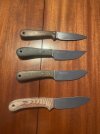
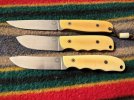
As for other more suitable knives, I have more than a few that are perfect for this work. In the last few years, the most used and my go to reliable choice is a 4” Kephart in 20cv made by Paul Rasp dba CPE Knives. Others in the regular rotation are ones made by Phil Wilson and Gene Ingram. A few other new ones are in the queue to try next year.

IMG_0712.jpeg


IMG_7954.jpeg

IMG_6148.jpeg
 
Last edited:
In that case, I wouldn't worry about disassembling them every time. I'd wash, rinse and dry them, then deep clean once a week or something.

You could also try some anaerobic sealer or maybe food safe grease between the tang and scales for a less permanent seal that's better than nothing. You've already said that you're cool with gluing them on though so that's certainly a solution as well. Depending on the hardware, you might find that there are corby or loveless bolts that will fit in the holes in the tang and scales so it doesn't end up looking like screws full of epoxy when you're done.
Brass corby bolts and clear epoxy are ordered. Should make for an interesting project.

As to the cleaning, I could and should have made my first post clearer. The concerns about cleaning the knives are due primarily to health risks from the wild pigs, not concern about rust. The deer are not much of an issue. The wild pigs carry some nasty diseases, anthrax and brucellosisis as just two issues, that are potentially dangerous to humans.

Our state game management agency, Texas Parks & Wildlife Department, has issued warnings to hunters to always wear rubber gloves while cleaning them to avoid contact with skin. We inevitably have minor cuts and punctures on the skin on our hands from being in the field. So without rubber gloves on, the pig parasites and other nasties have direct contact with the cuts in the skin. The biggest challenge was cleaning the retained crud out of the torx head openings. The pigs have so much greasy fat, it really sticks and requires scrubbing to remove.

We hunt relatively close, within 50 - 60 miles or so, to an area known as the “anthrax triangle” in South Texas. The pigs rooting around expose the anthrax spores and carry the anthrax spores, among their other nasty items, as they really roam around.

The meat processors I use have all stop even allowing the pig meat into their buildings. We segregate pig meat into separate ice chests for transport to avoid cross contamination with our deer meat. Many hunters now just leave pig carcasses in the field. We still bring it in and eat it. The men, and women, I hunted with growing up taught us to eat what we killed and not kill unless the meat would be put to use. I still follow that mindset unless an animal has some obvious health issues, then it is opened up and left for the scavengers.

So the cleaning concern was focused on avoiding bare hand contact with potential residues from inadequately cleaned knives. I do not know any hunters first hand that have become sick from it, but I’d like keep it that way.

 
Last edited:
Maybe an ultrasonic cleaner would ease the burden of cleaning knives with screwed on scales?

As mentioned in the post above, my concern is to avoid bare hand contact with the crud remaining on the knife due to diseases, mostly from the wild pigs. Taking a dirty knife home and into the ultrasonic cleaner is spreading potential for contamination. On knives with smooth surfaces, cleaning with soap and water and scrubbing it with papers towels does the job quickly and effectively in a few minutes. After washing and drying, the knives are wiped with Clorox clean up wipes, before going back into a sheath. Those wipes are not bleach, but some sort of antibacterial chemical. It does not harm or discolor the knife like bleach could.
 
Last edited:
The merits of screw construction can be debated, but this method certainly isn’t cheaper or faster for the maker.
 
Back
Top