I've selected a Helle Harmoni blade which is your laminated stainless blade with hidden tang. Blade length is about 3 1/2". I simply wanted a general purpose around-the-camp knife, and a couple of knives of the 'bushcraft' genre caught my eye. One of them is the Helle Eggen, but the blade was unavailable.
Rather than just buy a knife (which I should have done), I got fussy and decided I didn't want a wooden handle, for starters, and wanted something just a little more contemporary, leaning a bit more toward 'tactical' and bit less toward primitive.
Two handle ideas, neither very original.
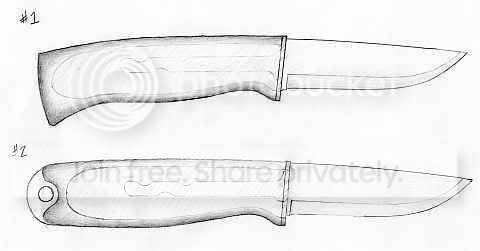
The rough sketches both show a tracing of the actual blade. Sketch #1 is nearly a copy of the Helle Harmoni Plus, so it's closer to traditional in profile. Sketch #2 is your run-of-the-mill action adventure wannabe sort of thing. Both are about 4 1/2" to 4 5/8" overall length handles.
I've tried to depict perfectly flat sides to both handles, with a uniform, large radius all around on both. In #2 I'm trying to show a pommel style that would be your standard full-tang style...this would be a stainless insert held in with epoxy and a pin, I guess.
Both handles would be black micarta.
I like them both, but would like to get opinions--you know, are they too boring (I'm after boring, actually), impossible to make, completely and obviously out-of-character for the blade, etc. I'm not going to build my handle based on a vote, but I'd also prefer the concept not be too laughable and would like opinions.
I'm just a little concerned either could end up suggesting 'supermarket kitchenware aisle', so if there are ideas to possibly reduce that, I'm all 'ears'.
Oh. My idea for the guard is 1/16" or 3/32" stainless steel--whatever I can find--and I would like to silver solder it. I've only silver soldered/brazed at high temperature (~ 1200F), and didn't care about ruining the material. Any tips on how to keep the blade cool without putting a major, sharp gradient in work temperature right at the tang would be appreciated. I have no idea how dangerous soldering at 400F will be with laminated ss. I assume it's bad juju. Should I simply not do it at all?
Rather than just buy a knife (which I should have done), I got fussy and decided I didn't want a wooden handle, for starters, and wanted something just a little more contemporary, leaning a bit more toward 'tactical' and bit less toward primitive.
Two handle ideas, neither very original.
The rough sketches both show a tracing of the actual blade. Sketch #1 is nearly a copy of the Helle Harmoni Plus, so it's closer to traditional in profile. Sketch #2 is your run-of-the-mill action adventure wannabe sort of thing. Both are about 4 1/2" to 4 5/8" overall length handles.
I've tried to depict perfectly flat sides to both handles, with a uniform, large radius all around on both. In #2 I'm trying to show a pommel style that would be your standard full-tang style...this would be a stainless insert held in with epoxy and a pin, I guess.
Both handles would be black micarta.
I like them both, but would like to get opinions--you know, are they too boring (I'm after boring, actually), impossible to make, completely and obviously out-of-character for the blade, etc. I'm not going to build my handle based on a vote, but I'd also prefer the concept not be too laughable and would like opinions.
I'm just a little concerned either could end up suggesting 'supermarket kitchenware aisle', so if there are ideas to possibly reduce that, I'm all 'ears'.
Oh. My idea for the guard is 1/16" or 3/32" stainless steel--whatever I can find--and I would like to silver solder it. I've only silver soldered/brazed at high temperature (~ 1200F), and didn't care about ruining the material. Any tips on how to keep the blade cool without putting a major, sharp gradient in work temperature right at the tang would be appreciated. I have no idea how dangerous soldering at 400F will be with laminated ss. I assume it's bad juju. Should I simply not do it at all?
Last edited:
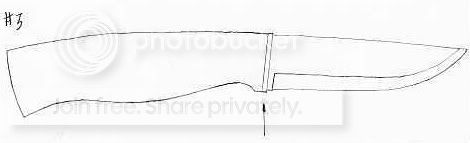

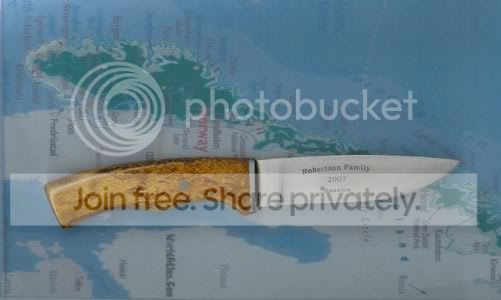

 It only gets worse as you go along.