Setting up my vfd-help.

Joined
Sep 27, 2014
Messages
1,108
Okay,
I am so close. I have 240v 1ph wired in my garage. I have this motor and this vfd all wired up and ready to go. The vfd is the non nema version.

https://www.vfds.com/manuals/saftronics-s10-manual.pdf

But I am struggling to figure out how to program the vfd. I have power to the vfd and the display comes on when I plug it in. But after that I have no clue what I am doing. I have begun to read through the manual, but I feel like I am reading a second language.

The vfd is used. Should I begin by setting it to factory settings for 60hz so I have a starting point?
Is there any sort of youtube type tutorial on getting this thing going? I haven't found one yet.
I really appreciate any help here.
 

Attachments

  • IMG_0554.JPG
    IMG_0554.JPG
    252.9 KB · Views: 26
Unless you know exactly what it did and how it was controlled in its previous life, and it's close enough to your new application that you have a pretty good idea exactly what needs changing, a factory reset is usually the best starting point.

As VFDs go, it looks a reasonably basic unit: not too many fancy settings that you don't actually need.

The 60 Hz factory reset (set Parameter 25 to 020) looks like it should give you control from the keypad. You can start changing things from there once you have it running.

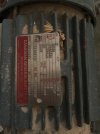
I can't see any settings for the motor rating plate values in the link. As far as I can recall, I have never seen a VFD manual that does not allow for different motors. Is there another manual at all?
 
I reset it to factory settings....F25 set to 20. Now, when I press "run" motor comes on and runs slowly. Yes! But, as I increase the speed the motor starts to make a clicking sound when I get to about 10.

It won't go past about 12 or 13 and then the vfd shuts the motor down and I get an error message. 3 times I got an OL2 message. I think the numbers I am seeing as it runs are Hz. OL2 message is an inverter overload. I don't know what that is or how to fix it.

Help. I am so close.
 
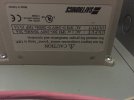
You didn't say what size drive you have? VFD label pic?

according to the book, after what you have done, if you are on a 60 cycle system,,,, you have a drive that is too small. There are only two corrective measures listed for the OL2 fault. You ruled out V/F setting when you reset F25.
 
Last edited:
get to the VFD manufacturer's website and download the operator's manual. you said VFD was used. was supposed be to OK? same with motor. if getting inverter overload, you either have a bad motor or a bad VFD. do you have a multimeter where you can check basic health of the motor?
 
Looks like that's the manual. Section 3.2 will have your parameter list. You should be able to step through each one an verify that they're set where needed. Most of the default settings should be fine. The manual appears to give a page number for a parameter description if you're unclear on any of them.

You might want to increase your upper frequency if you want your machine to run faster than the motor's rated speed. Looks like your VFD will be set to start at 10Hz. You should be able to use the up and down arrows to bump it up to 60Hz. I'd probably just set F08 (SP1) to 60 if you want your VFD to start at full rated motor speed. Better yet, I'd probably wire up a switch and potentiometer to control start/stop and speed, and then you can keep the VFD in a protective cabinet of somekind. Just make sure there's airflow, and a way to control/eliminuate ingress of dust and debris.
You'll have to change F10 and F11 and wire accordingly if doing an external control. Just make sure you get the right potentiometer.


Since it's only a 2HP motor on a 3HP VFD, you might think about reducing your max current (and related) settings, though, honestly, it should be ok. It's just a little bit of added protection for the motor if it were to draw some excess current for whatever reason. For belt grinders though, this isn't as applicable, as say, something like a conveyor that would see variable loads for varying periods. Unless you're really hogging hard for extended periods, you should be ok.

Other than that, you might find that you want to change some torque settings, but you might be ok there too, just depending on your grinder and how you grind.
 
I did set f8 to 60, but that didn't fix the problem. I do have a multimeter, but I don't know what to do to check the "general health of the motor."
 
Also, you might ring out the motor to make sure your windings are all good, if you haven't already.
 
The page number references in the parameter list do not seem to correlate with pages in the document itself and I cannot find any other documentation for the S10.

Checking out the motor with a multimeter is normally a case of checking the windings each have the same (pretty low) resistance across them and that there is no continuity (i.e an overscale resistance reading) from each winding to the others and to ground. You'll want the wires and links disconnected when you do this and you'll want to check the configuration of the links is correct for operation on 230V when you reconnect.
 
1, 6, 7 to phase 1
2, 4, 8 to phase 2
3, 5, 9 to phase 3
How do I ring out the motor? Just open it up and check the windings?
I realise you obtained this from an otherwise reliable source, but its intended for a delta wired motor.

I believe you have a nine wire motor intended as a ”Y” connection.

For lowvoltage ”Y” connection.
Leads 4,5,6 simply connect to each other, nothing else.
Leads 1&7 connect to phase one
Leads 2&8 connect to phase two
Leads 3&9 connect to phase three

Have you an ohm meter ? you can verify your motor type.
If you find continiuty between 7,8,9, this indicates a ”Y” type connection scheme.

Here is better diagrams over that previous EC&M link...
http://wildness.me/3-phase-motor-wiring-diagram-9-wire/
 
Last edited:
Btw, with ohmeter, its only possible to perform rudimentary test of motor health.
It will only reveal if and what kind of problems exist, but wont reveal if a motor in poor condition & likely to soon fail.

Here is a pretty good youtube detailing basics of ohmeter testing ”Y” connected 9 wire motors.

A ”Megger” is otherwise needed. Its a special type of ohmeter what tests resistances at very high voltages. It will detect potentially leaky & soon to fail insulation.
 
Last edited:
I realise you obtained this from an otherwise reliable source, but its intended for a delta wired motor.

I believe you have a nine wire motor intended as a ”Y” connection.

For lowvoltage ”Y” connection.
Leads 4,5,6 simply connect to each other, nothing else.
Leads 1&7 connect to phase one
Leads 2&8 connect to phase two
Leads 3&9 connect to phase three

Have you an ohm meter ? you can verify your motor type.
If you find continiuty between 7,8,9, this indicates a ”Y” type connection scheme.

Here is better diagrams over that previous EC&M link...
http://wildness.me/3-phase-motor-wiring-diagram-9-wire/
I will try that wiring. I think that is how it may have been wired when I got it. There were 4 sets of wire that were connected together. But I didn't look at which ones. I just posted on blade forums and got sent to that link I posted with the info on 3 sets of 3 leads. I may sneak out to the garage now and see.
 
I believe you have a nine wire motor intended as a ”Y” connection.

For lowvoltage ”Y” connection.
Leads 4,5,6 simply connect to each other, nothing else.
Leads 1&7 connect to phase one
Leads 2&8 connect to phase two
Leads 3&9 connect to phase three

This was it!!!!Runs up to 60 hz no problem. Very quiet higher pitched hum as it runs, but sounds solid and fine. I am sooooooo pleased. Thank you to everyone here that has helped me out over the last years as I asked a million questions and slowly made my way towards building my own 2x72. I will post some pictures in the next few days of my grinder, vfd setup/enclosure etc. This site is full of amazing information and great people. I wouldn't have figured out this motor problem without everyone's input today.

I can't wait to get the grinder set up and running now. Ohhhh yah!
Thank-you.
 
Next question. When I have run my vfd up to 60hz is my motor running at 1730 rpm? I've seen threads that said a 1730 rpm motor could be run at 3460 rpm with a vfd. I'm not sure how that can be done.

I know that the vfd has a function that makes it shut down after 1 minute if it runs at 150%. So I am guessing I can run above 60hz? But I am guessing if I run it above 90hz it will shut down?
 
Set parameter 6 to 120 Hz and give it a try.

The 150% overload is usually Current (Amps). You are just increasing frequency and therefore motor speed, so it should be no problem.
 
Last edited:
Glad you figured it out. Tim is correct. 60Hz will give you the motor's nameplate RPMs. You can set your high freq limit up to 200Hz, which will give you just over 3x the nameplate speed. Personally, I probably wouldn't go much over 120Hz for the sake of the longevity of your bearings. Balance could also be an issue at top speed, but most of that will likely depend on your drive wheel balance as well. Not to say that your motor/bearings won't run at 200Hz, but most makers get by with only up to 120hz.
 
Back
Top