Sharpening GEC/Northwoods 1095?

Joined
Dec 21, 2008
Messages
82
So a pair of Northwoods slipjoints arrived today and the Burnside Jack's 1095 blade came with what I'm told is the typical GEC edge.

I tried getting a decent edge with my Sharpmaker but no luck. I tried both angles and the edge still feels dull. I'm thinking that the stones may not be hitting the edge and instead, are just honing the shoulders of the bevel.

Anyone had any luck using a Sharpmaker on this blade? Any tricks you can share with a newbie? I couldn't freehand to save my life and no decent bench stones are available in my part of the world.

I like the ergos and build of the knife. If I can get a sharp edge on it, I'd be a happy camper. :)
 
I have lots of GEC's and I free hand them. I tried the sharpmaker (I own one) but like you, it did not sharpen the edge; my guess is that the angles on the blades are smaller. Give free hand sharpening a try; I get excellent results, though, admittedly, I've had a fair amount of practice. The Spyderco stones that offer the same grits as the sharpmaker are good places to start.
 
Last edited:
So a pair of Northwoods slipjoints arrived today and the Burnside Jack's 1095 blade came with what I'm told is the typical GEC edge.

I tried getting a decent edge with my Sharpmaker but no luck. I tried both angles and the edge still feels dull. I'm thinking that the stones may not be hitting the edge and instead, are just honing the shoulders of the bevel.

Anyone had any luck using a Sharpmaker on this blade? Any tricks you can share with a newbie? I couldn't freehand to save my life and no decent bench stones are available in my part of the world.

I like the ergos and build of the knife. If I can get a sharp edge on it, I'd be a happy camper. :)
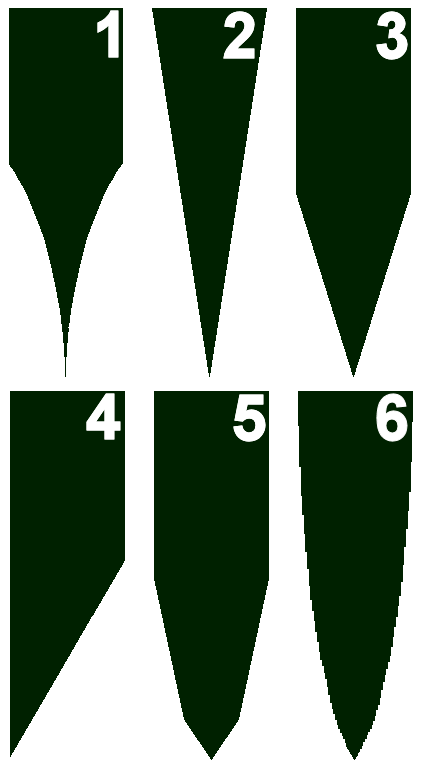
I suspect this is what is happening.

For 1095, I like 20-dps for EDC. I know some people take it thinner and GEC's 1095 is probably hard enough for that. But I prefer a more durable edge.

On most of my EDC knives (using a Lansky, but I think you could do the same with a Sharpmaker) I establish a secondary or back bevel at 17-dps and then set my primary cutting edge at 20-dps. The result looks something like picture #5 in this picture - a so-called compound bevel.
Ground_blade_shapes.png


When setting the back bevel, you will not reach a burr on the edge. If the blade is relatively thick just above the edge, this will take some time as you're removing a lot of steel along the shoulder of the primary bevel. But I find it helps slicing and makes future touch ups easier.

Once you feel the secondary bevel is established, you can set the primary bevel to 20-dps. Just work the edge until you raise a burr on one side, then move to the other side and raise a burr there. If you're not raising a burr, you are probably not removing enough material to create a new apex.

Once you've reprofiled the edge to a setting that is copacetic with your sharpening system, you will probably be able to touch up the edge without needing to reach a noticeable burr. (You will probably create a burr, but it won't be big and easy to feel, which is good because this minimizes material loss.)
 
Like Aias I freehand sharpen. I DO use a set of medium and fine Spyderco stones. It just takes practice to sharpen freehand and it is not that difficult to get a decent edge. Stropping helps a lot too for minimizing the times you need to break out the benchstones.
 
I received my first GEC just over a week ago. I spent most of that time a little frustrated that I couldn't get it as sharp as the rest of my knives. I still loved the knife, but I thought I would have to learn a new technique to get it nice and sharp. All of my knives to this point had been stainless, so I figured there was something about the 1095 that didn't like the DMT diafolds I use. It turns out that I had underestimated the amount of work it took to get a good edge on the knife. I think it must have come ground to a peculiar angle and I just wasn't hitting it quite right. I just kept working on it and working on it while I was contemplating whether to try waterstones or oil or maybe just add a ceramic to the end of the process. On Saturday, I used the knife and gave it a couple passes on my diafolds like I do with all of my knives, and all of a sudden the blade popped in line. It wasn't just as sharp as my other knives, now it is my sharpest knife.

My guess is that you just have to keep working on it. From what I understand the Sharpmaker doesn't excel at setting a new angle on your edge, it's more for maintaining. I bet if you took a marker to your edge you would find that the 20 degrees of the Sharpmaker aren't quite what the Northwoods is ground to. You might have to try another method that is a bit more aggressive to initially set the edge and then you'll be able to maintain it on the Sharpmaker. Once you get that edge set properly all of that work will pay off. That's been my experience anyways. I'm pretty new to knives and sharpening, so YMMV.
 
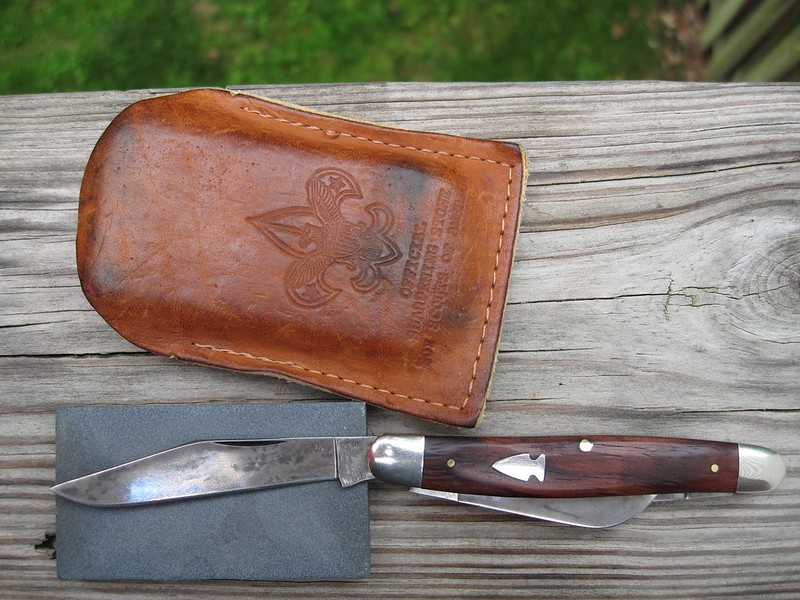
I've never used or owned a sharp maker or any other gizmo. I always freehand. When I got my Northwoods stickman, all three blades were not quite what I wanted. I just used my old boy scout carborundum stone, and finished off with a Eze-Lap model L fine diamond hone. Too a little while to get where I wanted, using the small circle honing method. Now to shaves hair. With free handing, I don't get too hung up on angles.
14211539277_6e5e6c318e_c.jpg
 
One thing I was hoping to learn from this thread was exactly what angle GEC puts on their factory edge. Does anyone know? As has already been stated, it probably isn't the 30 or 40 degree angle that the Sharpmaker provides.

I use a Lansky and have experimented with 20 and 25. I'm still not that happy with my edges.
 
The sharpmaker should really be labeled the sharpkeeper at least with the medium and fine stones it comes with. I have been able to put an edge on a very dull knife but it took forever. I had much more luck using a sharpie to mark the edge then making a few passes on it to make sure your actually hitting the edge and not honing the shoulder. If you have a lansky setup, which is what I am also using now, just put your own edge on there and you'll be good to go.
 
I'd guess GEC bevels are around 20 degrees on each side. It just seems that theyre not totally sharpened when you get one. My typical method which I find works like a charm is to freehand a 15 degree bevel on a fine diamond stone. Its not quite free hand because I made a 15 degree ramp to put my stone on (actually a 5 dollar dual side course/fine diamond stone I found on the Bay). This way I just hold the blade horizontal to the stone and lap it back and forth. Similar to a sharpmaker? not sure never owned one. Then I usually finish on my lansky sticks at 20 degrees cleaning up any abnormalities from the stone and convexing the edge slightly. After that its just stropping on leather with green rouge.
 
I'm pretty sure GEC free hands on a rotating stone. So their angles will, naturally, be a bit inconsistent.

As to sharpening, all the advice here is good. Whatever method you use, you just have to plug away at it until it gets sharp. It can take a while. Once you are there, however, you will be good to go and maintaining will be a snap.
 
One thing I was hoping to learn from this thread was exactly what angle GEC puts on their factory edge. Does anyone know? As has already been stated, it probably isn't the 30 or 40 degree angle that the Sharpmaker provides.

I use a Lansky and have experimented with 20 and 25. I'm still not that happy with my edges.

I wouldn't worry about what GEC does. The blade belongs to you and you can choose different angles to meet different needs. My rule of thumb:
15-17-dps for fine cutting and soft wood whittling (this is a frail edge)
20-dps for EDC
25-dps for hard use shop knives

I couldn't sharpen well with my Lansky till I learned to spend more time with the course stone and stayed on one side till I raised a burr full length. Then raise a burr with the course stone on the other side. From there it's a matter of honing with finer stones and lighter strokes to polish the edge and remove the burr.

After I got the feel for raising and removing a burr, I was able to make better progress free hand sharpening.

Hope this helps.
 
I have a few GECs and Northwoods and I also sharpen them on a Sharpmaker. So far I've gotten good results with what I do. I always reprofile on the 30 degree side, with the edge of the coarse stone, then switch to the flat of the stone for reprofiling the tip. I don't do typical straight down strokes with reprofiling, but do small circular motions. Once I start to see a noticeable relief edge, I switch to the 40 degree angle and sharpen like Spyderco suggests. On these GECs for whatever reason, I usually have found that angling the blade very slightly inward for a slightly steeper angle works best for me. Once I get a good edge from sharpening on the stones, I strop it and it's good to go. Hope that helps.
 
I use a Sharpmaker on a lot of my knives, GEC 1095 included.

For 1095 I normally use the 20° per side setting, but I like a robust edge.

Do remember you will likely have to modify the bevel angle of the knife to match the Sharpmaker angle. You won't be sharpening the edge until you do that.
 
I use a Sharpmaker on a lot of my knives, GEC 1095 included.

For 1095 I normally use the 20° per side setting, but I like a robust edge.

Do remember you will likely have to modify the bevel angle of the knife to match the Sharpmaker angle. You won't be sharpening the edge until you do that.
I figured. I'll probably have to look for one of the Lanksy kits. I know they're available in my area. It's the bench stones that aren't.
 
You've already got a fairly expensive Sharpmaker. Why not just get a $15.00 to $20.00 Norton crystolon (silicon carbide) medium/fine stone and use that to rebevel your blade and touch it up with the Sharpmaker. If you freehand like Carl does, you can easily get by with the Norton alone. That crystolon stone will sharpen any blade you want.
 
One thing I was hoping to learn from this thread was exactly what angle GEC puts on their factory edge. Does anyone know? As has already been stated, it probably isn't the 30 or 40 degree angle that the Sharpmaker provides.I use a Lansky and have experimented with 20 and 25. I'm still not that happy with my edges.
I freehand & I also use an edgepro. On GEC's, when I need to sharpen, I find the angle that will just slightly steepen the factory edge, and use a minimum of passes. This leaves a sharp edge that is not readily visible as a resharpening. It is very useful to obtain and use a good loupe. Unless I am sharpening a pile of toss-about kitchen knives, I am constantly going to the loupe to see what is going on with the edge when using the edgepro or freehand. 'Course my eyesite isn't what it once was. If the maker published the bevel angle, great, but as some posts have pictured many knives have multiple bevels, or bevels that would need a calculus formula to describe. Before I start to sharpen I look at the entire edge, both sides, with the magnifying glass. I then set an angle on the edgepro, make a couple light passes in one spot to see where my edge is going to fit with the existing edge, and if need be, make adjustments. This tells me what angle I'm dealing with. On really bad knives, i go to a 320 Shapton and start over, but I lose a lot of material when I have to this. I follow the general advice of about 20-24 degress for a thick hunting style blade, and somewhere around 16 to 19 degrees for vegetable and chef knives. I get good results with quality steel with a base angle of about 18, and then finish the edge steeper with 1000/4000 at 22-24. This has given me good durabilty of the edge, and good slicing ability. Thin edges shave & slice great, but deform quicker in all but the finest steel. The main thing is to maintain the angle throughout the process, as well as an equal numbers of passes to keep a symmetrical edge. I sharpen lots of friend's knives, and once I've finished, I write down my settings for that knife. makes for easy touch-ups. I am a fan of the double bevel, and Shapton stones. I love the precision you get with the edgepro. Free hand is the same principle, just requires concentration & skill (or a jig of some sort) to maintain the angles. Well heat-treated 1095 steel is a joy to sharpen. Some of the high tech stainless, is a lot more work.
 
All I can say is practice, and do so on less expensive knives.

I usually sharpen 1095 on wet sandpaper on a flat surface. I used lay the sandpaper on the soft side of a mouse pad to help me get convex edges, but I don't need it anymore.
 
All I can say is practice, and do so on less expensive knives.

I usually sharpen 1095 on wet sandpaper on a flat surface. I used lay the sandpaper on the soft side of a mouse pad to help me get convex edges, but I don't need it anymore.

I think this is the most important message if you are new to reprofiling. Those expensive GECs will quite happily take a 30° edge with a diamond stone, but it takes a while to get a knack for it. The first time I reprofiled a knife it was my first GEC, I guess it worked out alright in the end, but I took off more steel than was necessary and left a slight dent at the base of the blade. I have a sharpmaker, and also a Diamond stone, with fine and extra coarse sides, I just lie that against the sharpmaker ceramic stone and that way I have a fixed angle to grind the bevels too a narrower angle.

I really appreciate the grinds on the GECs, they are the most consistent and neat of any traditional knife, even if they require adjusting,
 
I use a Sharpmaker on a lot of my knives, GEC 1095 included.

For 1095 I normally use the 20° per side setting, but I like a robust edge.

Do remember you will likely have to modify the bevel angle of the knife to match the Sharpmaker angle. You won't be sharpening the edge until you do that.

:thumbup:

I was sent some Spyderco ceramic stones 25 years ago by Sal, and got to like them. Unfortunately I ended up with just the ultrafine, but then I was bought a Sharpmaker a couple of years or so ago. I often just use the ceramic rods free hand or like you would a steel, but I also use the device more or less as intended, and find it pretty good. Like Frank I usually use the 20 degree per side setting, that generally works for me, and it's worked on my GEC knives, which are all either 1095 or 01. As has been said, the standard stones are not very abrasive, so maybe you just need to work at it a bit longer, maybe do a cycle with the 30 degree setting and then the 40 degree.

I've not tried the increasingly popular mousepad/sandpaper technique, but ScruffUK swears by it, and I've been very impressed with the edges he produces like that.
 
:thumbup:


I've not tried the increasingly popular mousepad/sandpaper technique, but ScruffUK swears by it, and I've been very impressed with the edges he produces like that.

There's a guy who often is at the local craft show, and he does wood carvings of duck decoys and birds. He uses a small stockman pocket knife for all his work, usually an old Schrade Old Timer. His carvings are unreal, with the texture of the feathers even looking real. And he uses the sandpaper and mouse thing. I've stood there and watched him shave off toilet tissue thin translucent curls of wood from exactly where he wants. D--ed impressive. ONce in a while he'll take a small piece of 500 or 600 paper and a mouse pad and touch up the blade if he thinks it needs it. I've been extremely impressed with his edges, and if I weren't so darn old and set in my ways, I may go get a mouse pad and some 600 paper. Very impressive!!
 
Back
Top