
-
The BladeForums.com 2024 Traditional Knife is available! Price is $250 ea (shipped within CONUS).
Order here: https://www.bladeforums.com/help/2024-traditional/
You are using an out of date browser. It may not display this or other websites correctly.
You should upgrade or use an alternative browser.
You should upgrade or use an alternative browser.
Sharpmaker impressions from a KME guy
- Thread starter No1up
- Start date
I know the feeling I bought the sharp maker then the spyderco bench stones .
I've been through a few finishing stones but nothing really compares to the edge and the Polish off that UF.
Even if you want toothy the UF can deburr so well . You feel every little detail of that edge .
I've been through a few finishing stones but nothing really compares to the edge and the Polish off that UF.
Even if you want toothy the UF can deburr so well . You feel every little detail of that edge .

- Joined
- Sep 20, 2015
- Messages
- 8,334
cbwx34,
Thank you ! That was enlightening. : :thumbup:: :thumbup: :thumbup:
Not that I do much of that but I notice the stones on the Edge Pro get black almost exclusively near the longitudinal center line of the stone. I don't get into the rear most part of the edge as well as I would like so I tend to use some emphasis on the corner/edge of the stone. Where the sharpening coil should be if any of these silly conigates would actually provide a knife with a sharpening choil. Though the edges on my woodworking tools are magazine photo pretty I am still at the geeeeter done and geeeeter sharp stages on my EDC knives. I am not good enough with the Edge Pro to be satisfied with the aesthetics yet.
tipping the stone onto the corner even slightly, lowers the angle,
Thank you ! That was enlightening. : :thumbup:: :thumbup: :thumbup:
Not that I do much of that but I notice the stones on the Edge Pro get black almost exclusively near the longitudinal center line of the stone. I don't get into the rear most part of the edge as well as I would like so I tend to use some emphasis on the corner/edge of the stone. Where the sharpening coil should be if any of these silly conigates would actually provide a knife with a sharpening choil. Though the edges on my woodworking tools are magazine photo pretty I am still at the geeeeter done and geeeeter sharp stages on my EDC knives. I am not good enough with the Edge Pro to be satisfied with the aesthetics yet.
- Joined
- Sep 20, 2015
- Messages
- 8,334
I have ignored the Sharp Maker for two reasons. Maybe I should reconsider.
First but almost as emphatic as my second is that many of my edges are well bellow 20° per side. I am obsessed with thin knives, think kitchen paring knives, and shallow angles. A whole lot of what I cut every day requires no more and the tactile experience of using these are too addicting to relinquish easily.
So
with the sharp maker I would be tilting my hand a fair amount, I imagine, so it is almost like being back to free hand guessing on a hand held stone.
OH, Oh, oh and I just thought of a third HUGE REASON I have avoided the Sharp Maker and it is a totally irrational one I'm sure. I have two sets of the ceramic rod sharpeners that you can find in any sporting goods store. One set I bought and the second set I found when I cleared out my parents stuff after they passed away. I just looked on the base . . . they are called Crock Sticks . . . theyre a CROCK alright !
Both of these generic ceramic rod sharpeners SUCK so bad they do absolutely nothing. Over the last twenty years and more I have come back to them thinking it was ME but no they are only good for . . . for . . . for . . . well I can't think of a single useful thing I could do with one of those ceramic rods.
So I was traumatized at an early age by ceramic rod sharpeners promising the world and delivering only disappointment and low self esteem. Why pray tell do they have little slots so I can see the stones when they are stored in the wood base ? Or was that just to make it easier to drill the storage holes and get the wood chips out ? If that were the case best to have used two slabs of wood routed like a pencil is made but I am getting off on a tangent.
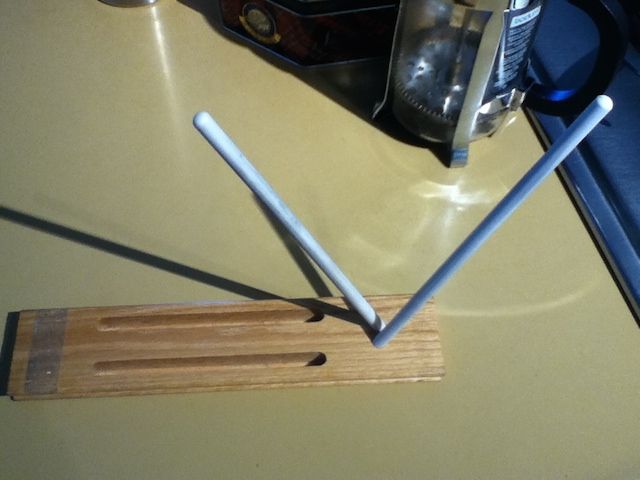
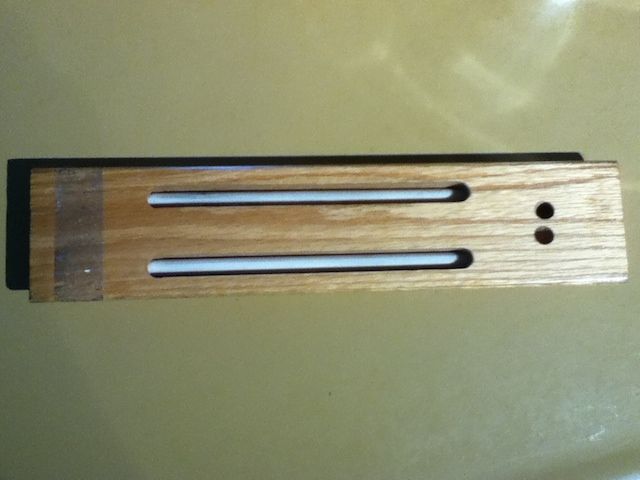
And lastly, originally secondly, I am phobic about sharpening AGAINST THE EDGE. From what I know of metal working, jewelry polishing, and actual experience sharpening woodworking scrapers which admittedly are softer cutting edge steel . . .
It is always better to move down the bevel and OFF the edge.
Why ? ? ?
Because it BURNISHES the molecular structure of the steel into a sharper edge. Think pushing putty into a fine smooth edge by pushing it with your thumbs ever finer as opposed to trying to do the same by tapping on the putty, edge on, with a rock.
This, I believe, is part of the attraction of a "well broken in" translucent hard Arkansas stone. it pushes and burnishes the metal and not so much abrades it.
For instance in jewelry they use a hard polished stone to burnish out scratches rather than try to abrade the whole surface to remove a fine scratch.
So if I were to buy a Sharp Maker I am sure I would find my self . . . hahaha . . . woefully, hopelessly, unadvisedly I know . . . ATTEMPTING to sharpen on the rods by starting at the bottom of the rod next to the base and moving the edge up the stone to the top.
I couldn't help it . . . it is just how I intuit an edge should be produced. At lest on the final stone or two.
The one exception might be a toothy edge where the pro sharpener is moving diagonally in both directions to create finely formed and well thought out actual saw teeth on the edge.
How ever effective that might be in the real world I am not there. I am endeavoring to create edges as close to the sharpness of broken glass as I can get. Two mirror like surfaces coming together to create the "Worlds Sharpest Edge".
I realize Sal is a smart man and that his Sharp Maker is well made and not like the Crock sticks . . . I just can't let go of the ladder and swim across the deep end . . . yet.
Hey any body want to buy some fine, vintage, almost unused ceramic rod sharpeners ?
I can make you a deal if you buy two sets. One for a loved one, (or hated one). Any takers ?
First but almost as emphatic as my second is that many of my edges are well bellow 20° per side. I am obsessed with thin knives, think kitchen paring knives, and shallow angles. A whole lot of what I cut every day requires no more and the tactile experience of using these are too addicting to relinquish easily.
So
with the sharp maker I would be tilting my hand a fair amount, I imagine, so it is almost like being back to free hand guessing on a hand held stone.
OH, Oh, oh and I just thought of a third HUGE REASON I have avoided the Sharp Maker and it is a totally irrational one I'm sure. I have two sets of the ceramic rod sharpeners that you can find in any sporting goods store. One set I bought and the second set I found when I cleared out my parents stuff after they passed away. I just looked on the base . . . they are called Crock Sticks . . . theyre a CROCK alright !
Both of these generic ceramic rod sharpeners SUCK so bad they do absolutely nothing. Over the last twenty years and more I have come back to them thinking it was ME but no they are only good for . . . for . . . for . . . well I can't think of a single useful thing I could do with one of those ceramic rods.
So I was traumatized at an early age by ceramic rod sharpeners promising the world and delivering only disappointment and low self esteem. Why pray tell do they have little slots so I can see the stones when they are stored in the wood base ? Or was that just to make it easier to drill the storage holes and get the wood chips out ? If that were the case best to have used two slabs of wood routed like a pencil is made but I am getting off on a tangent.


And lastly, originally secondly,
I am phobic about sharpening AGAINST THE EDGE. From what I know of metal working, jewelry polishing, and actual experience sharpening woodworking scrapers which admittedly are softer cutting edge steel . . .It is always better to move down the bevel and OFF the edge.
Why ? ? ?
Because it BURNISHES the molecular structure of the steel into a sharper edge. Think pushing putty into a fine smooth edge by pushing it with your thumbs ever finer as opposed to trying to do the same by tapping on the putty, edge on, with a rock.
This, I believe, is part of the attraction of a "well broken in" translucent hard Arkansas stone. it pushes and burnishes the metal and not so much abrades it.
For instance in jewelry they use a hard polished stone to burnish out scratches rather than try to abrade the whole surface to remove a fine scratch.
So if I were to buy a Sharp Maker I am sure I would find my self . . . hahaha . . . woefully, hopelessly, unadvisedly I know . . . ATTEMPTING to sharpen on the rods by starting at the bottom of the rod next to the base and moving the edge up the stone to the top.
I couldn't help it . . . it is just how I intuit an edge should be produced. At lest on the final stone or two.
The one exception might be a toothy edge where the pro sharpener is moving diagonally in both directions to create finely formed and well thought out actual saw teeth on the edge.
How ever effective that might be in the real world I am not there. I am endeavoring to create edges as close to the sharpness of broken glass as I can get. Two mirror like surfaces coming together to create the "Worlds Sharpest Edge".
I realize Sal is a smart man and that his Sharp Maker is well made and not like the Crock sticks . . . I just can't let go of the ladder and swim across the deep end . . . yet.
Hey any body want to buy some fine, vintage, almost unused ceramic rod sharpeners ?
I can make you a deal if you buy two sets. One for a loved one, (or hated one). Any takers ?
so it is almost like being back to free hand guessing on a hand held stone.
Essentially that is what it is. The sharpmaker is most useful for creating / maintaining a micro bevel and you can just as easily hold a stone at an angle. There are much better tools available if you need to reprofile a knife.
It is always better to move down the bevel and OFF the edge.
I usually finish with edge trailing strokes with my strops but if I finish with lapping films on hard backing plates than I prefer edge leading strokes.
Anyway.... I highly recommend reading the Science of sharp blog which is not only very interesting but features amazing detailed electron microscope pictures.
https://scienceofsharp.wordpress.com/
- Joined
- Sep 20, 2015
- Messages
- 8,334
Anyway.... I highly recommend reading the Science of sharp blog which is not only very interesting but features amazing detailed electron microscope pictures.
Read the first stickies ?
Ohhhhhh
I don't know. . . that smacks of "doing what I am supposed to do". I have never been good at that but I will consider it.
Haha
I best get over there. Thanks.
PS: holding one stone at an angle I question. Can't easily and quickly do both bevels.
Going edge leading against a film on a hard backing plate I would cut into it for sure.
My paramilitary 2 is sharpened to 17° per side but sharpness up almost perfect on the sharpmaker 30° inclusive. A slight tilt and you can get about any edge really. The sharpmaker is a sure fire winner to me and I can confidently say that if I would have started with it I would not have the KME and the worksharp Ken Onion... but I don't do much re-bevel work. I like all my equipment though I'm just really blown away by the sharpmaker.

- Joined
- Mar 4, 2014
- Messages
- 3,646
I did start out with a Sharpmaker, and was very frustrated, to say the least. The included video makes it look so easy. But there is a learning curve to sharpening no matter what you use.
I actually learned more from my EdgePro and KME, then started to re use the Sharpmaker more down the road. My process now is when a knife needs a full sharpening (or if just wonky from the factory), it goes onto the KME for a perfect bevel. So many knives, even sharp ones, are just a little off from side to side. This makes it difficult for good results on the SM. But after perfecting the bevel, it may not need to see anything but the SM for a very long time.
________________________________________________________
People Are Strange, When You're a Stranger.
I actually learned more from my EdgePro and KME, then started to re use the Sharpmaker more down the road. My process now is when a knife needs a full sharpening (or if just wonky from the factory), it goes onto the KME for a perfect bevel. So many knives, even sharp ones, are just a little off from side to side. This makes it difficult for good results on the SM. But after perfecting the bevel, it may not need to see anything but the SM for a very long time.
________________________________________________________
People Are Strange, When You're a Stranger.
I never watched the video but the KME and the Ken Onion really helped understand what needed to happen in order to get sharp... so I guess they ultimately made the sharpmaker better. I would not want to do a full blown dull knife on the sharpmaker that's for sure.
