shop lighting

Joined
Jul 14, 2004
Messages
2,623
Looking for some input here fella's!!

i'm working on getting my new shop useable for now. in my old (tiny) shop i used four 48" double light balasts. which lit everything up nicely. in my new shop these are'nt giving me enough light.

What are you guys using to light EVERYTHING up???
 
I dont worry about uniform lighting in the shop, I placed my lights over the equipment. This leaves the middle of the shop a little dark but good light over the tools. Typically designs have lights equally spaced over the shop floor. I have 3 magnetic base lights that I can move as needed as well.
 
Keep lights away from the forging area also, you want that a bit dark to observe the color of the steel for forging and heat treating.
 
I've got track lights on three circuits. When forging I only leave the furthest set on which
keeps the forging area pretty dim.

That said, I need more fixtures and could have figured the track placement out better.
It's basically a H that's a little too close to the walls, right about at the edge of the benches.
A more central set of tracks would help. It is very helpful to be able to just
reach up and move a fixture if you need more light somewhere as your shop use changes.
 
I've got 32 4foot flourecsent tubes (8 four tube fixtures) and 5 300 watt clears
going most of the time and as has already been said I've also got smaller lamps
on every machine in the shop (this is in 20x20') don't see how I could get by without
the smaller machine lamps
Ken.
 
I've got 32 4foot flourecsent tubes (8 four tube fixtures) and 5 300 watt clears
going most of the time and as has already been said I've also got smaller lamps
on every machine in the shop (this is in 20x20') don't see how I could get by without
the smaller machine lamps
Ken.

holy hydro :eek:
 
cleaning up content., will return. (this was much easier when everything was watts)
OK, so for lighitng a shop.

1. determine size of shop in square feet
2. calculate out the desired ligthing, I personally would try for the 2 watt per sqaure foot general lighting, and use spot lighting to boost work location up to higher levels. (OSHA likes 10 ft candles(edit ft. candles not watts) per square foot i think it was, for electircal / mechanical equipment spaces, precision manufacturing 3-10 watts per square foot)

so for example use a shop size of 80 sqaure feet, 8' x 10', and to attain 2 watts/sq.ft that would be 160 watts per sqaure foot at bench level.

average ceiling height 8.5' , lets say your bench is three feet tall, thats a distance of 5.5' from the source (unless you lights are higher).

3.e = i / r^2
Light intensity = intesity at the source (bulb) / distance to the table (or work area) Sqaured
 
Last edited:
the 4 foot plug in florecent fixtures are what I have. Just wired in plug in boxes along the top and I just plug and play :)
 
I use the high output tubes flourecsent. I have two double hung and each one is 8 feet long on one side of the shop and the some thing on the other. I also have a double 4 feet long in the center of the shop.

My shop lights are hung high and light the room very sufficient. You will be satisfied with amount of light you will get from installing these lights. Hope this was of help to you and God bless :)

Terry
 
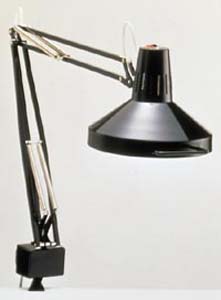
My shop is approx. 9-1/2' by 21'. I have (4) 4' 2-lamp fluorescent shop lights and (1) can light w/ compact fluorescent lamp. After visiting Nick's shop I was also inspired to pick up a couple of used drafting lamps similar to that shown below. I have them mounted at my grinding station. I should pick a couple more up for my drilling and bandsaw stations. They are very handy.

F1754_lg.jpg


Erin
 
Paint your walls white.
Lighting is very important, especially when you get a little age on you.
I am going to relamp my whole shop with quality fixtures after the Vegas show.
 
I put 15oo watts of ice cream cone like fluorescent screw ins in the new smithy with white walls and a lot of concentrated goose neck lamps at equipment locations.

There is 52 feet of 24" clear plastic panel under the eve which makes daytime overheads unnecessary.

As stated above 65 year old eyes don't give you the same look as 25 year old ones.:(:):D

Fred
 
I'll second the high output floresents, I've got two double 8' units on my new shop. It's a 24x30' and withe the white walls and ceiling they light it up great. They cost a bit more, but there worth it. I also have swing arm lamps mounted at every machine and station.
 
A hugely helpful tip I was given is to have a variety of light. You never know what the light source will be when someone else is looking over your work.

Take care, Craig
 
Have to disagree with fluoresent lighting above your machines or work bench(fine for general lighting). I would go with incandesent or quartz/halogene. Fluoresent light is not a constant light and won't show scratches in the blade as well. I had it in my shop (no longer) and would go to shows and say, "Where did those scratches come from." The incandesent light is more constant and much easier with which to see detail. Just my $.02.

Gary
 
I've got plain-ole-light bulbs, 100 watt, on a circuit with a dimmer... when heat treating I can get the light just right, when I need the light I just turn up the dimmer. Works pretty good.
 
The trick with fluorescent or any other lighting is to get lights that have a very high Kelvin rating, this is what will show your scratches. The color temperature of the sun can be above 6000K, incandescent bulbs can be as low as 2700K and regular fluorescent bulbs run in the 3000-3500K range. The is also the range that halogen comes in. Halogen shop work lamps are often much higher wattage and more focused than overhead fluorescent light, which is why I believe many find them superior, you're getting closer with a lot of light in the higher end of the "normal" indoor lighting spectrum.

If you look at mercury vapor lamps (the often dreaded knife show lighting), you'll see that they have a much higher kelvin rating than common home/shop lighting coming somewhere between 4000 and 6000K. Sunlight will reveal many of the same scratches that mercury vapor lamps will. It's my belief that the varied light mantra comes from trial and error without an understanding of color temperature and lighting. It works, of course, but it's not how I do it.

I just use 600W ceramic screw type bases on the ceiling - these can handle very high wattage compact fluorescent lights. These only cost 99 cents or so at the hardware store and work with a regular plastic or metal light can, so it's very cheap to install them and you can stick whatever light you have around the house in it if you run out of high quality bulbs. You can also mix your lighting up this way, trying regular incandescent bulbs, reveal bulbs, regular fluorescent, daylight etc. You can get high wattage clamp lights at Wal-Mart for $7 each which will work well for equipment/task lighting.

Do paint your shop white or put up white pegboard or something, it will make a bigger difference than you might imagine.

 
I do my final check for scratches in both the stone and metal polish at my main work bench which is at a huge window and I use two 75 watt reflector lights set at the left and right on the bench with 42 inch spring loaded arms. I look at the knife wearing a 1.5 magnification optivisor so I can pretty much see even the texture in the stone and 1200 gfit scratches..... I do recommend using an optivisor if you want to see how good (or bad) your finish really is.

This is the same location and lights I use for my knife photo's, which are taken with no light box and with the camera hand held.
 
Along with keeping Kelvin ratings in mind, spot lighting at adjustable angles can be helpful as flood lighting at the right kelvin rating may not throw shadows or reflections when needed.
 
Back
Top