Shop Tools...Mills & Drill Presses

Joined
Feb 20, 2008
Messages
138
I have another dumb question since I am just starting out, getting set up and know nothing about mills. I am sure that I will be buying a mill in the very near future. Something along the lines of the Seig X3. My question is....Do most of you who have a mill of this size use it for precision drilling (like handle pins) or do you use a drill press for all drilling and the mill for just milling? What I am trying to figure out is if it is really worth investing in a drill press or would the mill be used for most precision drilling and the press not needed? If a drill press is still useful enough to purchase, what would be the recommendations for knife making and general use in a knife making shop, a bench model or floor model? I am trying to set up a decent shop since I was told that with the right equipment the easier and more quickly it is to learn. Yet, I don't want to go out and buy a bunch of tools that will never or hardly ever be used.
 
i still dont ahve a drill press. maybe one of these days.
what i do have is a mini mill and i do use it more for drilling. love clamping the part in the vice then moving the dril to where i want it ( no clamp drill undo move clamp drill .... for me any more)
so far as milling im not real good at that yep
i think most tool and die guys would die if they saw how i used it :)
 
I use my mill for everything!! i used drillpresses for a while,and they'll work fine for fixed blades ect. but for real precision folder work a mill is your best bet. mine is the grizzly mill/drill..,i made this fixture plate for all my drilling.works great and i know every hole i drill/ream and every bearing race is 100% square.

millplate.jpg
 
Generally speaking, many manual mills are a superb "drill press" too.

I personaly don't own a drill press in my shop. I use a mill. I can think of at least two other shops the same way.
 
A small mill/drill will not totally replace a drill press for general shop use. I use my Seig X2 to drill the start and stop hole for milling a guard slot and where extreme accuracy is required. You can change from drill chuck to Collete w/o losing zero.

My floor model drill press was purchased 20yrs ago. It is a 16 speed import with an upgrade 5/8" chuck and a 3/4hp replacement motor(free). Most of my general drilling is done on this press. Great for large bits.

About 4yrs ago I purchased a bench drill press for use with small bits. Just easier to use(old eyes).

Your general drilling needs should dictate which drill press to buy. Just make sure to get the largest speed range you can afford and take the time to match speed to bit size.

Mike
 
I use both,also. Just make sure you put an indicator on the drill press to find out if thr head is square to the table. The X3 style mill is a good size for most knifemaking needs.
 
I use both. I do have a cross slide vise in it. I also do drill some of my holes with my mill. Depends on what the hole is for.
 
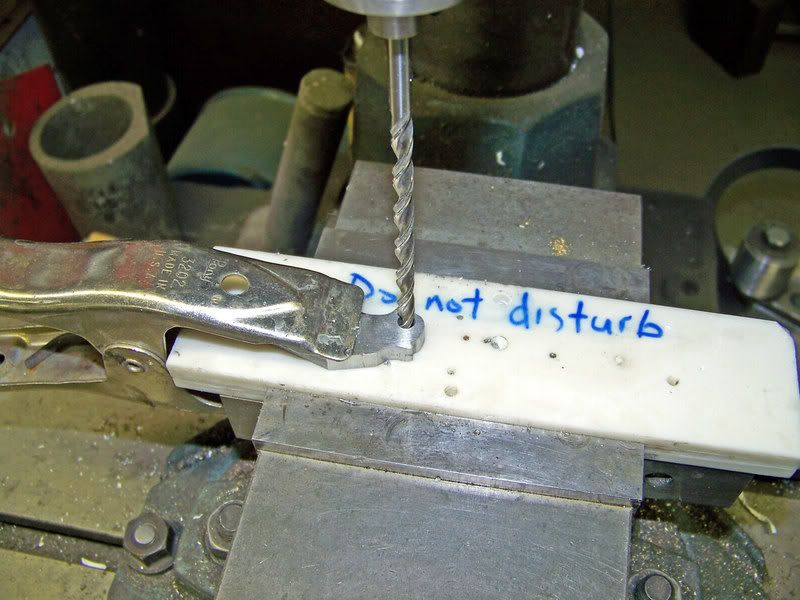
I have two drill presses and two milling machines. If I want a straight hole I clamp a piece of corian or aluminum in the mill vice and run a fly cutter over it so it is perpendicular to the drill. Unless somebody unclamps it I can drill a very nice hole.
here is a picture of the corian in my benchtop milling machine.
100_0691_edited.jpg
 
I use both,also. Just make sure you put an indicator on the drill press to find out if thr head is square to the table. The X3 style mill is a good size for most knifemaking needs.

Is this indicator some kind of special tool used to square the head with the table or are you just saying to be ure they are square? If there is a special tool/device for this I have never heard of it?
 
Yeah, a dial indicator is used for all kinds of set-up and inspection tasks. Look in an MSC (or similar) catalog; there's page after page of indicators and accessories.

It's good to have a drill press so you can leave your 'set-up' in place on the mill.

In rare instances, the hole(s) in a drill press table are critical for your set-up. For example, I drill a 5/16" hole, 2" deep, down the center of an 8" long piece of 7/16" square stock. I clamp the square stock with only 1" above the table, 7" below the table (through the center hole of the table). To do this on a mill, you would have to clamp the stock on the edge of the X-Y-table. Of course, this task is probably/possibly best done on a 4-jaw lathe (but I don't have one).
 
Bruce,my fixture is the same idea! i used aluminum and just machined the emntire surface square to spindle.every few months i'll take another .005 off to ensure there are no burrs ect.
 
Bruce,my fixture is the same idea! i used aluminum and just machined the emntire surface square to spindle.every few months i'll take another .005 off to ensure there are no burrs ect.

We are on the same track. It sure makes the blades close evenly with straight holes.
 
Yeah, a dial indicator is used for all kinds of set-up and inspection tasks. Look in an MSC (or similar) catalog; there's page after page of indicators and accessories.

It's good to have a drill press so you can leave your 'set-up' in place on the mill.

In rare instances, the hole(s) in a drill press table are critical for your set-up. For example, I drill a 5/16" hole, 2" deep, down the center of an 8" long piece of 7/16" square stock. I clamp the square stock with only 1" above the table, 7" below the table (through the center hole of the table). To do this on a mill, you would have to clamp the stock on the edge of the X-Y-table. Of course, this task is probably/possibly best done on a 4-jaw lathe (but I don't have one).

I have a dial indicator and a magnetic base but I can't figure out how or get the mental picture that you would use it to check square between the press table and chuck? That is why I wasn't sure what seamus was refering to when he said a "indicator". Doesn't seem you could use it against the bit because of the grooves in the bit and what if it is square and the bit is warped? I am just having a hard time tryng to figure out how to use it for this purpose. Anyone got a detailed explaination or a picture is worth a 1000 words. Thanks everyone for your replies and help. Hopefully after I get over this initially LARGE learning curve it will get a little easier.
 
My co-worker is the one who squares-up our mill; I'm sure Nathan or others could go into more detail...

you don't use your magnetic base. You want to mount the indicator arm either IN the spindle (as if it was a cutter), or AROUND the exterior of the spindle assembly.


See http://www1.mscdirect.com/CGI/NNSRIT?PMPXNO=1756525&PMT4NO=0
as an example of an exterior mounting. (MSC part #06451512).

See http://www1.mscdirect.com/CGI/GSDRVSM?PACACHE=000000054894638
as an example of a spindle mount (MSC part # 83785139).

Then you rotate/sweep the indicator around the surface of the table. You are square when there is no change in reading.
 
My co-worker is the one who squares-up our mill; I'm sure Nathan or others could go into more detail...

you don't use your magnetic base. You want to mount the indicator arm either IN the spindle (as if it was a cutter), or AROUND the exterior of the spindle assembly.


See http://www1.mscdirect.com/CGI/NNSRIT?PMPXNO=1756525&PMT4NO=0
as an example of an exterior mounting. (MSC part #06451512).

See http://www1.mscdirect.com/CGI/GSDRVSM?PACACHE=000000054894638
as an example of a spindle mount (MSC part # 83785139).

Then you rotate/sweep the indicator around the surface of the table. You are square when there is no change in reading.


Got it!!!! Finally!!! Now it makes sense!! Thanks for the response.
 
For a "close enough" method, but a pin gauge or drill blank in your chuck, and use a regular square (engineer's square, or combination square is good) to check for squareness. A v-block, on end, will check for squareness in the X and Y directions simultaneously.
 
Back
Top