Should all knife handle wood be stabilized?

Larry,
What about woods like walnut and redwood that bleed their colors. Will they cause the luster to darken? That might explain why walnut usually looks better not stabilized.
 
Hello,

An older thread, but still relevant. From the buyers perspective - a lot has to do with the relative humidity in your locale. Even if woods are kept oiled and used in the high desert where I live, the low humidity can cause a little shrinkage in unstabilized wood initially, if it was stored and shipped from a more humid location. This is true for even cocobolo and ironwood. Stabilized woods do better where I live.
 
ITs a very relevant thread. Handle selection can determine the overall functionality and feel of a knife. I love using burl, its just a plain good looking wood. I also like cherry, walnut, and a few others. I also use micarta quite a bit. it can be made to look very nice and it is very very functional.
 
Hi. New here
I realise this is an old thread but maybe I can still get some help. The very first knife I'm making needs handle wood and I'm trying to make team whole thing from stuff I already have. Looking around I found some pieces of mahogany that used to be a coffee table top. They are around 22mm or 5/8" thick so a little chunky at the moment. Do I need to harden the wood in some way or just use it and finish it?
A bit of history with the wood, I broke up the table top a couple of years ago as it had been damaged and then got left outside and the surface polish weathered away. At the time it looked like scrap and I smashed it up for firewood which is when I realised how solid it was inside :( anyway these pieces have been outside in the wood pile in UK weather for a year or so and none shows any sign of cracking or warping so I hope the wood will make nice handles because when I have test sanded a piece is comes up beautifully with golden lustre typical of mahogany.
What would anyone recommend?

Sent from my SM-G920F using Tapatalk
 
If it's that old & plenty still solid, it will make a good working handle. You're right about the thickness, mill it down a bit on the fat side (6-8mm?) & go ahead with the work. I guess a lot depends on your intended use, cleaning method & climate variations over time & general use. It would be better to use a finish which is completely impervious to water.

An oil finish would be OK, but will need more care in general, & don't leave the knife in the sink over night! An epoxy finish (some type of complete encapsulation of the wood, end grain & fibers) would be a bit better, especially if you can vacuum bag the wood & have the resin impregnate the wood before it sets up on you. Also, water-thin CA glues (CYANOACRYLATE) can soak into the wood if used as a filler & provide a durable finish.

Sorry if it isn't a "complete" answer to your question, but hopefully you have a bit more information to work with now. Use what you have is still a good rule of thumb. If you can buy something a little better, go ahead & try it on some scrap first! If you're into science, do all of them, set up a test & see what works best (usually the most time & money at that point, unfortunately).....

 
If it's that old & plenty still solid, it will make a good working handle. You're right about the thickness, mill it down a bit on the fat side (6-8mm?) & go ahead with the work. I guess a lot depends on your intended use, cleaning method & climate variations over time & general use. It would be better to use a finish which is completely impervious to water.

An oil finish would be OK, but will need more care in general, & don't leave the knife in the sink over night! An epoxy finish (some type of complete encapsulation of the wood, end grain & fibers) would be a bit better, especially if you can vacuum bag the wood & have the resin impregnate the wood before it sets up on you. Also, water-thin CA glues (CYANOACRYLATE) can soak into the wood if used as a filler & provide a durable finish.

Sorry if it isn't a "complete" answer to your question, but hopefully you have a bit more information to work with now. Use what you have is still a good rule of thumb. If you can buy something a little better, go ahead & try it on some scrap first! If you're into science, do all of them, set up a test & see what works best (usually the most time & money at that point, unfortunately).....
Mate that's a great answer and pretty much confirms my newbie thinking. I'm going to plain some thickness of it. If I had the right tools I guess I could split the wood into two thinner halves. To be honest I live in a town in the UK where I have no need to carry/use a knife, in fact it would be illegsl. Since starting to make this knife people keep asking me why I want a hunting knife and I keep telling them "I don't really want a hunting knife" The purpose of this project isn't to get a knife, hell there are much easier ways to own a knife than spending the hours I have done so far. The purpose of the project is in the making and not in the owning.
So what eventually that means I suppose is that I don't expect this knife will ever see much service in the woods etc and the only customer I'm satisfying is me so as long as I make this thing look as good as I can, learn a load of new skills on the way then it will be a success. To that end I think the mahogany with a nice oiled surface finish will serve it's purpose and be strong enough to last a good while.
I have quite a bit of this Wood so if it does turn out ok I might find a way to vacuum treat some scales out of what's left.
Thanks for your help.

Sent from my SM-G920F using Tapatalk
 
If you're doing an oil finish, something like Danish oil or Tung oil works very well. I use the wet-dry type of paper for finishing. A hard block is for flat surfaces, a finger or soft block for the curves. Once the grip is shaped well, finish sanded & to your liking, start with a 220 grit & work up a "slurry" or "mud" on the entire grip surface with the oil finish. It will look very ugly, but don't wipe it off! This is the first step in finishing a wood with open pores like mahogany (red oak, walnut, etc).

If you have a place where it's warm & dry, leave it in there until it's completely dry & hard (a water heater closet perhaps or furnace room). Next, go back to 220 & cut back the surface with oil until there are no "dull" spots from the mud. Once they're all gone (pores should all be filled completely now), wipe it off & let it dry again. Go up a grit to 320, wet sand & let it dry again completely. Etc, etc, etc until you have a 600-800-1000 grit finish (where you stop is up to you) which is dry. The last step is to put a small spot of oil on your palm & then rub down the grip, to give a slight coat of oil to seal up the fine scratches & give a sheen to the wood.

This will give an amazing finish which is in the wood, not on it & should look deep & soft to the eye. It takes a bit of practice, but it's a wonderful way to see the grain & figure of the wood. Best, tim
 
wow thanks. Good info.

Sent from my SM-G920F using Tapatalk

I have had great luck with Howard block conditioner if you are going the "oil route". It's actually an all natural mix of beeswax, carnuba wax, and mineral oil. Obviously like stated above this finish can't sit in water or anything, but it's food safe, gives an absolutely wonderful satin luster, and is really easy to use/maintain. If you use it though, make sure to use it when the wax is warm (i take the top off and pop it in the mic for 20 seconds), and for virgin wood let it sit on there overnight and then buff it down.

Here are before and after of my last project using Howard
2e3y6nn.jpg

15hzjwm.jpg

>>>/\ American Black Walnut from my property
 
Thanks W.C. I will have to see what's available locally in my part of England. I know I can get tung oil and I always have some linseed oil. I will look out for the conditioner you've mentioned. Thanks again.

Sent from my SM-G920F using Tapatalk
 
A bit of history with the wood, I broke up the table top a couple of years ago as it had been damaged and then got left outside and the surface polish weathered away. At the time it looked like scrap and I smashed it up for firewood which is when I realised how solid it was inside :( anyway these pieces have been outside in the wood pile in UK weather for a year or so and none shows any sign of cracking or warping so I hope the wood will make nice handles

Sent from my SM-G920F using Tapatalk

The fact that this wood has been sitting outside for over a year in the (typically rainy) UK weather would bother me. Generally you want wood to be good and dry. I would try to dry it out for quite some time before using it.
 
This is definitely an old thread.
My current opinion in regards to knife handle material is if the wood will benefit from stabilizing,
and the project will benefit from a more durable material, have it stabilized professionally.
After a couple years doing my own stabilizing using Resinol 90c I tried K&G to see how their stabilizing compares to what I was able to do.
Much better results with the wood stabilized by them. Since then I have been using K&G to do all my stabilizing.
 
Mark, completely agree with your comment about stabilization & wood in general. The "new guy" is in the UK & I'm not sure what's available there for this process, what access to resins he has & basic skill sets he's working with, hence my general answer to his question.

It would be interesting to hear from some of the UK blade makers who have danced on this path, to see where they source woods & what is used there & available. There must be something, but does anyone in the UK have some help for our new friend?
 
it is possible to get excellent results without stabilization, but it does require a lot of experience and labour. Quality stabilized wood it's a cheap way to get very good results with minimal efforts and expertise...plus you can throw spongy, fibrous and spalted woods in the bunch
 
How do you guys feel about stabilizing woods like maple or walnut? Woods that are hard enough and not normally prone to cracking. Would it be overkill or prudent in your opinion.

Some figured woods when stabilized seem to dull down a bit. I don't think it is my imagination but when I stabilize maple burl, the figure seems to become a little higher contrast, but seems to lose a lot of the metallic shimmer or chatoyancy it had while natural. Same thing with walnut.

Mark, I have been wondering this myself. I typically stick to the motto "Stabilize it all" since most knives I make are going to be used (hopefully). I am mostly using native hardwoods and this does not apply to dense & oily woods (e.g: desert ironwood, african black wood etc.)

I still use a few early knives I made with about 6 years ago with un-stabilized hardwoods and they are in great shape, though they see regular use and care in a fairly meticulous kitchen. Whenever I work with un-stabilized walnut, I notice how nicely it accepts the finish. It seems more prone to overheating during sculpting but it accepts oils and finishes in a way that I can only describe as "better" of more fully. I am able to fill all of the grain beautifully. The walnut I have used that IS stabilized seems to have a limit on how nice the finish can be. And at some point it seems that any open grain is blocked by the stabilant and maintains an open look that simply doesn't look as good. (Almost as if there are air pockets within the stabilant.

Thanks for posting this question. It's something I think about often as all of the traditional Japanese knives were made using natural wood handles. Parts may wear out and need to be replaced or changed to better fit a new owner's hand, but isn't that the nature of objects that last? They need occassional attention and can handle it... where as, when the handle on your Wal-Mart knife goes out, there's no fixing, replacing or maintenance that will help... The other consideration is that gun stocks don't seem to be stabilized in the same fashion as knife handles. Though they are properly cured and well finished, and generally well cared for.

Stabilizing seems to improve stability of woods that "need" it but it does not seem to improve the finish and look over natural wood.
 
The fact that this wood has been sitting outside for over a year in the (typically rainy) UK weather would bother me. Generally you want wood to be good and dry. I would try to dry it out for quite some time before using it.
It has been undercover so not getting rained on or wet directly. It seems pretty dry but appreciate it may absorb from the air. When I started to plane a piece to think it down and then tested sand it to see how the grain looked, the wood reacted like dry Wood in the way it cut and formed dry powder from sanding. It's possible the original hard finish it had as a table top has continued to protect it. There is a noticeable difference on the end 5-10 mm of some pieces that where broken up and the end grain left exposed but I think I can easily avoid those areas. I think I will go with this wood for now as it is my first knife and I might yet mess up the shaping etc I mean it's more about learning to shape bits of wood for me at the moment, I'm not expecting to produce the finest knife history has ever seen ;) (maybe on my second go eh)
Thanks.
The fact that this wood has been sitting outside for over a year in the (typically rainy) UK weather would bother me. Generally you want wood to be good and dry. I would try to dry it out for quite some time before using it.


Sent from my SM-G920F using Tapatalk
 
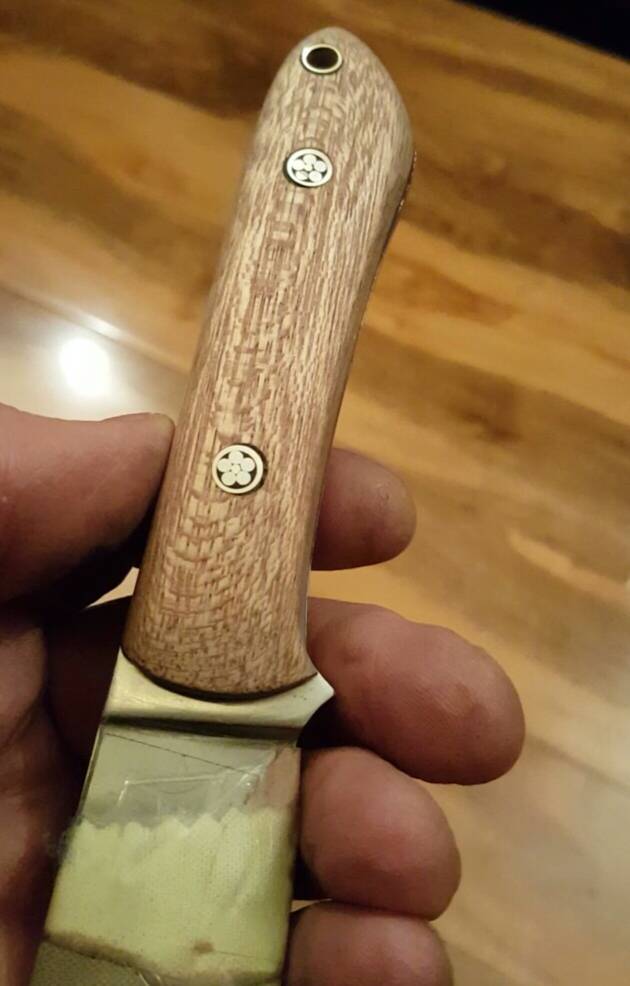
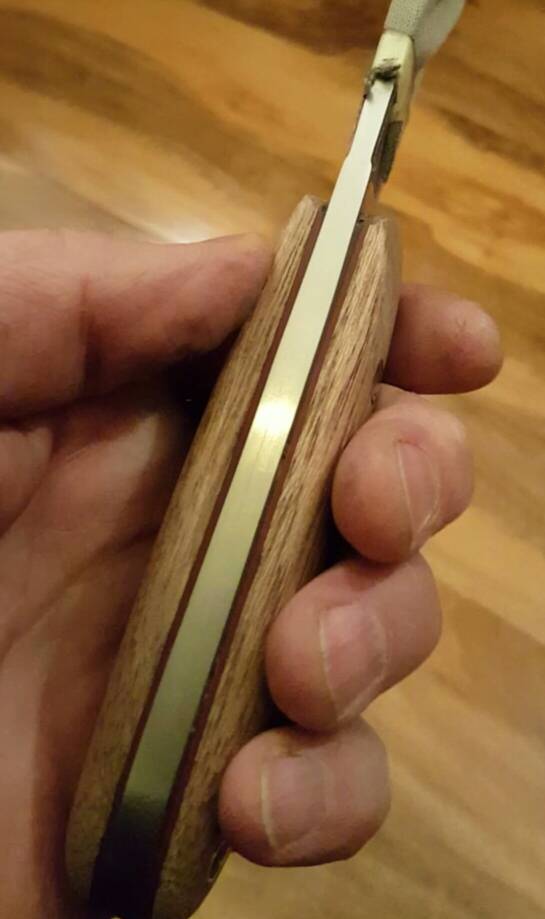
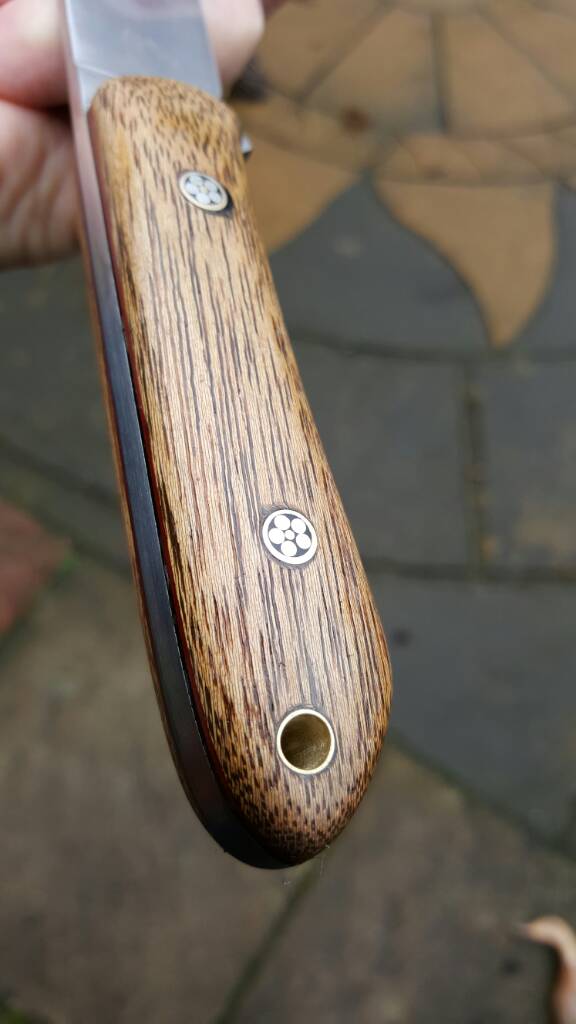
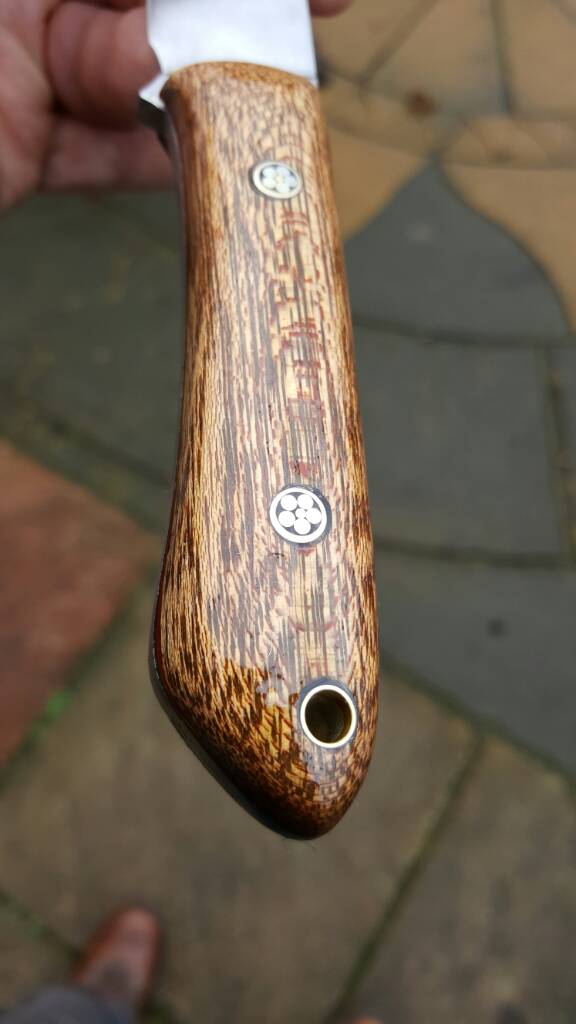
Getting there. My first ever knife with the rescued mahogany scales. Not perfect by some way but I'm happy with this first attempt. The handle needs oiling now.
Thanks for all the advice.
5c52de1c3105ee6070c38318041dd52a.jpg


Sent from my SM-G920F using Tapatalk
 
Back
Top