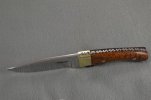
Should I put some Tru-oil on my stabilized scales?

Joined
Dec 5, 2013
Messages
1,180
So, I shaped and sanded a set of stabilized Boxelder burl scales all the way to 2000 grit. I then lightly hit them with the buffer; sewn cotton buff with white compound. They look pretty good but, I'm wondering if I can get more depth and contrast by adding a few coats of Tru-oil and refinishing. I've never worked with Tru-oil before but I've read good things about it here. What do you guys think?

Bob

Untitled by Ranger_Bob, on Flickr
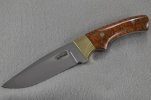
 
To me they look like they are only sanded to 800g or so. Were they home stabilized, or professionally stabilized?

I do put a couple thin coats of tru oil on my handles after they are sanded. The wood can still absorb moisture even though the wood is stabilized.
 
To me they look like they are only sanded to 800g or so. Were they home stabilized, or professionally stabilized?

I do put a couple thin coats of tru oil on my handles after they are sanded. The wood can still absorb moisture even though the wood is stabilized.

I believe them to be professionally stabilized but honestly don't know where. I bought them at a knife show a while back. I'm actually not even sure on the wood type, might actually by Black Ash Burl or who knows? I was pretty diligent about sanding through the grades. I sanded dry so maybe that makes a difference? I was not intending to fill in the small voids because I like the natural feel of them. Now I'm not sure.

Bob
 
Hmmm, there's definitely a cloudy look to your handle that starts disappearing at 600-800g in my shop, but maybe its the resin used? I'm not sure then. Try wetsanding with some 30% thinned tru oil and see what happens?
 
I found this guide a while ago. Its the same process that I was taught a couple decades ago by a master finisher, who did fine furniture and boats. The handle feels like soapstone when done. You cab use Tru Oil as well, but it will be a bit glossier, and have more of a plastic feel.

http://www.wwch.org/technique/finishes/oilfin.htm
 
[I often work with work that has an open grain or tiny pits like in burl wood. I read on Bladeforums that some guys use CA glue on their fingertip to coat the scales after sanding to 400 grit to fill the grain and tiny holes. I also used to finish walnut gunstocks by wet sanding a thin coat of polyurethane to fill the grain with the same wood dust as the stock. I now often use "Zap-a-gap" brand of Ca glue to fill tiny pores or voids...sometimes doing it twice or three times and finish sanding in between. I personally like the luster on your scales but the tiny pits bother me. If you get those filled then I would not use a varnish or Tru oil at all but just buff the scales with pink compound to a nice luster. Here is Afzelia wood filled with Ca glue .
 

Attachments

  • DSC_0041.jpg
    DSC_0041.jpg
    52.4 KB · Views: 41
  • DSC_0037.jpg
    DSC_0037.jpg
    47.4 KB · Views: 29
Last edited:
Birchwood Casey (the maker of Tru-Oil) also makes a Sealer and Filler product that you can use underneath Tru-Oil. I've had good luck with this product, and it goes a good job in sealing up the grain. You'll want to try it on some scrap wood first, because it cures much quicker than Tru-Oil and you need to know how to work with it.

TedP
 
Back
Top