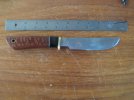
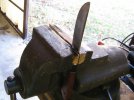
show me your bend tested knife..

Joined
Aug 25, 2010
Messages
50
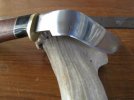
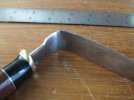
Heres one I bend tested, the edge cracks and the spine stays flexible.

differentially hardened in water, 52100, skinner prototype. hand forged from 3/4" round bar.
 

Attachments

  • bend test 002.jpg
    bend test 002.jpg
    39.3 KB · Views: 267
  • bend test 005.jpg
    bend test 005.jpg
    43.9 KB · Views: 220
  • bend test 007.jpg
    bend test 007.jpg
    33.8 KB · Views: 286
  • bend test 009.jpg
    bend test 009.jpg
    39.2 KB · Views: 279
I never understood the purpose of that test. Any piece of steel will bend when you put it in a vice and exert pressure. I mean, we all know that, so what's the big surprise when it bends? I know it's an ABS test and all, but...

Dave
 
The more important question is: what's the hardness of your edge? I could put an annealed KSO in a vice and bend it at least 90 degrees no problem.
 
If that test was important to you, good for you for doing it. It's the only way to find out what you would want to know. I think the ABS version of the test is a little different, but they describe what they're looking for with their test.

Take care, Craig
 
It's an ABS thing.
Today, the official reasoning behind this test is that it shows a maker can control temperature and steel condition, etc.
Many adherents to the ABS school no longer defend this blade treatment as the transcendently optimum method for knives as many did in the past. Some still do, of course.

To me a maximum-performance test for bending failure would involve measured force applied perpendicular to the blade's axis before complete failure. A soft, bendable spine doesn't provide maximum support for the edge. All else being equal, a knife so prepared will usually bend and fail with less applied force than a "full-hard" blade HTd to an appropriate hardness.

On the other hand, you don't get a cool Hamon on a full-hard blade!:)
 
Last edited:
sorry for the uneducated post, but are knives really supposed to be able to withstand that? hw hard was that blade the edge portion?
 
I honestly don't see the need to take a fully finished knife to failure. Maybe a couple of rough finished knives to test that your methods are giving the results you want, but isn't it a waste of time and material to completely finish a knife then break it?
Right now I send my blades out to be treated, and I trust that they are being done right so all I test is the ability to hold and edge and not break in non destructive ways. I have played a bit with scrap pieces and purposely broke them to study what was happening. I took notes on what I did and what the results were, then I made a small EDC did a home HT based on my earlier tests and tried to break it. It survived, it looks rough and it was never meant to be sold so I didn't put a lot of effort into finishing it. I still use it around the house and at the shop. Could I have bent it to 90* and had it return, no but I did have it bent over to about 20* so that was good enough for me for a shop knife.

I do feel that some destructive testing is needed, just not on finish work. Lets say I have an order for 5 knives of a particular design, I would make 6 and after HT I would take one of them finish the edge and try to break it in an abusive way. Prying, throwing it into hard wood with force, that sort of thing. If it survived then it should withstand normal use no problem and I would continue to finish out the rest of the batch as they were made the exact same way. If it failed then the whole lot would be suspect and would have to be redone till I got past the test stage and I found out what cause the first batch to fail. Test knives would never go out the door and would be kept on file for a record of what was done and how it failed.

Is that an acceptable practice to test your work, or would I need to do more? This is a serious question and would like some feed back on it. Your reputation is only as good as you worst knife to go out the door
 
I can't believe you put all that effort in finishing that knive and then destroyed it! That is a very nice looking piece of wood on the handle that is now wasted. All the test knives I have seen are very simply finished with tape, paracord wrap, rubber mat or cheap wood for handles. I hope you learned something from this.

* I have never made a knife from scratch, I've just reground a few and put together some kit knives. I am no expert, so maybe I don't know what I'm talking about. I do know that I hate to see good wood go to waste.
 
I'm guessing this was one of your first knives, and the finished piece didn't quite live up to what you were hoping for so you scrapped it. That's okay, that's how most folks start out. The handle looks nice. I'm sure it was useful practice for you.

Most bend test knives don't develop such a kink. And they usually spring back quite a bit. In my opinion, the best bend test knife would return almost to straight. It looks to me like your blade was probably pretty soft.

The most important question (to me) is how well did it hold an edge? Dead soft steel will bend like putty, but won't hold an edge. That is why the ABS test requires the knife to perform some cut tests before the bend.

Be real careful not to get sucked into the hype, lest you start repeating it yourself. :thumbup:
 
I never understood the purpose of that test. Any piece of steel will bend when you put it in a vice and exert pressure. I mean, we all know that, so what's the big surprise when it bends? I know it's an ABS test and all, but...

Dave

That's only one step of a 5 step test.
It must first shave hair, sever free hanging rope, chop through 2X4s repeatedly and then shave hair again, after which the edge is fully examined for absolutely no chipping or deformation.
If the blade is not heat treated with good control of temp and grain size, properly hardened, tempered, ground, sharpened, etc., one of those tests will divulge that failure.
After which the blade is then taken to a full 90 flex. You really don't want it to take a set/bend.
That test shows that you can properly harden, temper, grind and control where it all takes place.
A properly done blade, as well, would have RETURNED nearly straight after going 90 degrees with no cracking in the hardened portion.
If any part of the test fails, the knife fails.

The test does NOT show or prove that this is the optimum way to make a knife - it shows that the maker is in CONTROL of where he/she puts his efforts of grain size, hardness, tempering, grinding, sharpening, etc.
 
Last edited:
A properly done blade, as well, would have RETURNED nearly straight after going 90 degrees with no cracking in the hardened portion.
If any part of the test fails, the knife fails.

May i ask a question please? Does the blade with the 1/4" thickness at the spine and the length of 4-5" need to excel in this test? I am dead serious.
 
Very interesting discussion.

I'm a hobbyist knifemaker, I do it for enjoyment. I make some knives using farrier's rasps, mainly because I like the look the blade has when the file teeth are left visible, and because I get them for free.

Recently I made a smallish knife (5" blade) which was a thru tang. After heat treat, while hafting it in the handle, I noticed the blade had taken a bit of a bend at the ricasso. I only noticed this when I was roughing out the handle.

I attempted to straighten the knife in a vise. I eventually gave up on that, and the exercise turned into an experiment to discover how tough the steel actually was.

Very unscientific method, but I simply struck the handle of the knife, from the side with a 2 lb. deadblow hammer. It wasn't my intent (initially) to break the knife, but that is what ended up happening.

Farrier's rasps, like all files, are quite hard and brittle. They can be snapped easily by banging them sideways against a hard object.

This knife, however..... It took a great number of blows from that hammer. The power of my pounding was way beyond anything I would ever have done to this knife in the field.

The blade would flex and spring back true, over and over. It never did take a bend. I don't know how far it would flex, but I do know that I was hitting it hard enough (two handed) to make my vise table move sideways with each blow.

Eventually the blade snapped. I took the blade which broke off, about 4" of it, and chucked it broken end first into the vise and proceeded to pound sideways on the tip with the deadblow hammer. Again, a great deal of flex until finally the blade took a slight bend, just before breaking when more power was applied.

Frankly I was very pleased with the results of this un-scientific yet eye-opening test. I knew this steel was tough, but this helped me understand how tough.

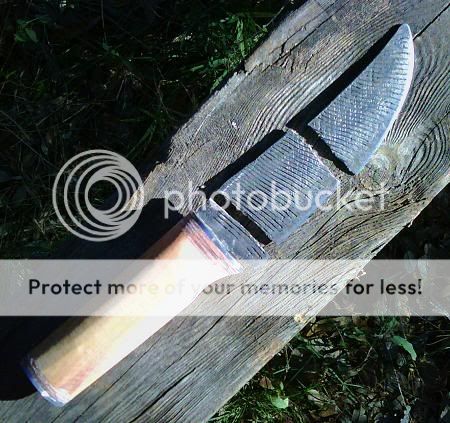
Here is a pic of the knife. The first break occurred closest to the handle, and it broke right along one of the file grooves. Even so, the blade took an incredible amount of abuse before breaking.

IMG00059.jpg


So what does this event tell me? I was impressed.

Andy

 
May i ask a question please? Does the blade with the 1/4" thickness at the spine and the length of 4-5" need to excel in this test? I am dead serious.


Does it "NEED" to excel?

I can't say if it needs to or not. I can do it, and have done so many times.
It may not be my preferred method in most circumstances, but it's a comfort to know that I can do about whatever I want, when I want.
The maker who has control of his methods and tools, and knows his steel, can make it do about whatever he wants.
If that's what you want it to do, you can learn to do so by experimenting, and learning from those experiments, as well as listening to other makers who don't go in for hocus pocus.
 
Is that a hamon in the first picture? If so it looks fairly low towards the cutting edge which would explain why it may have taken such a drastic set...more soft steel behind the edge than a knife with a differential hardening 1/2 way up. The crack makes me think what I'm seeing may just be a reflection, however. What cutting tests did the knife go through prior to bending?
 
Heres one I bend tested, the edge cracks and the spine stays flexible.
differentially hardened in water, 52100, skinner prototype. hand forged from 3/4" round bar.

It deformed and would not be considered flexible, IMO. I have my doubts about the edge, too. The thickness of the secondary bevel shoulder is rather large and retained some deformation near the crack. To me, it looks like the whole knife was too soft. I have read your heat treat process a few times over and have my doubts about that as well. I think your 2 second water quench isn't cooling down the body of the blade enough. It could be that the remaining heat auto-tempered the edge a bit too much.

... but I'm still green and can only speculate.... forgive me, if I offend.

I hope to follow in the footsteps of my mentor and have my ABS test knife come away in as good of shape as it went in.

If you were trying to emulate the ABS testing, you need to clamp the tip of the knife in the vice, 3" of the way in from the end. The handle is just as important to the testing as the blade is. If your handle or tang breaks, you fail.

Rick
 
Last edited:
I've seen quite a few blades tested and/or being tested. All of the one's I've seen have been taken to 90 degrees and have come back to about 20-30 degrees. Virgilio's blade seems to have stayed at 90 degrees with not much rebound. In my interpretation this seems to be a very soft piece of steel. Did you do many cutting tests before the bend test? I'm curious as to how well it kept an edge.

Some people question how much flexibility is needed and I would have to, that is until I had to break into my own house by prying a steel gate open. I used a Jason Knight knife I was carrying (fixed, 4 inch blade). I bent the blade to at least 45 degree before the gate came open. The blade went right back to true. Although it's not always needed I'm coming to expect that sort of performance from my own fixed blades.

Mike
 
Not my knife, but for those that haven't seen it before, here is the video from Ashokan of a knife bend. I'm glad I'm not the only one who finds the knife bend disturbing. However, judging by the applause, it is an accomplishment.

Here's Bill Hoffman bending his knife for his ABS Journeyman test, perhaps the most disturbing part of the whole weekend.
[youtube]ABxMRpL9NXU[/youtube]
 
Back
Top