Single phase vs three phase controllers

Joined
Jan 3, 2011
Messages
8
I'm looking for some help from more experienced members here. I'm looking at a controller that is 3-phase only https://www.clrwtr.com/Products/ESV112N02TXB But the same vendor has a 3-phase or single phase controller for $12 more. It seems to me that spending $12 extra for a controller that could accept either 3-phase or single phase is a great deal. Am I missing something? Is there a catch?
 
I am going to assume you want to use this in a location (like residential )that has single phase power.
You will need a phase converter that has single phase input and 3 phase output.

The one you linked to is 3 phase input

Also that one is not sealed to prevent dust from getting inside and messing things up. You can use one that is not sealed but will need to do something to keep the dust out. Sealed vfd's cost more
 
If one understands how VFDs work, its known either type will work with singlephase input.
One caveat with 3ØVFDs, one must derate the maximum power drawn. For example, If loaded to 30A on a 3Ø supply, (10A per conductor). Singlephase supply will draw 15A per conductor for that same amount of motor power.(its not precisely 15A, but the point is illustrated)
Further example, a 15hp 3Ø VFD should not be connected to a motor over 10hp, or just be careful how heavy you load it.

Some 3Ø VFDs if supplied by single phase will emit a fault condition indicating phase loss. Thats easily defeated by jumpering one of the singlephase conductors to the otherwise unused 3Ø terminal. 3Ø VFDs monitor this by seeing voltage exists on all three input terminals, But does not care about phasing otherwise.

Its generally best to specify a VFD to its type of supply.
But my overall point is, it will work. So dont bypass a good bargain on 3Ø VFDs just because you can only supply singlephase.
 
Last edited:
If one understands how VFDs work, its known either type will work with singlephase input.
One cavaet with 3ØVFDs one must derate the maximum power drawn. For example, If loaded to 30A on a 3Ø supply, (10A per conductor). Singlephase supply will draw 15A per conductor for that same amount of motor power.
Further example, a 15hp 3Ø VFD should not be connected to a motor over 10hp.

Some 3Ø VFDs if supplied by single phase will emit a fault condition indicating power loss. Thats easily defeated by jumpering one of the singlephase conductors to the otherwise unused 3Ø terminal. 3Ø VFDs monitor this by seeing voltage exists on all three input terminals in reference to earth, But does not care about phasing otherwise.

Its generally best to specify a VFD to its type of supply.
But overall point is, it will work. So dont bypass a good deal on 3Ø VFDs if you can only supply singlephase.

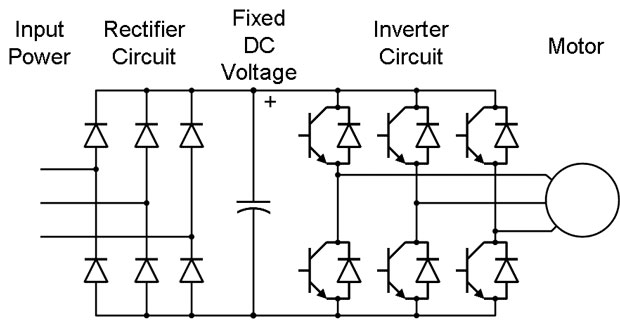
Wow, I'd never really considered this before, though I think I've see it in action. The first thing a VFD does is run the input power through a big bridge rectifier and filter caps. I would think the capacitors would be sized for a more or less even input from three legs so the DC feeding the inverter might not be perfect but I think what you're saying makes sense and I've seen three phase amps "single phase" just fine on a dropped leg. A big 5 HP 3 phase VFD is pretty cheap and easy to come by on the bay, I'm going to try this. :thumbsup:
 
I would think the capacitors would be sized for a more or less even input from three legs
Its actually the diodes and their respective conductors on the circuitboard what bear the extra load. Its multiple capacitors are just paralleled to make a bigazz capacitive value on the DC buss and fit within the overall physical size designed.
One can Google images of "VFD block diagram" or similar verbage to find abundant examples VFD theory of operation.
 
Last edited:
Dan, if you're considering spending that much money on a VFD drive, why in the world are you looking at that VFD rather than the normal one used by most knifemakers? For an open (NEMA 1 enclosure) Chinese VFD (and most all VFD's are made in China these days) you're looking at $120 or less shipped from here in USA? Perhaps you're in some other part of the world, but I see the linked place is here in USA.
 
Last edited:
I'd not thought about the idea of using single phase on a 3 phase input either, but it would work just fine.

VFD-Diagram.jpg
 
Yep just jump the 3rd leg from one of the hots. It does not check phase angle just looks for voltage on all 3 legs.
 
Some 3-phase VFDs will run on single phase. Others will not. It depends very much on the individual drive.

I have salvaged several drives over the years, but none recently. I certainly had a couple that would not run if there was no phase-phase voltage present between any 2 of the 3 input phases.

If you have a salvaged drive, it's obviously worth a try, but I'd caution against buying a 3-phase drive in the expectation that it'll work ok on a single phase supply unless you've checked it out and know for sure it'll work.
 
Some 3-phase VFDs will run on single phase. Others will not. It depends very much on the individual drive.

I have salvaged several drives over the years, but none recently. I certainly had a couple that would not run if there was no phase-phase voltage present between any 2 of the 3 input phases.

If you have a salvaged drive, it's obviously worth a try, but I'd caution against buying a 3-phase drive in the expectation that it'll work ok on a single phase supply unless you've checked it out and know for sure it'll work.

What would happen if you hooked up the two hot legs from a single phase system and hooked up the natural from that single phase system to the 3rd leg? You have 240 or 120 leg to leg that way so you'd never have dead combination. Would that "fool" the drive? I assume the drive isn't using a neutral or ground reference, but looking at leg to leg voltage?
 
I think it would still show a phase fault as it’s looking for 240v and it’s only getting 120. But maybe if you dropped the neutral through a 2:1 step up transformer. But that would be the same as jumping from one of the 220 lines to the 3rd leg.
 
I assume the drive isn't using a neutral or ground reference, but looking at leg to leg voltage?
VFD is looking for voltage between ground and each L1,L2,L3 terminal.
Thats why it only wants to see voltage & does not care with phasing. So jumpering the otherwise unused phase terminal to either singlephase conductor prevents a powerfault display.
I suppose that works to supervise its grounding connection too. Were ground somehow to disconnect, VFD should display a fault.

As aside. Offhand, dunno how VFD would react to the scenario were it connected to a corner grounded delta supply.
Will have to think about that...
That scenario would be much the same as connecting the neutral of single phase split supply as mentioned previously.

Good thing corner ground delta is rare configuration, Its been years since I seen or worked on them.
 
Last edited:
Back
Top