Skeletonizing Kitchen knife handles recommended or not worth the trouble?

Scoli Forge

Knife maker in training
Joined
Feb 9, 2015
Messages
73
I'm working on my kitchen knife blanks and was wondering if it is common practice to skeletonize the handle to save weight. The stock is an 1/8 inch thick W2. I didn't plan on tapering the tang at this time do to the thickness of the scales I'm going to be putting on there. I'll post a picture of the knife below for reference. I'll also post a picture of the handle material. This particular knife is going to be getting hackberry scales with brass corby bolts. Thanks again for the input. I appreciate all the help I have received from everyone so far.

jFTAWZU.jpg


6wcWxRy.jpg
 
I will usually just Swiss cheese the tang with a dozen or so 1/4 holes. Just to when I get tired of drilling holes. I also sleep better at night when I know all that epoxy has something to hold onto.
 
Thanks for the reply Viral. While swiss cheesing the tang is there a good rule of thumb for how much "meat" to leave around the edge?
 
I also do the "Swiss cheese" thing. I don't have a formula - I just take off enough weight that I think it will balance right when I put the scales on.
 
I stay about 1/8- 1/4 away from the edge. Idk if it's the right or wrong. Just seems to work.
 
Thanks for the input guys. I'll run with your advice and get these tangs drilled out.
 
Depends on how you want it balanced. Chef knives are a specialized niche that I don't venture into much, but some of them are intended to be heavier in the handle to keep the blade lively. See what the balance is like, loosely fit the scales if you need to, and decide if you need to shift the balance forward by lightening the tang or whether it is good like it is.
 
I like mine as forward balanced as possible, so I'm starting to try to go for the limit as far as skeletonizing goes.
 
I like mine as forward balanced as possible, so I'm starting to try to go for the limit as far as skeletonizing goes.

Can you elaborate on that? I'm learning more about kitchen knives.
 
After Viral's initial advice that's what I started aiming for. I'm not putting as many as you do Don, but I've plotted 12 quarter inch holes with emphasis on the back to bring the balance forward. I'm aiming for the balance to be at my third finger when holding in a pinch grip. I'm thinking this should produce a lively feeling knife that I'm hoping will feel like an extension of my hand. I'm interested in seeing where the balance point actually ends up falling once everything is done.

* btw big fan of your work Don.
 
Can you elaborate on that? I'm learning more about kitchen knives.

Well, it's just my approach to making a chef's knife. There are many makers that do really, really thin knives, but I like to make them feel heftier. A lot of Japanese knives (and my ideal performance standards are based off the Japanese knife) are hidden tang with a really skinny, narrow tang. On top of that, they usually use a really light wood like ho. The Kato, for example; I tried it out a few months back and this is a serious workhorse. 0.200" thick at the spine with a substantial taper and a full convex grind. Knives like that don't feel cumbersome to me, they just feel great. You'd imagine that it has trouble cutting through a lot of food, but comparing it to other knives it wedged on potatoes less. Thin knives even have a tendency to drag a lot, so even if they have the capability to cut slivers, they're slowed down by how much surface area is in contact with the food (then with the light knife, you have to do the work).

I played drums for many years and an analogy that clicks for me is that the drumstick does all of the work for me; I'm barely using some wrist and finger movement. I like my knives to feel similar in that aspect.

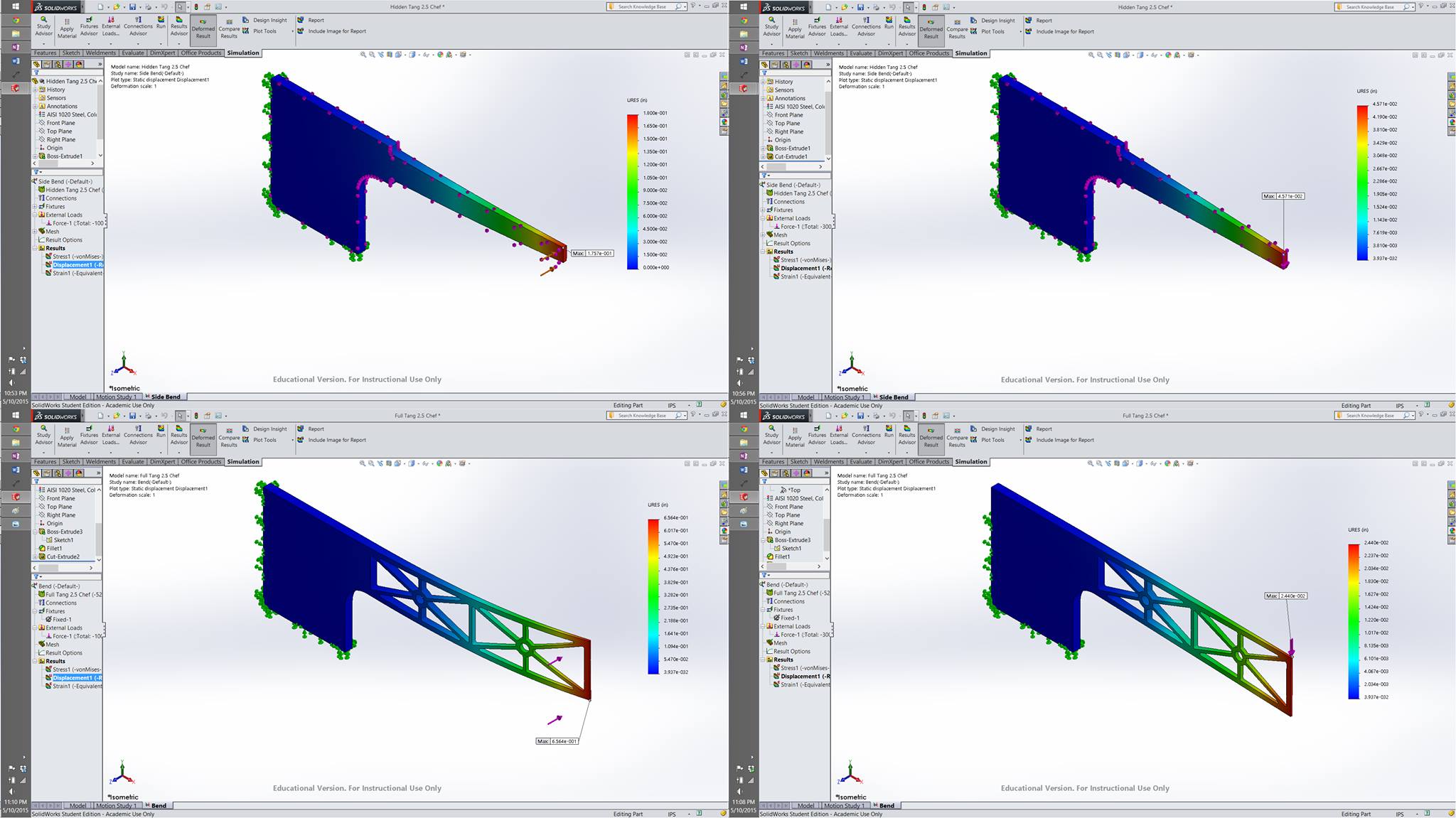
It's really difficult to try to get that same kind of feel and balance with a full tang and the materials we often see here (phenolics, composites, heavier woods). I did some SolidWorks models and it's possible to end up with the same weight with some serious metal removal (would have to be lasered/watered/edm/etc); I'll have to play around with the FEA more to make sure it isn't floppy like crazy though. Here's a really early thing I was messing around with. They're both the same weight. The FEA here doesn't really tell me much though since there's the rest of the handle that's unaccounted for. When I come up with actual iterations then I'd do direct comparisons to what I have been doing (simple holes drilled).

cELsIjL.jpg


I hope that's what you were asking about :D Lemme know if I missed the mark completely.

 
I do on full tang knives, makes a big difference on balance and "feel" of a knife. The way I normally do it is to drill my pin holes, and then drill 3/16" or so holes in a square pattern then use a dremel cut off wheel to take big square sections out. I leave the handle thick towards the blade/handle junction, and go larger the further aft I go. I'll see if I can find a pic of one I posted here a while ago. If it's stainless I do the cut outs after heat treat to reduce risk of stress risers. I also taper the tang.
 
Thanks for the example pics Will. I burned my dremel up a couple weeks ago trying to get my blanks cut apart. I'm saving up for a foredom to replace it with. I was trying minimize steel waste by putting the blanks close together and that kind of back fired.

Since i'm not tapering the tang on this particular knife after I get all the holes drilled in the tang i'm doing to use my small wheel attachment to hollow grind the center of the tang to get some more weight reduction.
 
If Nathan remebers , he skeletenized my Fallkniven TK-1 , turning a poorly balanced knife to a perfectly balanced one. I tested that knife on deer !! It's all about balance ! The balance point on the TK-1 was moved about 3/4" forward [that on a 4" blade hunter].
My kitchen knives , Henckel's or AGRussell ,are balanced about mid-bolster. That regardless of knife size and Japanese AGRussell or Henkel's with their difference in weight.
If you're good in math you could calculate that a few large holes does better than many small holes !!!
Leave at least 1/8 " between holes and edge. Somewhere on BF ,I think, are my comments to a Chinese maker whose knife broke right through an area that was weakened by holes and a curious step in blade thickness.No mystery there !!
Balance !!!
Having recently watched Nathan's video - if he could only learn to slice a tomato with parallel sides , he'd do well making kitchen knives !
 
Well, it's just my approach to making a chef's knife. There are many makers that do really, really thin knives, but I like to make them feel heftier. A lot of Japanese knives (and my ideal performance standards are based off the Japanese knife) are hidden tang with a really skinny, narrow tang. On top of that, they usually use a really light wood like ho. The Kato, for example; I tried it out a few months back and this is a serious workhorse. 0.200" thick at the spine with a substantial taper and a full convex grind. Knives like that don't feel cumbersome to me, they just feel great. You'd imagine that it has trouble cutting through a lot of food, but comparing it to other knives it wedged on potatoes less. Thin knives even have a tendency to drag a lot, so even if they have the capability to cut slivers, they're slowed down by how much surface area is in contact with the food (then with the light knife, you have to do the work).

I played drums for many years and an analogy that clicks for me is that the drumstick does all of the work for me; I'm barely using some wrist and finger movement. I like my knives to feel similar in that aspect.

It's really difficult to try to get that same kind of feel and balance with a full tang and the materials we often see here (phenolics, composites, heavier woods). I did some SolidWorks models and it's possible to end up with the same weight with some serious metal removal (would have to be lasered/watered/edm/etc); I'll have to play around with the FEA more to make sure it isn't floppy like crazy though. Here's a really early thing I was messing around with. They're both the same weight. The FEA here doesn't really tell me much though since there's the rest of the handle that's unaccounted for. When I come up with actual iterations then I'd do direct comparisons to what I have been doing (simple holes drilled).

cELsIjL.jpg


I hope that's what you were asking about :D Lemme know if I missed the mark completely.

Thanks for that!!(I'm saving this!)
 
Having recently watched Nathan's video - if he could only learn to slice a tomato with parallel sides , he'd do well making kitchen knives !

You have to cut your tomatoes wedge shaped to help square up and level wonky hamburgers. :D


I think that balance is very important to the function of a knife. In my experience I see three aspects to balance. One is total weight, two is center of balance and three is distribution of mass (light on the ends for rotation or heavy to resist deflection, applies mostly to weapons). I'm trying to learn how to apply these principals to kitchen knives.

On something like a hunter or skinner or utility knife I usually want it light and the center of balance on the first finger so you can relax your grip or change grip with a wet or slippery hand that is tired without the knife wanting to slip out. I don't think this thought process applies well to a kitchen knife that is in regular vertical contact with food or a cutting board.

I think what Don is saying is he likes some weight in the blade, probably for stability as much as helping the blade cut, and a light handle, perhaps because that's the bit of weight your arm is supporting and moving up and down all day? So very tip heavy is good?
 
I like to do a deep 2" hollow grind on my tangs, this can significantly lighten the tang. I want the tang as light as possible on most of my knives and especially a kitchen knife. I usually taper the tangs after hollowing them. I want my full tang kitchen knives to have the weight forward feel of a Wa handle.

It is interesting noting the grind geometry vs size and weight on a lot of kitchen knives... check your weight vs others in the style and it will tell you a lot. I usually hit a very consistent weight (within a few grams) even on a large knife. Lots of metal removal...
 
It's very much personal preference- everyone simply likes what they like, but there's really no substitute to talking with chefs and getting feedback from someone who uses a knife all day and night.
I know very skilled cooks who LIKE serious weight in the handle. Most, though, are happy if the knife balances at the "pinch point" or just a squeak beyond. (As Don points out, Japanese knives are a whole different world.)
That means that the handle can't be too light.
Again, there's no right answer, because as soon as you start making them blade heavy, someone will ask for one that's evenly balanced.
 
Back
Top