
-
The BladeForums.com 2024 Traditional Knife is available! Price is $250 ea (shipped within CONUS).
Order here: https://www.bladeforums.com/help/2024-traditional/
You are using an out of date browser. It may not display this or other websites correctly.
You should upgrade or use an alternative browser.
You should upgrade or use an alternative browser.
Slippie or Frame-Lock folder, what's...
- Thread starter Lycosa
- Start date


kc custom
Knifemaker / Craftsman / Service Provider
- Joined
- Apr 20, 2005
- Messages
- 2,365
One of the things between the two, is to my knowledge the people making liner locks don't have to make
a spring. Pins are peened instead of washers and screws. Hopefully someone that makes both will chime in
as I'm sure detents have to be precise. Now add another blade or two.
Ken.
a spring. Pins are peened instead of washers and screws. Hopefully someone that makes both will chime in
as I'm sure detents have to be precise. Now add another blade or two.
Ken.

- Joined
- May 13, 2009
- Messages
- 4,182
I think Ken pretty much summed it up. With a frame/liner lock you have the luxury of being able to take it apart to make corrections after it's complete. A slip joint is a little harder to do that to once it's pinned. Oh yeah, and then there's that multi-blade situation too. I don't know much about that yet. 

Stacy E. Apelt - Bladesmith
ilmarinen - MODERATOR
Moderator
Knifemaker / Craftsman / Service Provider
- Joined
- Aug 20, 2004
- Messages
- 38,737
A slippie is a pretty basic setup and construction. The skills and tools needed are fairly basic.
A liner or frame lock requires more skill, precision, and tooling.
The first trick to learn is that you need to make any folder three times.
Once on paper, drawn open and closed. A light box is a really useful thing to have for superimposing the closed drawing over the open .
Once in clear plastic (Plexiglas- AKA window Lucite - great for all knife template).
Then when that is fitting up right, in steel and metal.
The way to get a good fit-up for a slippie is to make an assembly jig from a sheet/block of aluminum or mild steel. Use the same pins and drill bits you will be using on the blade, spine, and liners. This allows you to adjust the fit-up of the blade until she walks and talks before final assembly and pinning.
BTW, there is no rule that I know of that says you have to pin the blade. A barrel pivot can work fine on a slippie, and allow assembly/disassembly for adjustments. Just pin the liners to the backspring solidly with two or more pins (relieve the backspring clearance forward of the center pin by a few thousandths). The scales can be made removable by tapping the liner, just like on a liner/frame lock.
A liner or frame lock requires more skill, precision, and tooling.
The first trick to learn is that you need to make any folder three times.
Once on paper, drawn open and closed. A light box is a really useful thing to have for superimposing the closed drawing over the open .
Once in clear plastic (Plexiglas- AKA window Lucite - great for all knife template).
Then when that is fitting up right, in steel and metal.
The way to get a good fit-up for a slippie is to make an assembly jig from a sheet/block of aluminum or mild steel. Use the same pins and drill bits you will be using on the blade, spine, and liners. This allows you to adjust the fit-up of the blade until she walks and talks before final assembly and pinning.
BTW, there is no rule that I know of that says you have to pin the blade. A barrel pivot can work fine on a slippie, and allow assembly/disassembly for adjustments. Just pin the liners to the backspring solidly with two or more pins (relieve the backspring clearance forward of the center pin by a few thousandths). The scales can be made removable by tapping the liner, just like on a liner/frame lock.

- Joined
- Aug 27, 2004
- Messages
- 2,701
harder to make? Which folder is more of a challenge or are they about equal? Thanks for the input.
I personally feel that each style of folder presents different and unique challenges. I will preface this by saying I have not made liner or frame locks at this point but have studied their design and tooling required. I can imagine that the lock face/angle and placement of the detent in a liner lock requires great skill and care. But any more skill than fitting a slipjoint blade tang so that the blade has the right amount of spring tension but also that the spring is flush with the spine of the knife in open/halfstop/closed position?
I have seen frame locks built with nothing more than a dremel tool/cut off wheel, drill press and assorted hand tools. Same with slipjoints. On the flip side I use tooling plates, fixtures, rotary table/milling machine/surface grinder when I build a slipjoint. I think you get the idea.
While it is true a slipjoint can be made with a removable barrel pivot most collectors or buyers of highend slipjoints will want traditional assembly methods. This means peening pins, including the blade pivot pin. Peening pivot pins IMHO is one of the great skills learned when making slipjoints. Peening a pivot pin can greatly affect the mechanics of the knife. A blade can have side to side play or too tight if not peened perfectly. And on top of this, the pin must disappear in the bolster when finished!
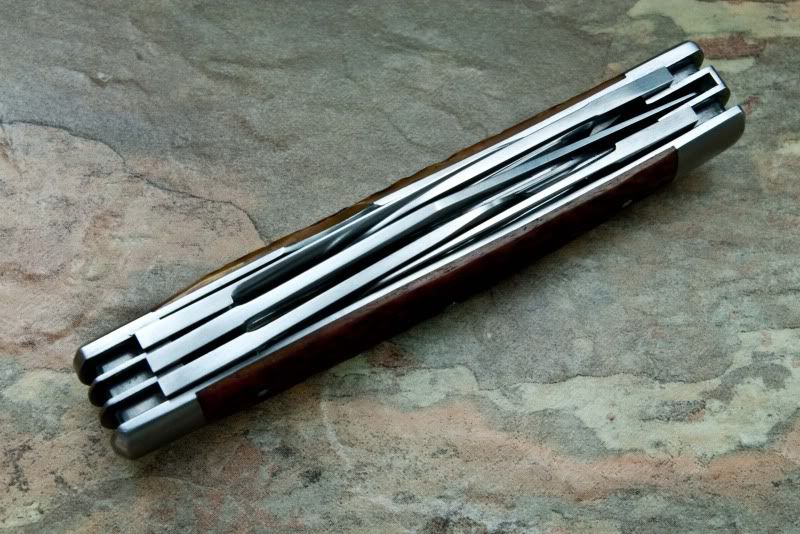
You did mention not only which is harder to make, but which is more of a challenge. When you start adding blades the challenges goes sky high. On many multi-blade slipjoints a single spring must work two blades! To get two tangs that have perfect geometry working on a single spring is something that will put your skills to the test. I have included a couple of pictures of two slipjoints that I have built that should give you an idea of just how hard a slipjoint can be to build.
Bottom line is that you can take either style of knife to great extremes , requiring very refined but different skill sets.



SBuzek
Basic Member
- Joined
- Dec 7, 2006
- Messages
- 3,622
I have made both and agree with Ken completely,and I find slipjoints more challenging than liner- frame locks.After peening the pivot and the removing it 3 times cause it won't hide,the bald spot on my head becomes bigger.Also Ken is correct in saying that just peening the pivot in a slip joint can change the way it works.
Stan
Stan

- Joined
- Oct 20, 2008
- Messages
- 5,547
NICE work, Ken. Those multi blades are impressive. I recall seeing one in ivory and damascus with eight blades including a corkscrew, by Kaj Embretsen, that basically put my jaw on the floor. The time involved must be staggering. Not to mention the stress.
Having built liner and frame locks, yep they are hard enough too. It's true that almost any style of knife is its own path to walk, requiring many years to fully master. I can build a decent liner lock, but when I go to Ken Onion's shop, very quickly I am reminded that there is a level of engineering that can go into them that is WAY ahead of me. He can design and build knives for production runs that 100 out of 100 knives are fully parts-interchangeable with great walk and talk. Using trig to calculate the best lock face/lock bar geometry for optimum wear characteristics over years of use.
I'm sure most folder designs get as intense as you want to make them.
Having built liner and frame locks, yep they are hard enough too. It's true that almost any style of knife is its own path to walk, requiring many years to fully master. I can build a decent liner lock, but when I go to Ken Onion's shop, very quickly I am reminded that there is a level of engineering that can go into them that is WAY ahead of me. He can design and build knives for production runs that 100 out of 100 knives are fully parts-interchangeable with great walk and talk. Using trig to calculate the best lock face/lock bar geometry for optimum wear characteristics over years of use.
I'm sure most folder designs get as intense as you want to make them.