
Small Tanto (Akuchi?) style WIP

NJJ

Joined
May 28, 2013
Messages
232
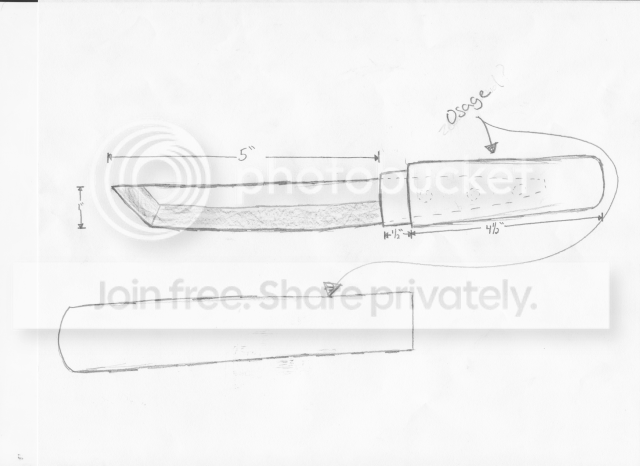
I started getting things ready for my little tanto style knife with saya. I want it to look something like this -
tantolayout_zps9629299c.png


The handle and saya and going to be osage and the blade is going to be .125" 1080 steel. The blade will be ~5" and the handle will be ~4.5".

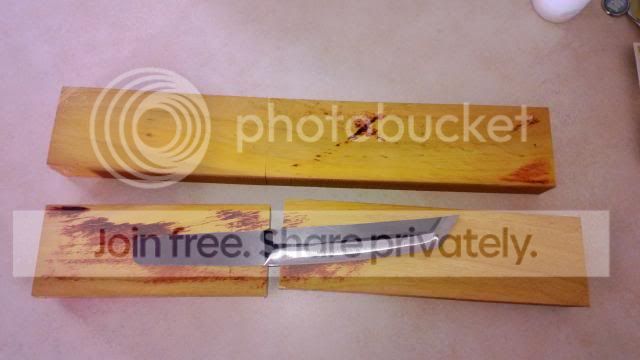
I got this much done today -
WP_20130603_001_zps15532443.jpg


I still have to file a bit more on the bevel, should I go up higher than what I have, or is that about right?

Hopefully I can get some more time to work on it this week.
 
I would quit filing there, and finish the bevels with sandpaper and a hard flat block. You want them dead flat with a crisp straight shinogi. All the fine details, like the yokote, should be sanded in after HT.
When you get to that step, I'll give you a trick that gets a crisp yokote. It might look nice to file small 45 degree flats on the mune (spine) to make it have three equal size facets. This is called mitsu-mune ( Three sided spine).

Don't forget to drill the ana and make the machi (shoulders the habaki sits against) before HT. An aukuchi still has a small and thin tsuba(guard), but it is the same size as the handle, so it does not stick out any ( it is actually more like a seppa). 1/8" thick metal to match the habaki is normal. Copper works well for both.

Unfortunately, you already have cut the wood in half, but the preferred method is to inlet the wood to fit the whole blade with the bevels down, then separate the two halves.
 
Thanks for all of your help with this :)

I am still new to a lot of this, so please bare with me. What is the best way to put the habaki on? Can I get a bigger piece of copper/brass and drill it/shape it out to fit? I was originally going to make the habaki smaller than the handle so it would slide into the saya, but I may change my plans.

The mitsu-mune sounds like a nice feature to implement, so I'll work on that tomorrow.

Thanks again,

Nick
 
http://www.bladeforums.com/forums/showthread.php/1004703-Habaki-fit-up-question
http://www.bladeforums.com/forums/s...anto-Chapter-2-The-Habaki-(picture-intensive)

The habaki is easily made by folding a piece of copper strip in a tight "U". Then it is shaped a bit, silver soldered together, and finally hammered and filed to fit the blade perfectly. It can be fairly thin and small on a tanto, and some folks leave it off all together. The small round tsuba ( it would be called a guard on a regular knife) is slid up against the habaki. If you don't use a habaki, just make the machi a little deeper to provide shoulders for the tsuba to sit against...just like fitting a guard on a regular blade. Make the disc of metal for the tsuba a bit oversized, and file it down to fit the exact shape of the tsuka. I especially like mokume for this on an aikuchi, but any soft metal will work - nickel silver, sterling, brass, copper.

The habaki is on the blade to fit it to the saya and hold it in centered in place. This helps prevent the blade from rattling and getting scratched. It is slightly wedge shaped, and when fully inserted into the saya gets just snug, but not tight.
 
Thank you for the links!!! I am a visual person and those just explained it to me perfectly! I think I may just be able to do that, now I see what you were saying about the "shoulders" before heat treating, that would be a pain after HT. I hope to get the shoulders cut and holes drilled today, I'll try to get some more pictures up tonight.
 
I don't have much to add to what they've said except that I like to use masking tape when sanding. Maybe some electrical tape over the top of that if I find myself hitting it a lot. I'm sure the pros don't need it much but it I do lol. It makes sure I don't make a mark if I slip, go to far, etc.... Its a pain to resurface an entire area or have to bring an line back to crispness all because my stiff, sore, hands made some mistakes (RSI :( ) Especially if I were doing a tip like that, which wouldn't have much surface area touching the abrasive, making me more likely to accidentally rock it and dull the line at the edge of the bevel.
 
NJJ,
One thing on making a Japanese blade, or any knife for that matter, is to take your time. Plan each step as well as the ones that come after it. There is an old koan that goes something like......"Do the whole task in your head one hundred times. That will make it much easier to do only once with your hands."

Don't rush to do too much in a day, or even a week. Spend twice the time you think you need on sanding and shoot for as flat as possible on any flat surface. When done with that step, set it down and go do something else for several hours , or better, let it sit overnight. The next day, look it over closely. Usually you will see things that still need to be worked some more.

When it is ready for HT, it should look perfect except that the edge is about .020" thick. Don't make the mistake that so many do by saying, "Oh, I will fix that after HT."

On fitting a habaki, you can make the basic shape before HT, but don't do the final assembly and fitting until after HT and all the polishing is done. The habaki needs to be a snug fit, and if you fit it before HT, it will always be a sloppy fit. Wrap the polished blade in tape and fit the habaki.

BTW, when I say "polished" I am referring to the togi, or "polishing", of the blade. All the steps after the blade is shaped and hardened are generically called "polishing" ( shiagi togi). This is not the same as a mirror polished western blade.
 
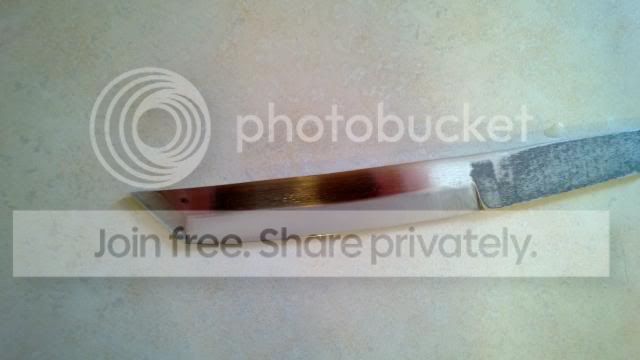
WP_20130604_002_zpscbd2fcb8.jpg


I think this is as good as I am going to get with hand tools... I really need a grinder. Now on to the machi and the ana. I had an idea about using Brazilian walnut or black walnut for the habaki, would that work? Or just stick with the copper?
 
I would not use wood. Use 12-14 gauge copper sheet. Wood at .100" and less would not work well at all.
 
NJJ,
One thing on making a Japanese blade, or any knife for that matter, is to take your time. Plan each step as well as the ones that come after it. There is an old koan that goes something like......"Do the whole task in your head one hundred times. That will make it much easier to do only once with your hands."

Don't rush to do too much in a day, or even a week. Spend twice the time you think you need on sanding and shoot for as flat as possible on any flat surface. When done with that step, set it down and go do something else for several hours , or better, let it sit overnight. The next day, look it over closely. Usually you will see things that still need to be worked some more.

When it is ready for HT, it should look perfect except that the edge is about .020" thick. Don't make the mistake that so many do by saying, "Oh, I will fix that after HT."

On fitting a habaki, you can make the basic shape before HT, but don't do the final assembly and fitting until after HT and all the polishing is done. The habaki needs to be a snug fit, and if you fit it before HT, it will always be a sloppy fit. Wrap the polished blade in tape and fit the habaki.

BTW, when I say "polished" I am referring to the togi, or "polishing", of the blade. All the steps after the blade is shaped and hardened are generically called "polishing" ( shiagi togi). This is not the same as a mirror polished western blade.

I missed this post... oops.

I have decided to use the copper like you suggested and use the method from the second post. One thing I love to do is imagine and build through the process in my mind before I actually touch the project. I will slow down a bit ( I do tend to "hurry" through my projects, I blame it on being young and just the excitement of building) and when I think i'm done I'll sand and polish some more :)

I'm sure I will have some mistakes in this one, but that is part of the learning process ;) and I'm sure this will not be the only one I make. Thanks again for your help, it is greatly appreciated.
Nick.
 
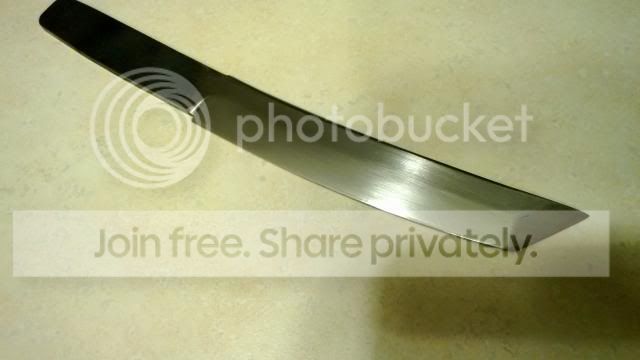
Got it HT'd and tempered today -

WP_20130605_006_zps03485881.jpg


It's just sanded to 320 now. I hope to make the habaki tomorrow and get it sanded to 600.
 
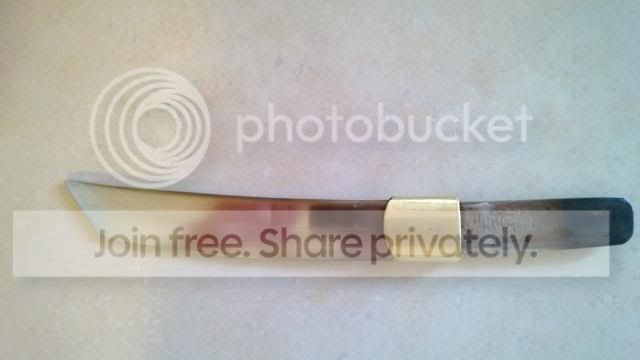
I got my habaki made and slid on, not sure if I'm 100% happy with it-

WP_20130606_010_zpsda2589d4.jpg


What do you think?
 
That looks pretty good.

Hard to tell from the photo, but if a habaki is just perfect, the mune and ha should be level with the habaki top and bottom. It is hard not to have a little projection, especially on your first habaki. This is part of determining how deep the machi should be.

The machi-gane ( the stops that slide up against the machi) should be about 3/4 of the way back in the habaki.

BTW, I know you said you were going to drill it in post #9, but where is the mekugi ana? The nakago (tang) looks like you annealed it and decided to drill it after the tsuka/saya are made. That works fine, too.


OK, I am going to tell you what you have done on this blade that makes it a tanto shaped western knife, not a real tanto. You made a tanto shaped blade on a tang. The proper way is to file the whole bevel all the way back to the nakagogiri ( end of the tang). The nakago ( tang) should have the same shape and bevels as the blade part. There is no plunge line. When the habaki is slid on, it should meet seamlessly with the blade surface all around. Properly fitted, you should not be able to slip a piece of paper between them anywhere. With the plunge and thicker tang on your blade, the habaki will obviously have a gap at the ha. The shape of the nakago varies, but the whole blade should have a smooth and gradual taper in thickness from the nakagogiri to the monouchi, and then taper toward the kissaki (The front 1/3 of the blade length from the tip is called the monouchi). This tapered nakago will allow a tight fit into the tsuka with only the mekugi holding it together. The tang you have is just a flat piece of steel that is thicker than the blade, and will not work as well. For this reason, most "Western Tanto" knives like yours generally have the handle glued on, and the peg is just decorative. The true tanto can be disassembled for cleaning and sharpening with merely the mekugi knocked out.

This isn't to say that you haven't made a nice knife ( I am impressed by how well it looks), but just to tell you where it should be different if you are looking for authenticity.

Here are some links that may help explain it :
http://home.earthlink.net/~steinrl/glossary.htm
http://www.ncjsc.org/gloss_nakago-1.html
http://www.google.com/search?q=naka...1KIG5qQHFsoDABA&ved=0CDwQsAQ&biw=1440&bih=687
 
I am learning a lot with this project, I guess I kind of jumped in over my head :) I think I am going to finish this one up and then start another that will be more authentic. I never knew they could be "broken down" for cleaning. The bevel the entire length of the blade/nakago makes sense, I was wondering about that when I made the habaki. I still may drill the ana or I may just glue this handle on since I'm not really close to being authentic. I hope to get some more progress done this weekend.

It's not going to be perfect, but I hope I learn enough on this one to make the next one better :)

Thanks again Stacy for the help, there is a lot of new vocabulary that goes with these guys...
 
Back
Top