Small Tanto blade profile?

Joined
Nov 29, 2011
Messages
1,396
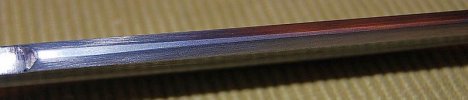
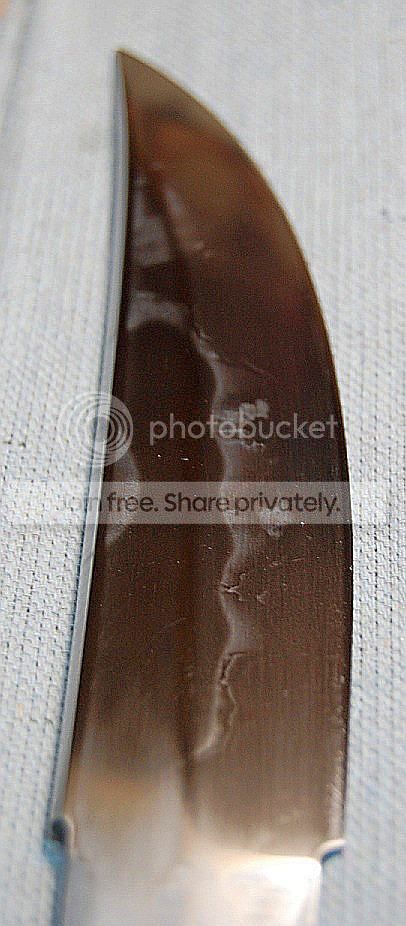
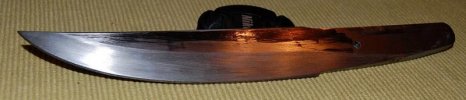
Ok not sure if this would be classified as a small Tanto, a kaiken, or a hamidashi or soemthing else. It is about 10" long with 5.5" roughly of blade length. Not trying to be entirely traditional but overall going with maybe a mix of traditional style.

Anyways working on profiling and filing the blade and have a few questions on what you guys think would be a more professional (professional as in looking more like professional made) takes on a couple small areas.

One is the mune I think its called (top of the blade portion) I have basically two small bevels and was thinking of leaving a slight flat top that tapers to the point to a basically nonsharp edge. However looking at cross section illustrations I see most have the nonsharp edge the full length of the blade. I dont want to leave a small flat because I like how it looks and come to find out it is considered a glaring amatuer mistake.

Second on the main bevel of the blade I have it a little over half way up and it will climb just a tad as I finish it up since the edge is still at .08" right now. I want to keep some thickness to the blade but not sure if there is a certain height associated with this that is more commonly accepted for whatever reason. The steel I am working with is 3/16" 1095.

Thanks for your input, oh and these pictures are of the blade in a very roughout state right now, you all can critique the finish when I get there :D
katana and pics 011.jpgkatana and pics 024.jpg
 
The inverted "V" shape is called ihori ( angle)
The flat top is called mitsu ( three sides)
A curved is called maru ( rounded)

So what you did is called mitsu-mune. It is a common shape.
The blade shape is tanto-O-kissaki (long tip knife)
 
Thanks Stacy. Think its time to get a book or two on this subject to add to the library.
 
I love the shape of your knife. With your nakago shaped that way does it mean you're making a tsuba and habaki to make a more traditional koshirae with a tsuka and saya?

I like the o-kissaki call. Lol. It does look like a knife made from the last foot of a Katana that had a long kissaki. Learning how Japanese swords are made is a slippery slope that there's no getting away from. Next thing you know youll have a pitch bowl to make tosogu along with a full set of stones to do your own polishing. :-) Just learning the Japanese terms is quite a chore.
Looking forward to seeing the finished knife! Please do share with us when it's done.
 
Thanks Brian, ill be sure to share. I plan on doing a simple habaki, will decide on the wood for everything this weekend. Hopefully do the clay quench this weekend as well. Oh and I would love to have some nice stones but gotta save up for that (and learn how to use them).
 
Stones are worse than crack. Once you start getting them, you always seem to need "Just one more". While all the Japanese texts say to only use natural stones, the modern synthetic Norton and King stones are just fine for 95% of home done togi. Same goes for using 1/2" and 1" squares of super fine grit (2000-8000)wet-or-dry paper for working on the hamon. They will replace ha-zuya and ji-zuya stones and get good results. Flitz, Simi-chrome, red rouge powder, and green chromium oxide work fine for kanahada.
 
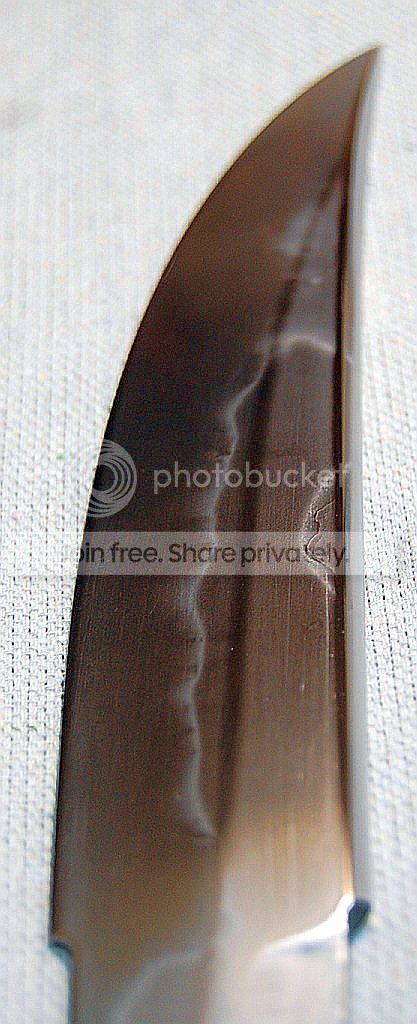
Well made some progress and a little setback. Did a clay quench in brine and turned out great except not sure if I sanded a little to far on one side and passed up most of the activity on the hamon (think thats what I did) plus during quench the last 1/4 of clay came off in first few seconds of quench. Must of not cleaned it as well as I thought. Anyways its got a fresh clay coat drying tonight. Will reheat treat this afternoon and see if I can get a little better results.

Will post some pics when I get round two completed.

1095tantohamonfirsttry013.jpg


1095tantohamonfirsttry001.jpg
 
I don't know...that looks like a pretty promising hamon to me. The real details won't show until later in the final togi. A second quench won't hurt, though.
 
Thanks Stacy I got it HT this morning and everything broke the same when quenched so I am hoping (with fingers crossed) that both sides come out similar or pretty close to it. I am really aiming for the results I got on the right side of the blade with the parts that look almost like little individual waves along the hamon edge. I think that looks really cool just gonna be alot of experimentation to get it consistently if thats even possible.

This stuff is getting addictive. I really enjoy the kind of random art side of creating the hamon and the surprise of what your gonna get when its sanded and etched. Kind of like making random damascus but that fun will have to wait until probably next year or the one after that.
 
Yes, it is really fun and really addictive. Just don't panic when a large part of the hamon disappears as you sand to 400 grit. It will start coming back at higher grits, and the etches after 1000+ will start refining it. Where you go from 2500 is up to you.
 
Last edited:
Ugh well wont have to worry about it with this blade. Looked fine after quench from what I could tell, threw it in the oven to temper at 410F for about 2 hours while we were out to eat. Got home and took it out to check for any straightening I needed to do and noticed a large crack had developed starting at the edge of the top of the bevel and the spine and following the bevel for about 1.5".

Didnt hear a pop, ahh well. Atleast I have a working template now. The adventures of knife making. Thanks for the comments guys. Ill post up when I get round 2 in the works.
 
Such are the woes of yaki-ire. Many excellent makers only have a 50% success rate.
 
Back
Top