- Joined
- Jan 1, 2009
- Messages
- 676
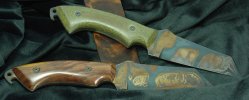
Let me start by saying this is not a blade we heat treated - but it is from a customer who uses essentially the same process we do. Lets start with a picture - post hardening - pre cryo.

Note the "snail trails". I have never seen this before BUT - this happens to him on different steel types such as 154 CM, ATS34, and in this picture on S30V. It is persistent in that if he finishes to 600 or 800 grit, it still shows in the right light.
He cleans his blade pre-HT - originally in acetone and more recently in soap and water - with no difference.
He uses a small scrap of brown paper (see near the butt of the handle mark)
He double wraps in the same 309 SS foil we use
He hardens at 1950F - 40 minutes - in the evenheat - plate quenches in the envelope to cool - and they come out like this. He follows with cryo in dry ice slurry and double temper to specs.
We are at the show in Kamloops BC and there are at least a couple other makers - respected makers - who say they get this all the time and just grind through it. We do well over 1000 blades a year and I have never seen this. here is the kicker - unique to this blade pictured. You can see some thumb ramp filework (gentle half rounds) and in the snail trail V in front of them, this blade has actually cracked. The crack seems to start about 3/32 in front of the last groove in the spine.
As I type this questions are coming to mind.
Thanks much
Rob!
Note the "snail trails". I have never seen this before BUT - this happens to him on different steel types such as 154 CM, ATS34, and in this picture on S30V. It is persistent in that if he finishes to 600 or 800 grit, it still shows in the right light.
He cleans his blade pre-HT - originally in acetone and more recently in soap and water - with no difference.
He uses a small scrap of brown paper (see near the butt of the handle mark)
He double wraps in the same 309 SS foil we use
He hardens at 1950F - 40 minutes - in the evenheat - plate quenches in the envelope to cool - and they come out like this. He follows with cryo in dry ice slurry and double temper to specs.
We are at the show in Kamloops BC and there are at least a couple other makers - respected makers - who say they get this all the time and just grind through it. We do well over 1000 blades a year and I have never seen this. here is the kicker - unique to this blade pictured. You can see some thumb ramp filework (gentle half rounds) and in the snail trail V in front of them, this blade has actually cracked. The crack seems to start about 3/32 in front of the last groove in the spine.
As I type this questions are coming to mind.
- What is he using for quench plates? Could the surface be uneven?
- How much pressure or weight is he using on the plates. (but there is clearly NO pressure on the bevels so...?)
Thanks much
Rob!