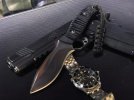
So here's my question about file knives...

Fletcher Knives

STEEL BREATHING BLADE MAESTRO
Moderator
Joined
Aug 30, 2007
Messages
5,483
Would you still have a good knife if your skipped the annealing and then re-heat treating process and just ground the sucker out?

I've made quite a few knife blades out of files just for practice and just cord-wrapped the handle. For the past couple of weeks, I've been carrying one of them around and using it just like my RC-4. It still has a great edge on it and doesn't seem to be suffering any ill effects from me beating the crap out of it.

So, then I question, "is it a good knife?" I know that it's ideal to have a slightly softer steel than the old crazy hard files for resharpening purposes and also to avoid chipping, but really, this is a pretty damn good knife. I haven't had it chip yet despite batonning it, prying with it, etc. and it's holding its edge REALLY well. Honestly, I think that, under normal use, these simple file blades I've ground out might just be good knives and last for a really long time. Am I wrong in thinking this?

I guess I'm just curious how important it is to make them soft and hard again (granted less hard) if you just want a good, inexpensive to you, fun to make, tough little knife. I know some people want it softer to work with for grinding and drilling to attach handles. I found that a dremel bit of the right size can drill through without having to soften the steel, if you go easy and take your time, so that solves the problem of being able to attach handle scales with pins.

What are you guys' thoughts? I'm sure similar questions have been raised before. Unfortunately the search function only works so well and you can't get this specific. I looked through several threads, but only found a bunch that explained how to anneal and harden, none that went along this thread's same lines.

Thanks in advance.
With the greatest humble respect for the information about to be bestowed upon my forehead,
Dylan
 
There are some folks who will put new/used files in the oven at 500 for an hour, then grind them from there. You can't let them get too hot grinding if you do it this way, but you can make good knife if you do it right. I make a few file knives, but I anneal, grind, HT, temper them.
 
Here is a post from a thread done in 05 that i saved.I too make file knives and have had good results using the info.
http://www.bladeforums.com/forums/showpost.php?p=3404412&postcount=82

That was easily the most useful thread I have ever read here. Thanks dude! That makes things A WHOLE LOT easier. I'll do this with a couple of the file blades and see how they turn out. I was under the impression that the only way to get them to the right hardness would be to anneal and then heat treat afterwards.
 
That was easily the most useful thread I have ever read here. Thanks dude! That makes things A WHOLE LOT easier. I'll do this with a couple of the file blades and see how they turn out. I was under the impression that the only way to get them to the right hardness would be to anneal and then heat treat afterwards.

Break a file and look at the grain. If it is a quality file such as Nicholson, you will find it wonderfully fine grained. And I agree that a temper at 450°, to 500° will give you a very good blade. Quite impressive in my opinion.
 
Break a file and look at the grain. If it is a quality file such as Nicholson, you will find it wonderfully fine grained. And I agree that a temper at 450°, to 500° will give you a very good blade. Quite impressive in my opinion.

Most of the files I use are Nicholson. They're great.
 
YVW. You might wan,t to read the whole thread theres some good stuff there.

I made my brother a hunting knife from a Nicholson he loves it ! And can.t get over how good it is compared to his store bought blades.

Goodluck,have lotsa FUN
 
I only have 10 knives under my belt to date. But better than half of them are files. I've had really good luck even in destruction tests. I'm going to try the method outlined in that post tho.
I usually do 500F x 2hrs. I typically hit the tang w/ a MAPP gas torch while the blade sits in cool water, go have a PB&J and come back to an easy to drill easy to tap tang to mount scales to.

this is my latest file blade.
 

Attachments

  • Technician small.jpg
    Technician small.jpg
    60.5 KB · Views: 77
I'm a little surprised you guys all temper at such high temps. I get a nice straw almost bronze color with 2 x 2hours at 375. I grind the edges very thin; they flex a little but don't chip. They stay sharp a long time. Maybe my oven is way off? That seems unlikely though since I've used two different ovens over the past couple years... BTW I use Nicholson files too usually, although I made one out of a Simmonds that worked good as well.
 
You may not be reaching full hardness in your quench.

I'm not quenching them, I'm using them as they were quenched and tempered when made, then tempering them back a bit more so they're not so brittle. Maybe that explains it. The broken new ones show a very fine even grain, at least as near as I can tell.

I can break a new file just by thumping it on the bench. After tempering and grinding as described above, I haven't been able to break any, not even smacking them on the vise or vising the first couple inches and pulling on them. I imagine if I used a cheater bar I could break one.

Not arguing with you, just trying to figure this out. If I'm doing something wrong I sure want to know.
 
I'm not quenching them, I'm using them as they were quenched and tempered when made, then tempering them back a bit more so they're not so brittle. Maybe that explains it. The broken new ones show a very fine even grain, at least as near as I can tell.

I can break a new file just by thumping it on the bench. After tempering and grinding as described above, I haven't been able to break any, not even smacking them on the vise or vising the first couple inches and pulling on them. I imagine if I used a cheater bar I could break one.

Not arguing with you, just trying to figure this out. If I'm doing something wrong I sure want to know.

I have been tempering mine the same way James, with the same results as you.
I havent put them to a real extreme test but so far the edge is holding up quite well.
 
Are you using your kitchen range? Do you use a separate oven thermometer if so? Depending on the intended use of a particular knife, 375° would normally be considered too low of a temp. For a razor, or maybe a scalpel, that may be OK, but for general use, that by all rights should be producing a brittle, to semi brittle edge, and be a tad hard to sharpen. If you are confident that your oven is giving you a true 375° temperature, I would suggest moving up to 425° at minimum, just to be on the safe side as far as edge strength. Kitchen ranges are notorious for being inaccurate, and usually to the hot side. My own kitchen range is almost 100° hotter than where the dial is set.
 
Kinda thought so. 375°, to 400°, is the recommended temper heat for a flintlock rifle frizzen, and that is pretty hard. A file will skate across it, leaving only the tiniest bit of a scratch.
 
Well, they're not that hard by any means, it's not difficult to grind, file or sand them after tempering like I described. I'm scratching my head wondering why all my pizzas don't come out burnt to a crisp, though :eek:
 
Cooking results may vary at higher altitudes:eek:...

I broke a file tanto temp'd @ 500F x 2 hrs. Real fine grain, tough to break.

Next time I hit the yardsales I'll pick up a couple of files and try at 375-500 see where the sweet spot is. Sarge's method might be a winner too. There has to be some kind of reasonable "acid-test" for file blades. Flex, memory, throwability, edge holding, ease of sharpening...etc. Since cutting is a result of geometry...we'll leave that to the individual maker. Any input ideas?
 
Thanks to Dylside and to everyone who contributed to this thread - I've been doing a some research 'cause I wanted to try to make a file knife and this has been very interesting and useful.
 
Back
Top