So, how hard are those big sawblades, anyway?

Joined
Nov 28, 1999
Messages
14,985
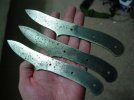
sawblade skinners 001.jpgReason I ask is, at a little Market Fair trade show yesterday, some old guy had some blade blanks for sale, cheap. He said they were waterjet cut out of an old sawblade. Already hardened, with holes waterjetted in, too. Just need to clean up the edges, grind the bevels, put handles on, etc... So, I bought 3 Semi Skinner style blades from him.

My question is; do I trust that they are decently hard enough to make a decent knife, or do I anneal them and requench them into some Parks AAA? They are maybe 1/8" thick(maybe), so I imagine I'd probably get some warpage and have to deal with a little decarb, if I did reheat treat them. They seem pretty hard right now; I mean, I can't bend them, as thin as they are, so...???

What Rockwell do they normally put these old sawblades into service at? If they're at least mid 50s, I might just leave them alone and use them as is.
 
Last edited:
Most the old saw blades were meant to be sharped with a file and they cut pretty easy with one. I'd anneal and re harden them.
 
If you have access to a rockwell tester that would be where I would start. If you don't send me one of the blades and I will check it and send it back to you. Try to file one, if you can cut it, anneal it and reharden it. But then you need to know what steel your dealing with to do a proper HT.
 
Unless he hardened and tempered them himself, I'd say chances are they aren't going to hold much of an edge. You could see how easily a file bites into them I suppose. Personally, I'd be leary of knives made from any mystery steel who's only classification was "old saw blade".
 
Well, I've got my answer now. I went to a friend's house and Rockwell tested these blades today. Random testing; a couple different spots on each blade, gave me results all over the place(none of those results, what I was looking for, either). The highest test was maybe 50, but most were mid 30s-40. So, it looks like I'll be annealing these and reheat treating them, when I get a chance.
__________________
 
There's no guarantee they'll ever get above 50Rc. They might be low-carbon steel that once had carbide or tool-steel tips on the teeth, when they used to be a saw blade. I imagine you could try to re-HT them like you normally would with 10XX and if that doesn't work, quench in a brine or "Super Quench" that is reputed to bring low/medium carbon steel up into the low 50's.

Either way, I sure hope they didn't cost much. To be totally honest, you'd likely be better off with a rusty old leaf spring or of course a bar of nice new 1084.
 
"Old Saw Blades" can mean anything from an antique saw mill blade to a flea market used Sears 10" miter saw blade. At 1/8" thick, I would guess the latter. Most likely they won't harden.
 
Danbo,

Since you don't really know what the stuff is.......... There is only one thing to do............ Play with them. Grind them and heat treat them like they were, perhaps 1080, or so. The main thing is to have fun and learn something. You will know if your experiments are worthy of trying to sell.

Many people are against using unknown steels, but it can sure be fun sometimes. Who knows, you might get lucky. It is a satisfying experience to make a knife from unknown steel, and have it turn out to make a heck-of-a knife.

Have fun my friend, and let us know the results.

Robert
 
Danbo,

Since you don't really know what the stuff is.......... There is only one thing to do............ Play with them. Grind them and heat treat them like they were, perhaps 1080, or so. The main thing is to have fun and learn something. You will know if your experiments are worthy of trying to sell.

Many people are against using unknown steels, but it can sure be fun sometimes. Who knows, you might get lucky. It is a satisfying experience to make a knife from unknown steel, and have it turn out to make a heck-of-a knife.

Have fun my friend, and let us know the results.

Robert

Will do. I'm going to anneal them, make the rear hole bigger to accomodate a thong tube, and then reheat treat them as I would a 1084/15N20 blade. As these are pretty thin right now, I'll do the bevel grinding after heat treat. Will be quenching into the Park's 50, of course. Will update, once I finish.
 
I used up a 3 or 4 foot circular blade that somebody gave me, practicing grinds and learning how to work up a nice pattern.

Ditto what everyone said about the unknown factor: making a good knife is a lot of work!
Using good, known steel is a very small price to pay to have a blade you can guarantee.
I pretty much present those knives like the railroad spike knives: if you do everything right, you still might or might not have a useful blade, but there's a Cool Factor for a lot of folks in the story of where it came from.

That said, though I lack a Rc tester, many of those blades are in use by friends and relatives, and I get good performance reports- I treated it as if it was 1084, and it seems to have worked. "Just lucky I guess"

Andy G.
 
Will do. I'm going to anneal them, make the rear hole bigger to accomodate a thong tube, and then reheat treat them as I would a 1084/15N20 blade. As these are pretty thin right now, I'll do the bevel grinding after heat treat. Will be quenching into the Park's 50, of course. Will update, once I finish.

I'm made many blades from old saw steel and don't recall any not hardening up in oil. I've always enjoyed using old saw steel.
 
Iv'e been making knives from 3' sawblades for about 10 years. Bought a couple dozen from a guy who had a fence made of them. They were tipped, but tough as heck and take a cobalt drill to drill. Rockwell 59. Great reports from mostly Hunters. Just my experience. My advice is don't buy them. Leave them for me:D
 
Last edited by a moderator:
Edited by Moderator

Razor's Edge - Please post this request in the Exchange " Knifemaker Services Wanted - Thanks".
 
Last edited by a moderator:
Back
Top