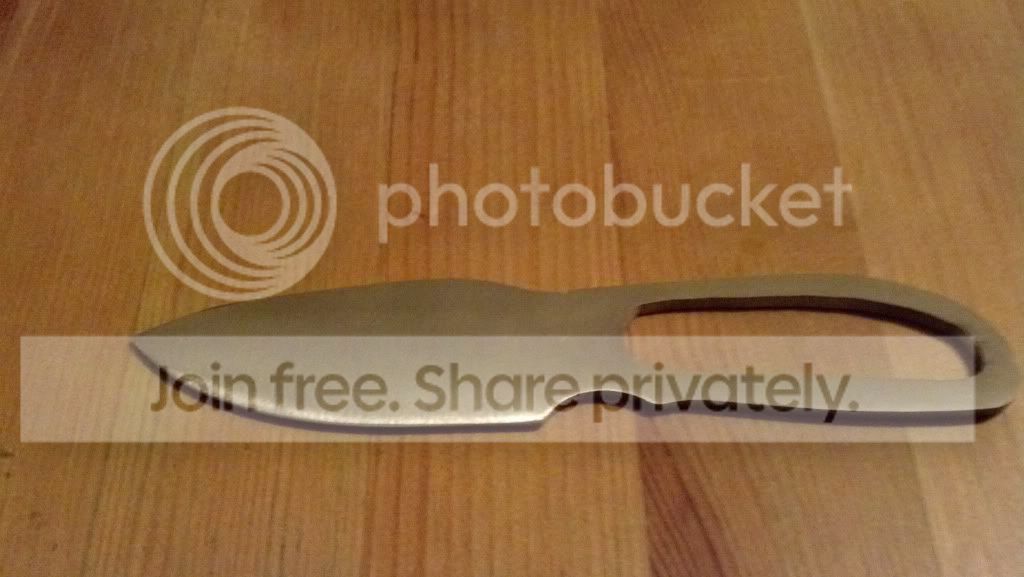
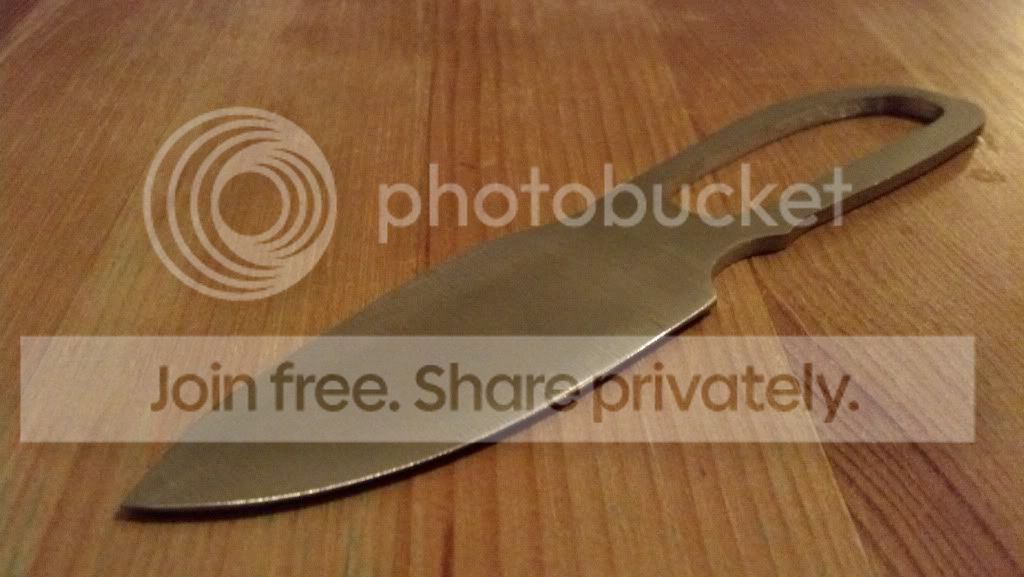
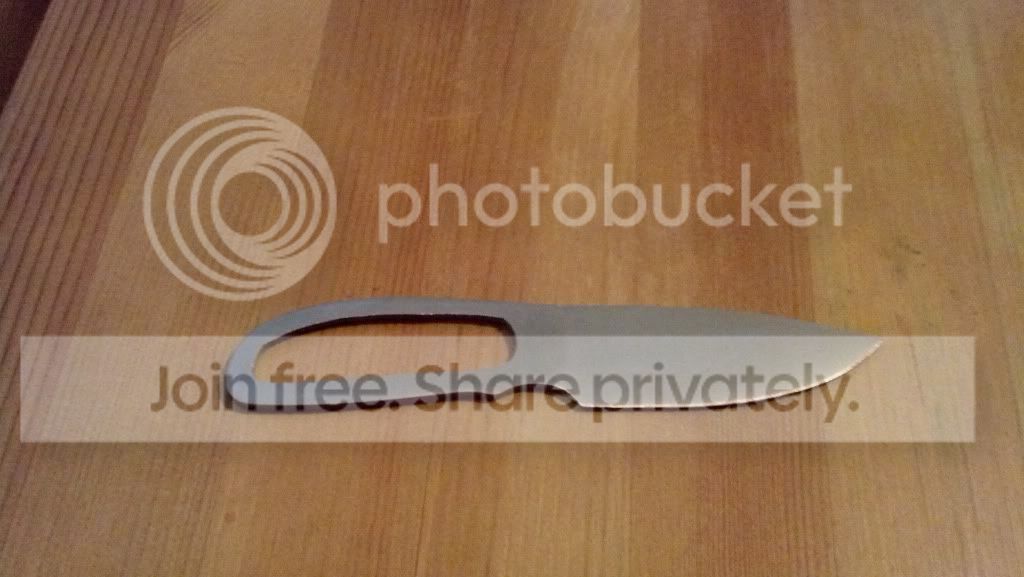
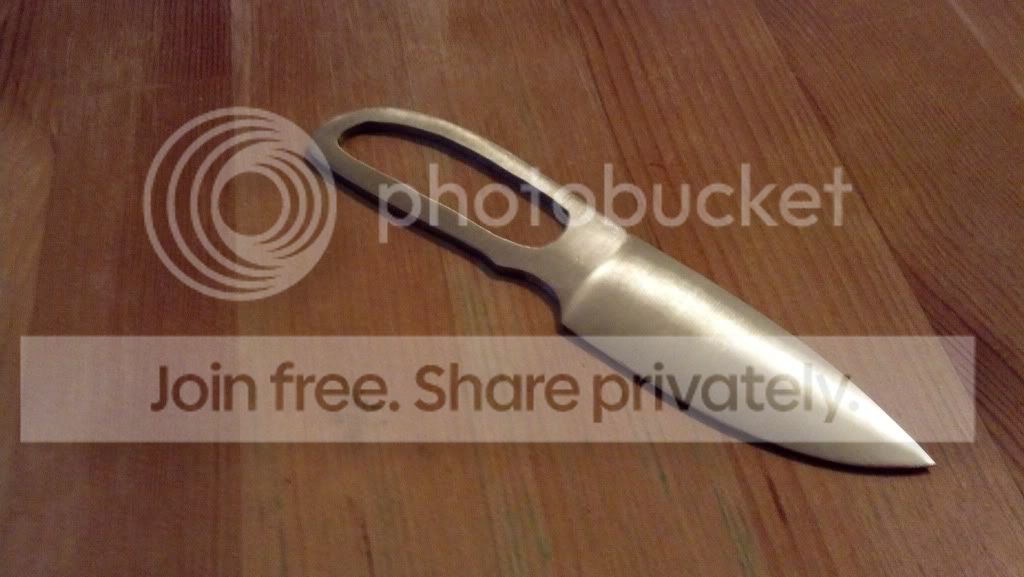
so proud of this beauty please check it out and tell me what you think

Joined
Aug 28, 2012
Messages
150
IMG_20130601_232602_885_zps827b4565.jpg


IMG_20130601_232622_882_zps50b8e0b9.jpg


I am amazed at how this turned out. At this stage, It isn't heat treated yet and as it is my first knife I'm looking for someone to heat treat this single piece but not sure who/where. What do people think of it? Where is the best place for single piece heat treats of 1095?
 
You have put a lot of effort and time into what you have done - so far. There isn't any blade grinds. The blade is too thick as it is to work well. Frank.
 
I remember his WIP thread, think I just posted there... There is a grind, just no plunge so it is hard to tell...
I will stick with my reply there, skeletonized knives aren't my thing, but to each their own... I think they sacrifice strength in an attempt to save a minimal amount of weight on something that it doesn't really matter. In the future, you may want to try less skeletonizing, and leaving a plunge. It really serves to show off the grind and add some dimension to the knife. The blade is still a little too fat IMHO, even with the grind you do have. I would also leave some verticals in the future if you are going to skeletonize. You can still cord wrap, or scale, or what have you even with the uprights but it will allow you to have more strength in the knife.
A lot of work in that one, be proud. A lot of people give up and never make it this far. Keep at it and they will only get better and better. Looks good even if its not my cup of tea...
 
looks like it is still 1/8 inch thick 1/8-1/4 inch from the edge meaning your edge will be blunt. Try to file a flat bevel extending from the edge (leave the thickness of a dime to prevent edge warping during heat treat) to 1/8 of an inch thickness 3/4 to 1 inch up from the edge

-Page
 
You have done a lot of work on that bar of steel you started with. The work so far seems to be coming out as you planned it. Darren Sanders would be a good person to do the HT, unless you connect with a local Florida maker who might invite you over to his shop to do the HT.

Some suggestions for this and future projects:

You are using only rudimentary tools. That's OK, but two are really poor for knives - the bench grinder and the Dremel. Bench grinders should only be used to profile the shape, and Dremels only used to smooth out edges and inside cuts ( like in your handle cut-out). All the other tasks are best done with files and sandpaper until you get a belt grinder. Use a block of wood to back the sandpaper. Don't just fold it up and use your fingers.

The plunge line is not a necessity for the knife to cut well, but is a good thing to learn to do. It can be subtly rounded, curved, or sharply straight....but it should be there to some degree. It not only makes the blade look cleaner, it delineated where the angled blade edge ends and where the flat ricasso and handle start. If you just sand the blade bevels into the handle, the front of any scales will often not sit flush. This won't matter in the paracord handle you plan on making here, but is a flaw in a knife with scales. All of this aids in clean and flat lines. The next two suggestions are part of this "clean look".

Try and make the bevels as flat as possible. The knife now has slightly rounded "convex" bevels. It will cut fine, and look OK, but the difference in a dead flat bevel will be a big increase in the looks department. It will also cut slightly better. There are knives where a convex bevel are desirable, but a small blade like this looks and works best with flat bevels. Also, the current blade still has a lot of sanding to go before HT. It should be at 400 grit and totally smooth. There should be no file or grinding marks left. If they aren't gone before HT, they will never be gone. After HT, you go back to 220 grit and start over, sanding the entire blade smooth, and going up the grits to whatever finish you want. Most stop at around 800-1000 grit, but you can go as high as you wish.

While that dip in the top has a purpose in your plan, it is not aesthetically pleasing. Making the top a continuous curve from butt to tip will be much easier on the eye. Try tracing this blade, and then erasing the dip out and making it a smooth curve.....how does that look? Remember, your thumb will sit on whatever surface is there...it does not need a hollow spot. If you wish some traction, file work the top of the spine. This will add to the looks, too.

If you are going to use paracord for the handle wrap, that is fine. However, the edges of the tang should be slightly rounded, or filed at 45° bevels to knock off the sharp edge. You can carry that effect down the spine to the tip for a look of continuity.

Plan the paracord wrap well. Don't just loop a length around the handle and call it a knife. You will have spent too much time working on this knife to have it look cheap and sloppy because you were in a hurry to put on the paracord. There are tons of paracord wrap tutorials online that will help you make a great handle. Finish with a 3-4" tail lanyard ending in a little woggle knot or bead on the end. That makes the knife easy to pull out of a full pouch sheath ( which you should also make for the knife). If there is a bad spot in the wrap, or you don't totally like it, just take it off and use a new piece of cord to try again. If it takes ten tries and 50 feet of paracord - so what. It will end in a really nice looking handle.
Once the wrap is done, and you have decided you like it. Use some thin and clear epoxy resin ( clear coat or bar top) and a small brush to paint the cord with just enough resin to soak in. It takes very little. Wrap a lint free cotton rag around the handle and give it a squeeze to remove any excess resin. The cord may not look like there is any resin on/in it, but when the resin cures, the cord will be rock solid. Use acetone to wipe away any place where the resin gets on the blade. Put the blade in a vise or clamp with the handle sticking out while the resin cures. Turn the blade every few minutes to prevent any epoxy from pooling or dripping. Wipe/blot off any drips while still runny, but don't touch it after the resin starts to gel. Experiment on some scarp cord wrapped around a bar of steel to get this down right before doing the actual handle.

 
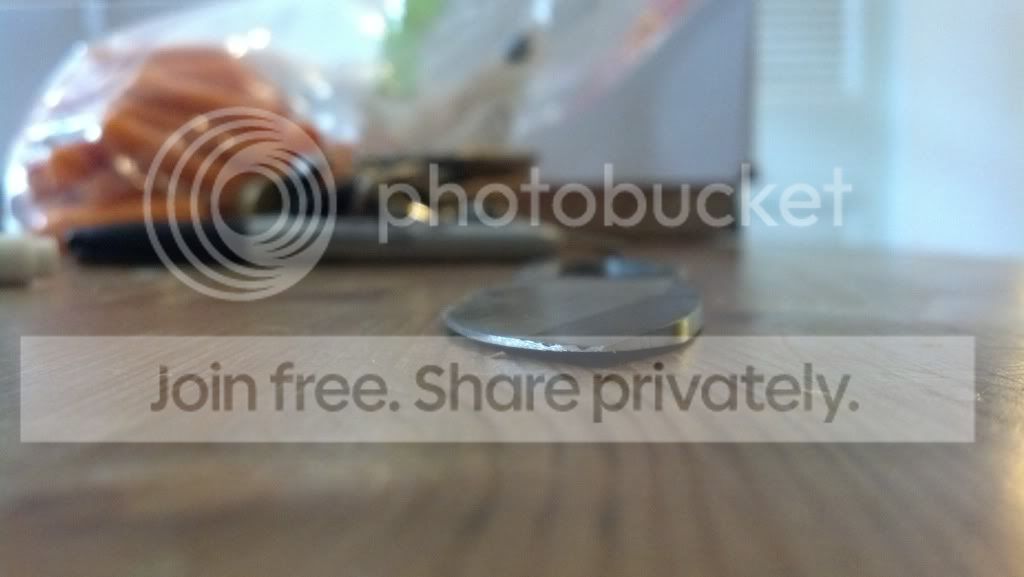
Stacy may have addressed it and I missed it, but it also looks like you have an edge on it already. If so, knock it down. It shouldn't be thinner than about a 1/3-1/4 dime. The heat treat can cause excessively thin areas to crack. Also consider just treating the blade or drawing it back pretty far. The thin tang will be brittle if left too near full hard.
 
Eric, the tang will be fine fully hardened at the same Rc as the blade. People seem to think hardened martensite is brittle stuff, but if properly tempered it is tough as heck. On your "shark" knife, you said you were going to over harden the tail so it would break instead of bend and trap a finger. That tail would be better if drawn back to the low to mid Rc50s where it would yield just a tad if struck hard, but never bend and trap your finger. It would break if taken beyond the elastic limit.
 
Thanks for the input guys a lot of this stuff I think I already knew. but in my haste to finish my brain tells me the blade looks finished. I'm gonna thin it out and remove some or all of that bump I got a 1x30 belt sander so that should speed things up a bit will post new pics this afternoon

Thanks again for the input
 
You could always plasti-dip (or better yet rough truck bed liner)the handles.i think I've seen some Johnson adventure knives like that.
 
Nice progress!

On my first knife a few years ago I did something similar (all files) with the skeletonized handles. After heat treating there was a bend where the material was too thin in the handle, and while trying to straighten, it broke. Now that being said I had a buddy who works at a braising company do the HT, and while a professional, they don't do knives, so it wasn't clamped. After that I did everything full tang w/o wasting time on skeletonizing.

Agreed on putting in a nice pluge, it's want shows off the blade grind. Don't be in a rush and take your time. This is the time to learn.. and each knife you learn more and more. I know when I rush, I mess up. So be patient. If you are getting tired, put it down an come back later when fresh.

Keep it up brother!
 
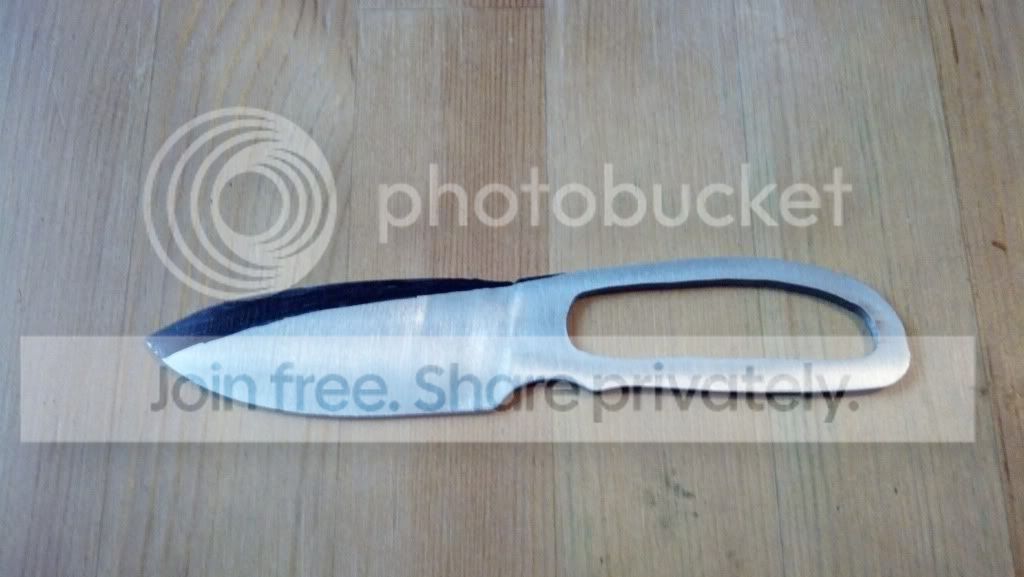
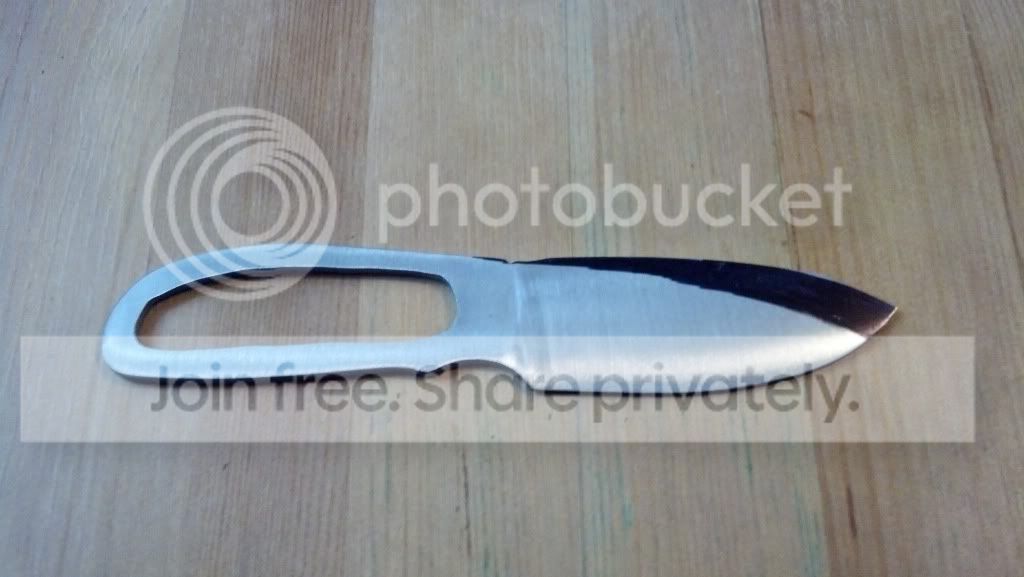
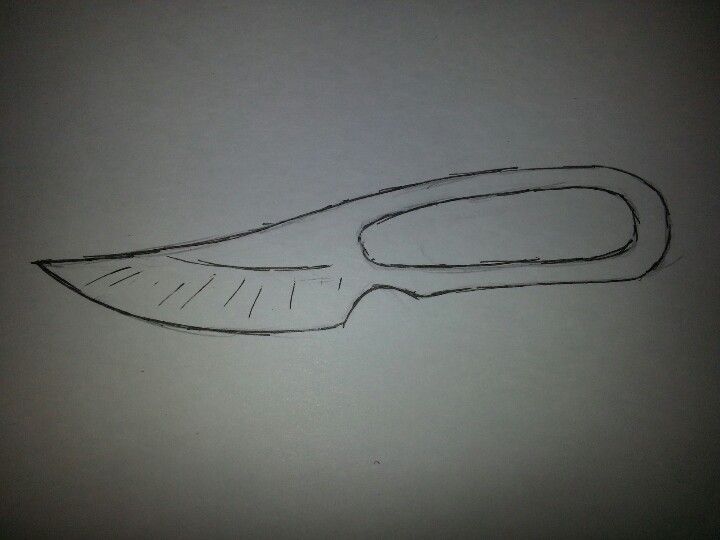
OK here is the blade thinned and a little bit re-profiled I have drawn to potential new profiles for the blade, one on each side and kinda want some opinions before I drastically re-profile the blade. I decided on this for 2 reasons first I agree with bladesmth that a smooth line on the top is much better aesthetically and second I realized thus will make it drastically easier to achieve the thin blade that I know will be a better cutter. So which looks better the longer one or the shorter one?


IMG_20130602_144729_477_zpscd1d6b07.jpg


IMG_20130602_144747_147_zps52c71491.jpg

IMG_20130602_144922_475_zps9765d489.jpg
 
Eric, the tang will be fine fully hardened at the same Rc as the blade. People seem to think hardened martensite is brittle stuff, but if properly tempered it is tough as heck. On your "shark" knife, you said you were going to over harden the tail so it would break instead of bend and trap a finger. That tail would be better if drawn back to the low to mid Rc50s where it would yield just a tad if struck hard, but never bend and trap your finger. It would break if taken beyond the elastic limit.

Gotcha. We actually did destructive testing and just confirmed exactly what you said about the tail. It was hardened and drawn back, and it did bend a little but did actually snap prior to the point a finger would be trapped.
As I told him, skeletonized knives aren't my thing, and they always look weak to me... but that said I have been pleasantly surprised how far I was able to push the thinner sections of the shark knife when properly drawn. Your experience and knowledge pool is far deeper than mine, so I defer to you. I know when I started out I wasn't researching properly and not involved with a mentor so I tried to HT crazy hard and didn't draw back far enough. In thd end I had a few snap. Now I know better!!!
 
And I second that, I like number 1 also. Even though I know its not the case, number two has the appearance of a repaired knife to me. One that had a tip failure and was reground...

I just happened to have a pencil in my hand while looking at that, and drew it with a nearly Shrade Sharpfinger blade... (what is called a trailing point) and thought it looked pretty sweet. If I get a minute I will post up that sketch... You could keep the tip and overall length that way...
 
MUCH better. #1 is a big improvement. That will be a really sweet knife ( did I just say "sweet knife"???....I must be spending too much time online :) )
 
Forgive the crude drawing. Fast and dirty... I like the nice long curves and it preserves the length..
ab99f056cfc990f9c5d5fabdce72b965.jpg
 
Last edited:
OK here it is with all advise applied except the finer sanding. But I'm gonna order some finer belts I think. Unless people think this finish won't affect its utility in which case I was considering leaving it in this state. (120 grit belt)
IMG_20130602_200654_878_zps666434fa.jpg

IMG_20130602_200726_520_zpsbea11445.jpg
 
I commend you for taking the advice that was given. This blade is really looking nice.
 
Back
Top