So what's this superquench I keep reading about?

That is a good thing.

Superquench is a concoction of various odds and ends that a well known maker came up with many years ago to harden things that did not have enough carbon to make a good knife. The theory was that it would quench so fast that it would make the steel harder. Metallurgy says differently, and the availability of quality quenchants and quality knife steels has negated the need to try.

I would not bother looking any farther into it. A couple gallons of Parks #50 and a couple gallons of medium speed quench oil will take care of all your needs for many years and thousands of blades.
 
A super fast quenchant. So fast it can be used to harden mild steel up to about 0.4 % carbon. Not for knife steel.

5 gallons water
5 lbs salt
28oz bottle of Dawn blue dish washing detergent
8oz bottle of JetDry or other rinse aid.

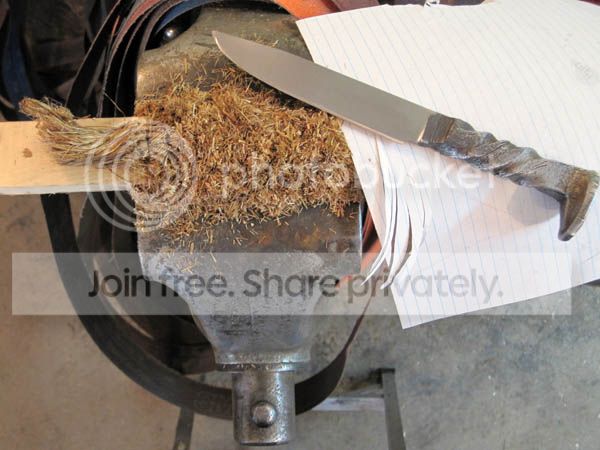
After quenching a railroad spike knife I was able to easily make 50 cuts of 1/2" hemp rope, and still slice paper (though with a little drag)

IMG_0124_small.jpg
 
Last edited:
It is essentially brine with dish soap. Nothing super about it... aside from the metallurgical misinformation and exaggerated claims.

I use brine to quench low carbon hammer heads and hardy tools.
 
In my answer, I was sort of melding superquench with G****d's goop. The goop is just as useless for normal knife steels, IMHO.
 
Basically it's just an extremely fast quench then? To which "magical" properties have been attributed that probably do not exist in the real world.
 
It is essentially brine with dish soap. Nothing super about it... aside from the metallurgical misinformation and exaggerated claims.

I use brine to quench low carbon hammer heads and hardy tools.

Rick, toss in some surfactant, you will be surprised. Once again, lets say it again - This is not for quenching knives.
I also stand by my personal results, which started out with a lot of skepticism of others claims.
 
Basically it's just an extremely fast quench then? To which "magical" properties have been attributed that probably do not exist in the real world.

Yup! Nothing magical about it. Just plain old boring science. It transfers heat very quickly. Way too quickly for alloys with more than a 1/2 % of carbon.

As said before, it's just brine with surfactants, developed specifically for helping a person get the most hardness out of low-carbon steel like RR spikes and old horseshoes... reportedly up into the high 40's on the Rockwell C scale.

Is that enough hardness for what I consider a proper knife? Hell no, not even close. But there's a market out there for knives made of that sort of thing, so if a maker wants to go that route they may as well harden 'em as much as possible. They'll cut... but not for long.

If you try to harden proper high-carbon cutlery steels in SuperQuench... I'm pretty sure you're just gonna shatter 'em.

On a sort of related note, a blacksmith I once visited told me a story about a 5-gal bucket of homemade SuperQuench getting broke open/spilled in the back of his pickup, along with a couple hundred pounds of steel... he didn't notice right away... it rusted the ever-lovin' snot out his truck bed and all his steel overnight... :D
 
Last edited:
For a RR spike or a lawn mower blade, it is fine. Above those carbon percentages, it is likely to crack/break a blade.

I find plain brine at 120F does fine. I agree that a little washing soda ( softener) and some dish soap (surfactant) will help with the speed.
 
I used my brine bucket(it has a little dish soap and soda in it) to quench rebar. I had made some musical instruments out of it. They cracked in many places. You have to know your steel if you are planning to use a fast quenchant.

RR spikes vary quite a bit in carbon content. Yes, even the ones marked "HC" can range between .20-.40%. When .05 can make a difference, you would almost have to get spectral analysis done on each spike to do any conclusive testing.


Rick Says: (I used my brine bucket(it has a little dish soap and soda in it) to quench rebar. I had made some musical instruments out of it. They cracked in many places. You have to know your steel if you are planning to use a fast quenchant.

RR spikes vary quite a bit in carbon content. Yes, even the ones marked "HC" can range between .20-.40%. When .05 can make a difference, you would almost have to get spectral analysis done on each spike to do any conclusive testing.)

You are right! A lot of work for a novelty item. It's funny though how often this comes up. Now, back to knives.
 
Back
Top