Softness of 12c27

Joined
Jun 16, 2007
Messages
301
Hi guys,

I bought a Tramontina kitchen knife made of 12c27 HT to 56 RC.(according to them) I got it to use and see how I like the 12c27 for use in future knives. It is not mirror polished, but has visible grind lines from the spine to the edge.

The back of the spine was a little rough ground so I got a bit of fine abrasive paper to smooth it down. As i was sanding, my fingernail was sliding along the side of the knife, and afterward I noticed a mark that had sort of been scratched/rubbed along the length of the blade from my fingernail. I can wipe/rub this marking away byrubbing along the grind lines either.

Can anyone who has used 12c27 before advise me: is it really this soft or would you reckon its just due to my fingernail 'scratching' perpendicular to the grind lines?

Thanks
Lang
 
Maybe your fingernail was contaminated with some abrasive from the sanding paper. Or maybe you have diamond nails you didn't know for.;) There is no way your fingernali to scratch any kind of steel.
 
I have a Bark River Nebula in 12C27 and no problems; the HT is excellent...I really like this steel. (for stainless, anyways) :thumbup:
 
If I recall correctly, Frosts/MoS use 12c27 in their stainless blades. My big chef's knife from them takes and holds an excellent edge. At a claimed 58 HRC, I've found no problems with softness here.

Edit:Ragnar's is where I read the 12c27 thing.
 
I have used 12c27 almost daily for about a year and a half with no problems.

It is a steel i use a lot for making knives. It sound strange that you would be able to scratch the blade with only your finger nails, even in a annealed state this would be difficult. Could you post a pics for us?
 
I own 1 knife in 12c27.
It is soft--It became noticeably dull after a very little use.
Probably inadequate HT.
 
I made a buch of knives for hunting use out of 12C27. They were all heat treated in a vacuum chamber an free ttreated. They were very fine cutters though they did not have quite the edge holding ability as 440-C. Frank
 
Thanks for the views guys. I am thinking it could be to do with the grind lines. My unsubstantiated theory being that those grind lines are akin to millions of very thin blade edges side by side, so on a microscopic scale it would look something like corrugated iron, possibly with sharper peaks. (maybe my analogy is laughable!) The fingernail was possibly able to push over those peaks leaving a pattern?

Ok extravagant theories aside, knifemaniac, I think you probably are 100% correct... The abrasive paper wore smooth quickly, and that grit had to go somewhere... probably under my fingernail.. Thanks for the insight.

I will try post a pick but I think the marks will be too faint to show on my camera.

Does anyone know Tramontina? Brazilian... are they 'decent', and a reasonable benchmark for me to look at as a comparative?


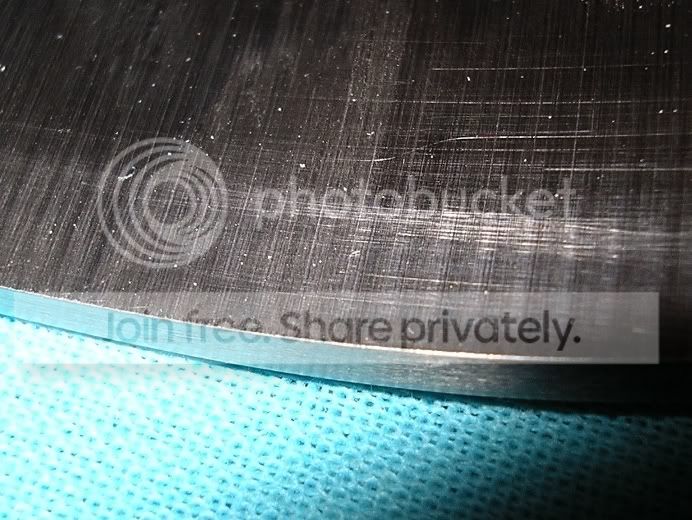
tramontinascratches.jpg

picture shows blade grind direction and longitudinal 'scratch' marks
 
I have some inexpensive Tramontina knives as well as high end Japanese knives costing 10 times as much, I would say that in terms of blade geometry and grinding, the Tramontina knives are similar to knives costing much more, the only difference is the less expensive steel which is heat treated to a lesser hardness. However, the blades are just as thin as the Japanese knives, with proper distal taper and precise grinding. So for the workmanship you get, the Tramontina are a far better deal than any comparable knives until you get to a much higher price range.

The customary German cutlery with full bolsters tend to be thicker ground blades of softer (RC 56) steel, whereas the Japanese cutlery which is all the rage now days are made from hard steel (RC 60+) ground very thin. This results in greater sharpness and edge holding, but due to the higher hardness the edges wear by chipping instead of rolling. That's why German knives can be touched up with a steel, but Japanese knives need to be resharpened on stones when they get dull.

The Tramontina knives I would say are ground as thin as a Japanese knife, but made of the softer RC56 stainless steel. Theoretically, the softer steel might not hold up as well when sharpened to a super sharp, thin edge. So it depends how steep of an angle you sharpen your knives at. If you experience rolling and dulling with low angles, try putting a microbevel on the edge to see if that helps.

Tramontina is a huge manufacturer of kitchen equipment, expensive stainless pots and pans, knives are only a minor thing for them. I really don't think they try to compete much with the major knife manufacturers, that's why their knives seem to occupy a lower price niche here. They make many different lines of kitchen knives, most of which do not seem to be available in this country. Here I have only seen a couple of different lines available, particularly the cheap junky low $ ones. Not a good representation of their products, so keep in mind that you get what you pay for, they offer a low end and some better quality lines of kitchen knives, if you can find them. The most difficult part is finding their knives at all!
 
Thanks for the insight olpap.

This post is from quite a while back and I have since found the knives pretty decent so am quite happy with the grade of steel to use for my own future knives. I reground a 20 deg angle (looked close to the factory angle) on my knife and its performed exceptionally well since.

I have only seen Tramontinas one range of knives which seem probably sort of upper mid range. Wow didnt know they made pots as well. I have seen their outdoor machetes which are very low grade. Tramontina is probably the best knives we would get in general supermarket stores here compared to the real cruddy 'Prestige' products that are quite widespread. The better stuff is in the more elite shops.

Thanks for the info

Lang
 
I just bought 2 Tramontina Kitchen knives, a 10 inch blade general knife and an 8 inch boning knife.
They are from 12c27 and seem like reasonable knives for $30 bucks a pair
 
I like my Tramontina kitchen knives, but I couldn't find any specific info on the steel they used. Danno, how did you know that it was 12C27? It's just a coincidence that I've been looking for a Frosts kitchen knife in 12C27, after reading a bunch of posts saying that 12C27 is a great steel for kitchen knives.

Regarding the low end Tramontina machetes, the edges are thin and the carbon steel is a bit soft, so they will dent and or chip easily, however they also out-cut any other readily available store-bought machete, I love them so much I almost have one of each model. I dont' care about the dents, the only machetes I have that are better are an Igorot pinahig and my Valiant goloks, which cost a lot more.
 
That is great info to know, I bet they would sell a lot more of those knives if they DID mark them as 12C27!
 
The one I bought was a chefs butcher knife that came in a sealed plastic pre-pack with the little cardboard leaflet inside: some special antibacterial stuff in the white plastic handle and for the steel it specifies Sandvik 12C27 or Krupps 1.4(something or other) hardened to 56 Rc. I think the types are probably pretty close equivalents to each other and they select whichever one based on supply/availability. They seem to make the vast majority of their knives from these steels.

I think most other their target market would not know the difference between 12C27 and ABC123, and hence the lack of signage on the blade steel.

You are right olpappy.. I suppose I wasnt judging the machetes in relation to other machetes on the market, just looking at the grade of steel. I suppose in relative terms its not a bad machete.

Lang
 
Back
Top