Solid steel knife

Joined
Jul 1, 2009
Messages
13
Has anyone ever machined a knife from solid steel? I think it would be a very strong knife. To bad I dont have a milling machine.

 
Many makers machine the knife from a bar of steel. With modern CAD systems, it can provide a very close tolerance blank. Many ( most?) integral knives are done this way. Edmund Davidson does his pieces this way, and has a book on the process and his knives.
Stacy
 
To bad I dont have a milling machine.

You don't need a milling machine.
These were all forged from either round bar or flat bar.
Just need a hammer and an anvil.
W2andcordwrap.jpg


military-03.jpg


petitnouveauweb2.jpg


stamp.jpg


hunter-024.jpg
 
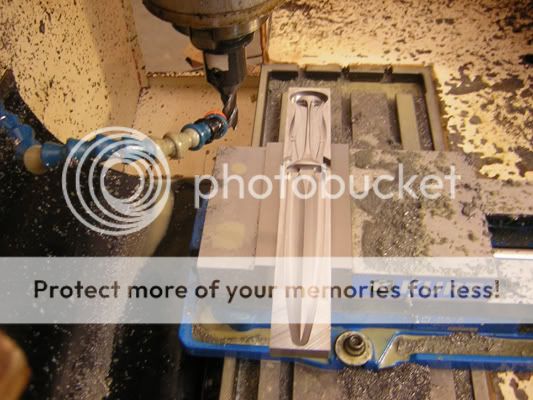
I happen to be working on a dagger milled from solid steel right now.

milled_dagger_project.jpg


As you can see, I won't be leaving the handle solid steel, because it would mess up the balance of the knife.

One advantage of using CAD to design a knife is you can evaluate the effect of tapers, grind depth and pommel size on balance. After applying scales, this one will balance on the guard because that is where I wanted it to balance.
 
Nathan, Very cool!

metalmeltr, You don't need a mill....you can do it all with hand files.
Rodrigo Sfredo(spl?) made an intragal dagger for his Masters and from what I heard he did the whole thing with files.
Mace
 
metalmeltr, You don't need a mill....you can do it all with hand files.
Rodrigo Sfredo(spl?) made an intragal dagger for his Masters and from what I heard he did the whole thing with files.
Mace

That is downright scary!
 
Some more pictures would be really cool Nathan. That one hints at a lot
of goodness.
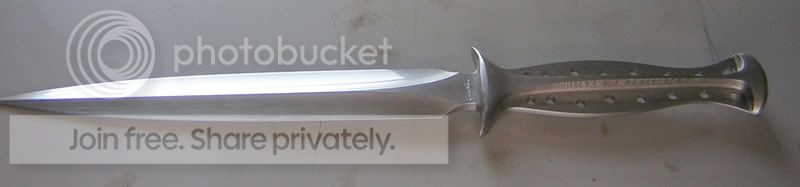
Yeah, I think it is going to be pretty cool when I get it done.

stats:
About 11 1/2" inches total length, .200" thick at the ricasso. Distal taper, tapered tang and center rib in the handle with integral guard and pommel. The blade has a pronounced center ridge due to the rather severe 2 1/2" hollow grind ("grind" is a bit of a misnomer here). Currently just under 5 ounces and will balance at the guard.

It is still pretty rough.

rough_dagger.jpg


I work on it when I can, 30 min here and there. Our own David Wesner (our in-house veteran moldmaker and twice the metal worker I'll ever be) has been kind enough to help me with my manual stoning process. I had the chance to spend several hours on it this last weekend, I'm currently close to 20 hours total (over six just stoning) and I haven't even started scales.

I'm about to need to start some skinning knives for the upcoming season, so it may stay in this state for a while.

Thanks ya'll for the kind words.
 
It occurs to me that a person could make an integral knife out of round stock by bandsawing the "waste" material off, and then grinding the bevels, etc. That way you would have chunks of scrap that are recyclable instead of a pile of chips/dust. You could set the "plunges" between guard/blade and guard/handle with a drill press if you started with large enough round so you could flatten it off for a nice drilling surface... even a rear bolster could be built this way. Is this feasible? I'm just curious and thinking out loud.

Making an integral with only files... good golly, that fellow must have bionic elbows!
 
Wow, Karl and Nathan, Those are some great examples of integrals.
I have been doing round bar integrals lately,might have to try the flat stock method too :thumbup: Thanks for the break down !
 
Nathan, Very cool!

metalmeltr, You don't need a mill....you can do it all with hand files.
Rodrigo Sfredo(spl?) made an intragal dagger for his Masters and from what I heard he did the whole thing with files.
Mace

He must have forged it out and then cleaned it up with files :eek:
 
I don't have a photo of it, but i did an integral sashimi knife from W-1 round bar. It was 1" round. I drew out the blade by forging it, then roughly forged down the tang between the front and rear bolsters. I then made cuts with the band saw at the places where the scales would sit between the bolsters. I ground the excess away on a grinding wheel, and finished with files. The result looked a lot like it was milled, but was all done by hand. It was not worth all the time spent just to get an integral rear bolster, so I don't do it anymore. I still forge them with integral front bolsters all the time. 1" round will make a great deba blade.

Stacy
 
I happen to be working on a dagger milled from solid steel right now.

As you can see, I won't be leaving the handle solid steel, because it would mess up the balance of the knife.

One advantage of using CAD to design a knife is you can evaluate the effect of tapers, grind depth and pommel size on balance. After applying scales, this one will balance on the guard because that is where I wanted it to balance.

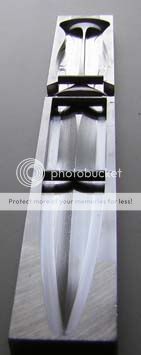
Just curious- I'm not much of a machinist- but how do you clamp the knife when you machine its other side?
 
Just curious- I'm not much of a machinist- but how do you clamp the knife when you machine its other side?

That is an excellent question, and not totally obvious, I'm impressed you picked up upon the need to do something.

weld.jpg


In order to have something to clamp against, I bridged over the dagger in the finished area with a few bars before starting side two. Had I been feeling ballsy I may have just left them as you see pictured and counted on the clamping to hold them in place, but I also added a few small tack welds.

I ordered the operations to keep a web of steel around the knife until the very end, at which point everything was being held in place by little more than wishful thinking. The last few cuts were pretty light.

edit: the welds were not to the knife.
 
This one was made using a mill, (but only as a drill press) and a belt grinder. It has a 4 1/4" blade of D2 steel, stag handles with black liners, stainless bolts, and tapered tang. It is something you need to really want to do though because it makes a lot of dust.
369058137.jpg
 
That is an excellent question, and not totally obvious, I'm impressed you picked up upon the need to do something.

weld.jpg


In order to have something to clamp against, I bridged over the dagger in the finished area with a few bars before starting side two. Had I been feeling ballsy I may have just left them as you see pictured and counted on the clamping to hold them in place, but I also added a few small tack welds.

I ordered the operations to keep a web of steel around the knife until the very end, at which point everything was being held in place by little more than wishful thinking. The last few cuts were pretty light.

edit: the welds were not to the knife.

Thanks for the response- I really appreciate it. I was checking out this site looking to learn something/read reviews while knife shopping, and never really had any intention of posting (I'm not really a huge knife guy). But I guess I tend to get carried away browsing- and your work just blew my mind and it got me curious how you managed to do it. I've had a little experience in a machine shop for some specific applications, but I've never had a chance to do anything so complex- not to mention the 2.5 axis CNC mill I've used becomes somewhat feeble-minded beyond 2-axis mode, and requires an inordinate amount of coaxing to properly execute a complex CAM program...
 
Back
Top