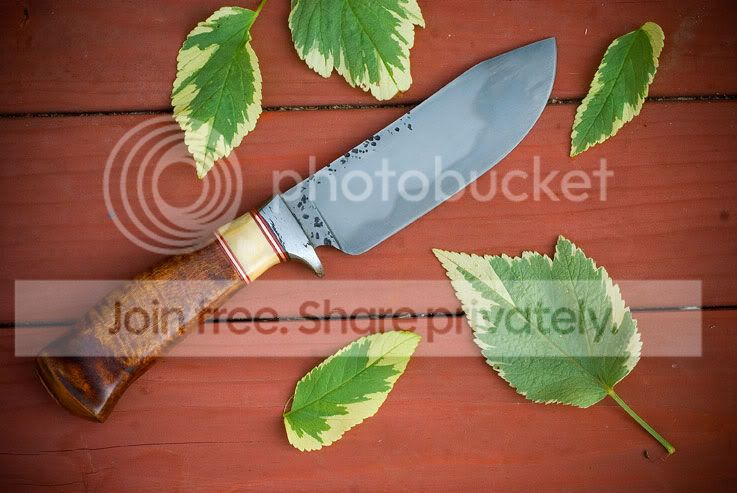
some hamon polishing insight

Good stuff, Nick! Just shows that knifemaking can be as simple or as deep as you want to make it. Thanks for taking the time to share!!
 
Nick, what kind of advice can you give for a first time hamon'er'.
.

Allden and I just attempted a hamon on my first knife today. We used satanite, I got about 1/10 of inch thickness. We put it in the toaster oven at about 180 degrees to speed up the drying. Got the blade to nonmagnetic and quenched in room temp mineral oil. Now there is almost like a new layer of mill scaling, very very tough, where the satanite was. Is that normal? If not, how can that be prevented? Sorry to turn this into a Q&A, but obviously you're an expert in this area.
 
HaHa! I'm not an expert in anything other than non-finished projects! :eek: :foot:

Sounds like you're off to a good start to me. Thin clay is key. I see a lot of posts where folks are putting the clay on 1/4" thick. I think for most knives, even 1/8" is too thick. I put a body of clay about 1/16" thick on.... and then thin the clay a little before applying the ashi lines.

The toaster over would work fine, but you can just take a propane torch and cook the clay. No worries about screwing anything up, because you're just cooking the water off. It will look like you browned it over the roaster when you're done. ;)

You can certainly do this stuff in a forge... but a controlled temp source makes it easier to monitor what works and what doesn't. Now that my Paragon kiln is working like it's supposed to, I love it for the austenitizing. This blade was soaked at 1450 for 5 minutes and quenched edge first (full quench though) in a very large, horizontal tank.

I like to take the blades down thin, as some of this stuff seems to be a bit of a surface phenomena.... the main line goes all the way through, but even that is different from side to side. I've had blades with crazy activity that I basically ground away.

I have very little scale after quenching, so it's hard for me to say on that. I scrape the clay off, wipe it with a rag, and run to the grinder and make a quick pass to look for the hamon. If it's something cool looking, I throw it in the tempering oven. If not, I start over.

You can waste A TON of time by going through the tempering process only to find out later that it didn't produce what you wanted. IMO. :)


Hope this helps a little! :)

There are guys like Don Hanson and Burt Foster that are a hell of a lot better at it than I am!!!
 
Hi Nick, So do i understand it right that vinegar or lemon juice still etchs but not as "harsh" as ferric? Thanks in advance for your thoughts.
 
That was perfect Nick. More info than I hoped. We didn't know about undoing the hamon so we did 1 temper round at 375 for 1 hour. I'm gonna do another one tomorrow, polish etch polish etch polish etch...like you say. I'll take it as it is now and chalk it up as a learning experience.
 
*edit* double post. That'll teach me to try to post in an ER waiting room...horrible coverage.
 
Last edited:
Nick have you tried the liquid anti-scale compound for the wash instead of clay? What little work I have done with W2 leads me to believe that about all you need on that stuff are the clay ashi strips if you are quenching in oil. the thicker parts don't really want to harden anyway. LOL. Where do you get that fine grit polishing powder? I was checking some of the lapidary supply houses on line and hey don't seem to have anything finer than 1000 grit in silicon carbide.
 
That was fabulous - points out a variety of things I thought I was doing properly, and never happy with the results of. Now that I've seen it demonstrated the right way, I can hopefully get the result where I want it. Thanks, my friend!
 
Glad you guys liked it, thank you! :)

Well except for you Gregory!!! :grumpy:

;):p:D

Joe, you can get that stuff on ebay... $10 for a pound! CHEAP! Fortunately it has proven to be very consistent. I was worried that for $10 I'd be polishing away and suddenly find a gravel sized piece scratching the shit out of my blade :eek:

Fortunately (knock on wood, throw salt, pray) that hasn't happened. :)

I have many different powders and use what works on each particular blade.... Which is always different. But the 1500 seems to be the most consistent for giving me a nice result. There are places that sell this stuff for $120 a pound!!! I'm sure it's quality, but I can't afford to buy four or five various grits just to experiment at that price.

Emphasiski, I used to take a blade all the way back through all of my normalizing cycles (in a salt bath) if one didn't turn out right so that I could do it over again. While that is the most consistent way, I learned that you can just walk right back over to the bench, do up your clay again, and go right back into your heatsource.

The one thing that will happen if you do it a lot (repeat clayed up oil quenches), is the point will start to drop. Much akin to how the point rises in Japanese swords when water quenched... I have one blade in the shop that's a prime example. It was a straight backed camp knife (2"wide, 11" long) I clayed...quenched... and then back again, FIVE (5) TIMES. The point dropped 1-1/4 inches after all those quenches!!! It's a giant drop point camp knife now!!!

I know some guys say that doesn't happen in their shop, so maybe I just hold my mouth wrong! ;)


I want to point out again, that there are many local forum guys like Don Hanson, Burt Foster, and Matt Lamey that are a lot better at this than I am. Part of the reason I have to do such a "high end" polish is to squeeze every last drop of juice I can out of my hamons.

If I went into a list of guys that are better at this then I am it would take me days.... Don Fogg is still one of the kings!!! Guys like Rick Barrett, Walter Sorrels, Anthony Dicristofano.... can do stuff I can only dream of at this point. :thumbup: :)

 
this is great. thanks for sharing. I have a question I will throw out there about ashi. I just clay quenched an Aldo 1084 blade and got a great wavy pattern that etched well. And until I read this post, I was about to consider the job done. On 1084 (only a moderate shallow hardening steel) is it worth the effort to try bringing out ashi???

This isn't the blade I'm working on, but it's the same steel and same treatment:

al.jpg
 
Nick, I have a couple more questions for you. I tackled that scale in about 5 minutes with some 150 grit paper. Finished my last temper cycle (not in that order), and I'm about to head out and get the blade up to 2500 grit. I don't have any windex on hand, so is there something else I could use to neutralize the vinegar acid?

Also, I don't have any of that silicone carbide. Would polishing it up with a higher grit paper work, say...2.5k or 4k grit paper?
 
Mossanimal, GREAT knife! I really like the shape and combination of materials! :)

As far as the ashi... or any fancy whispy stuff.... it's hard to get it on 1084. You can get a very vibrant, pretty white line with quite a bit of activity in it, but it's really hard to get stuff like ashi. I mean to even get them there in the first place. Can't bring them out with polishing if they're not in the steel to begin with.

I sure won't say it can't be done!!! I just know from personal experience that IN MY SHOP... a very active hamon is much easier to achieve with 1095, W1, or W2.

Emphasiski- I saw your other post, your knife is coming along nicely!!! Alden is a great guy and can definitely save you a lot of time and frustration in this craft.

The thing about the powder, is it cuts WORLDS apart from regular paper. Say 600 grit powder.... If you mix up a slurry of it with oil, it will give you finish much more like 1000 or 1200 paper as far as shine goes.... but it's not quite that cut and dried of a comparison.

Not having the powder, I would recommend you find some Flitz, Semichrome, Pical.... Although those are usually relegated to mail order.

You can even get the rubbing compound at WalMart (in the automotive section) that can do a decent job. It's definitely not the quality that you'll get from a fine powder abrasive, but it's a hell of a lot better than a poke in the eye and kick in the ass. ;)

Baking soda is a good product for neutralizing the etch. You do have to do something to neutralize it though, or it will just end up corroding the hell out of your blade.

Hope it goes well for you! :)
 
thanks Nick... I guess I knew that. It has been told to me lately... but I saw this thread and it got into my head again...

I've been using FFF and FFFF (ultra fine) pumice powder (from Rockler) on make up pads for my polishing. Any experience with that? I spent way more time on this latest blade polishing, and I now have a very nice white line rather than what you see above.... will post pics later.

thanks again....
 
Back
Top