- Joined
- Oct 20, 2008
- Messages
- 5,547
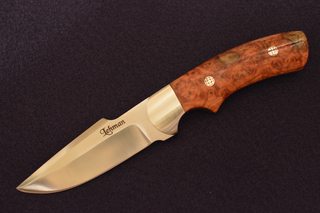
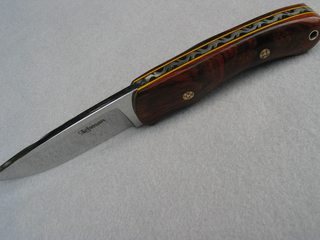
A customer has been sending me questions about this and that during a project design. So I've been educating him a bit at a time. This is a reply to something he asked me- why a 600 grit hand sand rather than a mirror, and why no solder but epoxy? I typed a bunch, and when I was done the explanation had interested me to the degree that I thought I'd post it here to see how some of your perceptions may mirror or diverge from my own.
"Well, the degree to which mirror finish was common in the past had a lot to do with the trends at the time. The hand-rubbed finish had not been popularized at that time. I think a fair amount of the shift to hand sanding came along with the rise of hamons in modern knives- they don't work with a buffed blade; damascus as well generally looks better if the steel is sanded but not buffed prior to etching. Makers like Don Fogg were pushing knives in a new/old direction with nice sanded finishes, and that in conjunction with the ascendancy of the ABS, whose go-to finish is generally hand-rubbed, brought a lot of change.
It is much the same with soldering- a paradigm shift over the years. Back in the 80's some guys like Buster Warenski were getting such nice fits on guards that solder became unnecessary- you never want solder to be an "attachment" method, rather it was a gap filler and moisture seal. With no gap to fill, a great alternative moisture seal to solder (and less disruptive to a clean build) is epoxy. Cleaned up well, it can't much be seen at all. The use of epoxy precludes any issues from the heat of the soldering process, as well as any question of retained flux causing problems down the road. With hamon and pattern welded blades, epoxy and a press-fit are preferable as they do not affect the appearance of a blade with an etched finish. Takedown construction is popular in high-end knives for many of the same reasons.
As far as the relative merits of a 600 grit finish, principally they are:
Less labor, so less cost to the buyer than a higher grit or mirror, but more labor than a belt finish
A good-looking finish that is easy to touch up. Scotch-brite works great.
Lengthwise grit pattern makes scratching generally stand out less.
A hand-rubbed finish retains crisper grind lines, generally speaking. Buffers tend to wash out detail. Many makers who mirror finish now, will hand sand to a high grit first and buff as little as possible.
Hand sanding tends to impart a flatter, truer surface to the blade than belt finish or belt with subsequent buffing.
And so forth."
Thoughts?
"Well, the degree to which mirror finish was common in the past had a lot to do with the trends at the time. The hand-rubbed finish had not been popularized at that time. I think a fair amount of the shift to hand sanding came along with the rise of hamons in modern knives- they don't work with a buffed blade; damascus as well generally looks better if the steel is sanded but not buffed prior to etching. Makers like Don Fogg were pushing knives in a new/old direction with nice sanded finishes, and that in conjunction with the ascendancy of the ABS, whose go-to finish is generally hand-rubbed, brought a lot of change.
It is much the same with soldering- a paradigm shift over the years. Back in the 80's some guys like Buster Warenski were getting such nice fits on guards that solder became unnecessary- you never want solder to be an "attachment" method, rather it was a gap filler and moisture seal. With no gap to fill, a great alternative moisture seal to solder (and less disruptive to a clean build) is epoxy. Cleaned up well, it can't much be seen at all. The use of epoxy precludes any issues from the heat of the soldering process, as well as any question of retained flux causing problems down the road. With hamon and pattern welded blades, epoxy and a press-fit are preferable as they do not affect the appearance of a blade with an etched finish. Takedown construction is popular in high-end knives for many of the same reasons.
As far as the relative merits of a 600 grit finish, principally they are:
Less labor, so less cost to the buyer than a higher grit or mirror, but more labor than a belt finish
A good-looking finish that is easy to touch up. Scotch-brite works great.
Lengthwise grit pattern makes scratching generally stand out less.
A hand-rubbed finish retains crisper grind lines, generally speaking. Buffers tend to wash out detail. Many makers who mirror finish now, will hand sand to a high grit first and buff as little as possible.
Hand sanding tends to impart a flatter, truer surface to the blade than belt finish or belt with subsequent buffing.
And so forth."
Thoughts?