Some tooling to identify

Joined
Aug 13, 2002
Messages
5,703
I was given this.
I basically know what they are. I think. :confused:
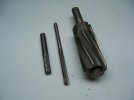
End mill, carbide tipped drill and reamer.
I am just not familiar with this type of each.

Any info would be greatly appreciated.

Patrice
 

Attachments

  • 100_3046.resized.jpg
    100_3046.resized.jpg
    26 KB · Views: 77
I have a bit similar to the first one for my die grinder. Tungsten carbide cutter/rasp/burr if I remember correctly.

Adam
 
First one is not an endmill but rather a rasp meant for side-cutting only. It has teeth rather than flutes and doesn't appear to have any end-cutting abilities. Personally, I've never used any cutter like that in a mill but I've only ever machined metals or plastics so it may have a use with other materials such as wood. Nathan probably knows something about it.

I believe you are right about the second and third tools.
 
The first is a rasp....Works well on wood and G10...I have used them in both materials on the CNC mill. It creates a fine dust just so you are aware as neither material is good in a dust form.

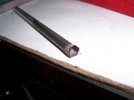
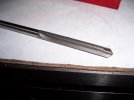
The second looks almost like a gun drill....Not too familiar with it but have used solid carbide drills that looked the same.

The third looks like it is broken with the material at the business end. It does resemble a reamer but I almost think that it might be used between arbors. Drive on one side and supported on the other for material removal in a horizontal mill? Possible I guess.
 
shadow boxing
as Terzuola call it
wend remuve about .05 of the scale material
in relation whit the hadle profile
chek page 118 of terzuola book
I use a pin on the table intead of ball bearing pilot

the second I believe its an spade drill,
carbide on tip only to chase holes
 
Patrice, I believe the reamer you have has a smaller shank so that it can be used in a drill chuck or otherwise be accommodated without having a large holder of some sort.

You can buy drills that have the same size shank as the cutting portion and you can also get them with small shanks and I think that reamer is the same concept.
 
1. rasp or burr for high speed side cutting of wood/plastic I agree.

2. Can't really see that well, how about better pics of the end and length?
As best as I can see I agree, Gun Drill.
Siingle point drill for drilling straight holes, lilely has acooolent feed hole inside.
http://www.sterlinggundrills.com/index.shtml

3. Shell Reamer
It is meant to run on an arbor with the big keyslots driving it. It looks to me like the arbour you have is not correct.


"Shell Reamers - High Speed Steel - (HSS) - Helical Flute

High Speed Steel Helical Flute Shell Reamers are designed to be used as a chucking reamer for reaming bearings and other similar work. They are fluted almost their whole length and have a tapered 1/8" per foot hole to be used with shell reamer arbors. One arbor fits several sizes of reamers so only 9 sizes of arbors are needed to fit all sizes of reamers."

"Shell Reamer Arbors - High Speed Steel (HSS)

High Speed Steel Shell Reamer Arbors are tapered to fit the hole in the Shell Reamer. They fit together with slots in the reamer which engage lugs on the arbor for driving power. "
http://www.icscuttingtools.com/catalog/page_197.pdf


If it's used tooling, you cannot trust the indicated sizes and have to machine and measure test holes.
.
 
Last edited:
Ok Gusval, got it.

Here is a better pic of the second one.

Thanks for all the great info guys, much appreciated.

Patrice
 

Attachments

  • 100_3060.resized.jpg
    100_3060.resized.jpg
    29 KB · Views: 18
  • 100_3061.resized.JPG
    100_3061.resized.JPG
    51.5 KB · Views: 17
The burr on the left could be carbide, I have one just like it. I use it to trace a template like on a frame style knife. The burr on the steel that is going to be the actual frame, be it stainless or damascus, and the smooth shaft on the template. This is usually done in halves so you get both side perfect in proportion. This is a Tim Hancock trick not my own.
 
Back
Top