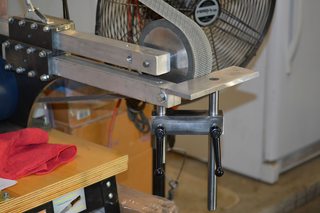
Source for tooling arms?

REK Knives

Moderator
Knifemaker / Craftsman / Service Provider
Joined
Apr 3, 2011
Messages
6,023
I am wanting to pick up a few extra tooling arms for my Wilmont (uses the KMG 1.5"x1.5" style arms). I need them to be maybe 17-20" long. I was considering northridge tool arms but they don't list a length. Also, are steel helicoil inserts needed in the aluminum arms, has anyone had any issues w/ the aluminum arm threads stripping?
 
I've made almost all of mine. Just ordered 1.5" square stock aluminum (I think from Metalsdepot), and cut them to length. Think I ordered 3 six-foot sections of it, and just cut off what I need.

It all you need to do is drill and tap for 1/2"-13, the aluminum is more than strong enough.

Oddly enough, the stuff cuts like a dream with a carbide toothed blade in the table saw...
 
You may have a local metal supplier. They were around $20 each close to me and like Matt said, just drill and tap.
 
Something else you might not have considered, 3/16 wall steel box section. I have solid steel, solid aluminum, and box section arms, and the box is my favorite. Its as light if not lighter than the aluminum, yet as dent resistant as steel. Even on small contact wheels (sticking a long ways out from the grinder) there is absolutely no noticable difference in rigidity or vibration. They're a lot cheaper as well. Mounting is simple as well, just drill a 1/2" clearance hole in the end, stick a longer bolt clean through, and back it up with a nut and loctite. It usually costs me about $7-8 per arm.
 
Thanks guys! My issue w/ drilling and tapping is that I don't have a mill yet and I'm not confident that my holes would be 100% square (which it needs to be for tracking). But those are great ideas and thanks Matthew Gregory Matthew Gregory for letting me know about the thread question!
 
Josh, I don't use my mill to drill and tap, as it's too small to handle something as big as 1/2" effectively. Just make sure your drill press is solid and square and you should be good to go. That's all I use. Besides, if you screw one up, you just cut it off and do another one - after all, you're making them! ;)


Thanks guys! My issue w/ drilling and tapping is that I don't have a mill yet and I'm not confident that my holes would be 100% square (which it needs to be for tracking). But those are great ideas and thanks Matthew Gregory Matthew Gregory for letting me know about the thread question!
 
Thanks guys! My issue w/ drilling and tapping is that I don't have a mill yet and I'm not confident that my holes would be 100% square (which it needs to be for tracking). But those are great ideas and thanks Matthew Gregory Matthew Gregory for letting me know about the thread question!

You're holes can probably be slightly off, as long as your platen, bushings, wheel holder, or whatever is cranked tight against the bar, it will still be square to the machine, as long as your tool arm socket is square. That said, aluminum is so easy to drill tap, and the material so thick, as long as your hole is drilled square, your tap will find it's own way easily enough.

There are plenty of quick and easy ways to square up a drill press, and if you have a dial indicator, you can likely get it square to within a couple thou with little trouble. (If you don't have an indicator, I'd pick one up anyway, especially if you plan on getting more machine tools.) It may also help to drill a pilot from both sides of the bar (drill 1/2 way through from opposite sides) with a short pilot drill, or better yet, a center drill, as this will help prevent your drill bit from wandering one way or the other. Usually not an issue with sharp bits in aluminum, but it may give you some added confident that it's square. Just use a combo square to scribe a line around the periphery of the bar, and then scribe a center mark from both ends.

Now, as for steel inserts, I don't think they're necessary, unless you're tapping much thinner aluminum. I imagine you'd snap the head off of the bolt before you could strip all of the threads out of a 1.5" aluminum bar. Last thing I'll recommend: chamfer and smooth the end of the threads on your locking handle where they contact the aluminum tool arm. This will help minimize any damage to the tool arm from cranking the handle into it.
 
Excellent points guys! Ok yeah I just have a little ryobi benchtop drill press right now, but I have spent quite some time making sure it's mostly square by using a piece of metal wire chucked up and bent slightly, then bringing the table up to barely touch it and spinning the chuck around so all points are contacting evenly. So I think it's pretty good, I just didn't know how perfect it needed to be.

Thanks for all the input!
 
steel tubing is my favorite and I have made a bunch. Cheap, easy and light. I have not noticed a difference with solid steel, aluminium and the tube steel at all.
 
Steel tubing is a nice compromise of weight and strength. But I just enjoy the feeling of solid steel. It feels unbreakable. And I get value for money for all the hours in the gym. ;)
 
Steel tubing is a nice compromise of weight and strength. But I just enjoy the feeling of solid steel. It feels unbreakable. And I get value for money for all the hours in the gym. ;)
See I hate the solid steel one more than anything. But that's probably a combination of my back problems and the steel arm having my 12" contact wheel on it. I went as far as cutting off all the excess of the arm so it's just barely long enough to hold a 2x72 belt on my grinder
 
My Wilmont LB1000 came with tooling arm made of thick wall steel square tube. the tooling arm I use for tool rest is thin wall and I have had no issues.
 
Steel tubing is a nice compromise of weight and strength. But I just enjoy the feeling of solid steel. It feels unbreakable. And I get value for money for all the hours in the gym. ;)

I asked a friend of mine with access to finite element analysis software to do a bit of maths for me, as I've heard people claim that they've seen bars like this bend permanently from being dropped or otherwise.

Assuming the bar is 20" long, and you clamp it to a solid surface for just three inches of that length, it would require over 800 pounds to deflect the bar .250".

Note the word 'deflect', not bend. Meaning, not permanent. Any of these options are past the realm of our requirements when it comes to strength, I'm sure. Use what makes you feel good about it. :)
 
I asked a friend of mine with access to finite element analysis software to do a bit of maths for me, as I've heard people claim that they've seen bars like this bend permanently from being dropped or otherwise.

Assuming the bar is 20" long, and you clamp it to a solid surface for just three inches of that length, it would require over 800 pounds to deflect the bar .250".

Note the word 'deflect', not bend. Meaning, not permanent. Any of these options are past the realm of our requirements when it comes to strength, I'm sure. Use what makes you feel good about it. :)


Well, I really lean into it when I grind. :D
 
I make all my tool arms from aluminum and have for 7 or 8 years. A real benefit to aluminum is weight. One of my 22 inch aluminum tool arms weighs about 3 pounds versus 13 pounds in steel. Also my local metals dealer sell 1 1/2 inch square bar stock at $4 per pound so a tool arm cost about $12 . If you drill and tap one a little off square you can turn the bar around and drill the other end. I have done this exactly twice and have made up about a dozen tool arms for various attachments and contact wheels. Steel inserts are unnecessary in my experience. Aluminum is great for tool arms in my opinion. Larry

PkU2R2Dm.jpg
 
For my KMG I've ordered several arms from both:
Oregon Blade Maker (35.50)
http://www.ebay.com/itm/Belt-Grinde...ing-grinder-/261987378353?hash=item3cffaa24b1
and Knife Grinder Parts (50.00)
https://www.knifegrinderparts.com/c...e-tooling-arm-knife-belt-grinder-one-tool-arm

Both were fine, quality wise. The more expensive one has a nicer finish with the radiused ends. The cheaper one leaves the two smaller holes untapped (the ones for the work rest). In my opinion, these are pretty cheap for something that an American machinist had to put their hands on.
 
i have both solid aluminum and solid steel arms. When the local metal supermarket told me AL was about the same price as steel, I tried AL. I wish I had done that on all of my wheels. I don't tap them, I just through drill them and use a lock nut on the axle bolt. Works perfect for me.
 
Back
Top