Spot/stain removal on finished blade?

Joined
Sep 16, 2002
Messages
1,577
The blade I'm currently trying to finish has been fighting me every step of the way, and it still is not relenting. Yesterday afternoon, nearing completion, I removed the tape from the blade and was greeted with some rust/spots/stains on the blade under the tape.

One area looks to me like rust from a fingerprint (steel is O-1), and some seemed to be epoxy (Golfsmith black shafting epoxy.) I managed to remove most of the epoxy with a fingernail and wood chopstick and some of the rust came away after rubbing with CLP oil, but there are still spots/stains that are not coming off.

Can anyone recommend a trick to remove this sort of thing without sanding it out and messing up the 600x hand rubbed finish that took me many, many hours to achieve (this particular knife fought me in the sanding area more than any I have finished so far?) I searched and found something about Naval Jelly, but I understand it is an acid and I wonder if that will etch or discolor the steel in the process, so I'm not sure that is appropriate for a finished knife...

Thanks for any help!
 
Last edited:
Depending on the finish, I have taken the last grit used on the rubbing and just gone over it again and that usually does it. If it is more of a mirror finish, I buff it out with black compound, followed by green. I hope this helps. Good luck, I know the feeling.
 
If you don't have the handles on yet then go back over it with the last grit you used if you have them on it is going to be harder. I usually ended up with less than desireable results after the handle is on and had to remove new scratches. I guess I aint the only one now. Good luck with that Paul.
 
Paul,
I'm in the exact same situation right now, LOL. Luckily for me it's on a machine finished knife but the last thing I wanted to do was go back to the grinder as this knife is complete and ready for sharpening :( . Live and learn I suppose.

-Josh

I'm pretty sure the solution here is to not allow this to happen in the first place. Again, isn't it woderful being a rookie :D:D:D
 
Thanks guys; unfortunately it's basically done, handles epoxied on, sheath made...ready to sharpen. I spent so much time getting the fish hooks out and the scratch pattern as good as I can beforehand, I know going back over it now with the handles installed will just screw that up and put in new fish hooks...the blemishes are mostly on the ricasso to make matters worse, as I think it would be somewhat doable if they were on the bevels. I guess I need to tape and untape about 100 times before it's all done and complete.

If anyone has any other tips or feedback on what the Naval Jelly might do, I'd appreciate it. An overnight soak in CLP seems to have helped a little more, but they are still there...
 
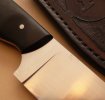
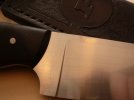
Here's a couple of pics that hopefully show what I'm talking about. The suspected fingerprint rust is above the top grind line about 1/4" to the right of the plunge. The other spots (epoxy, stain, rust???) are more or less in a straight line about halfway between plunge and scales, parallel to plunge, following the edge of the where the tape line was.

Thanks again!
 

Attachments

  • P1000504.JPG
    P1000504.JPG
    24 KB · Views: 68
  • P1000506.JPG
    P1000506.JPG
    27.9 KB · Views: 66
I'm on my phone so I can't see the pictures well but if its only light rust and staining try flitz polish. Wrap a paper towel around a sanding block and load it up with flitz and use the same motion you used to hand rub.
 
Paul,
I can clearly see the rust in your pics. Looking Darn good otherwise !! Can't wait to see the finished pics and what a teaser shot of the sheath, LOL.
Good luck with the rust

-Josh
 
Paul,
I have had the same problems when taping blades. Flitz has worked for me on some of the stains/rust. Now I only tape when absolutely necessary and remove as soon as I can.

Greg
 
Paul,

I have no suggestions for the removal of the marks on your blade; but if I might make a suggestion about how to prevent this from happening on future projects: After I have gotten the blade to finish condition, the next step in my shop is to clean the blade with windex or acetone and then spray a fine mist of WD-40 to the blades surface. I then wipe the ricasso area as dry as possible and get out the aluminum duct tape. I use the tape that is two inches wide. I unroll it on my work bench, sticky side up. When I have enough area exposed to cover the blade, I carefully lay the blade on the sticky surface of the tape up to the shoulders at the ricasso. Press it down so it sticks to the ricasso surface. The rest of the blade with the wet WD 40 will not stick to the tape. Fold the tape over just past the point and double it over and stick it to the other side of the blade and press it againt the other side of the ricasso. Stick the tape to itself around the outside of the blade.
You now have a pouch that contains the WD- 40 in contact with the blade surface.
After you have finished the fitting of the handle and guard the protective pouch is easily removed from the blade.

Good luck with your project, Fred
 
Josh, with all the problems and setbacks with this knife (and sheath), I've been debating whether or not to even post pics once it's done, but I guess I should as this will provide a better 'learning opportunity' from the feedback than a perfectly executed piece would!

Ryan and G. Shahan, thanks for the tip on the Flitz. What will this do to the current finish @ 600x...ie, will it not affect it because it's not aggressive enough, or will it be visible once I'm done?

Fred,
Thanks for this great idea, I'll give it a try next time! My other idea for preventing this in the future was to switch to stainless!!!
 
Paul you aint got nothing to be afraid of in entering the KITH. That little section looks nice. Those little stain really tick me off on O1. I hope you get them off.
 
when you do the flitz just make sure you do it evenly over the entire blade and any difference or change it does make will be even and thus not noticable
 
Thanks guys, I will probably give the Flitz a try. I will check with my 'customer' (friend who is getting stuck with it for free as a guinea pig) to see if he would prefer me to not mess with it. I'd like to try it though so I know for future reference as well, and not being a knife guy I think he could care less either way.
 
I don't think the flitz will be aggressive enough to damage what finish you have established. I think about the only difference you will notice is that it will "blend" the finish some.
 
Just wanted to say thanks for the Flitz suggestions. I managed to remove more (but not all) of the spots and rust from the blade without noticeably affecting the hand sanded finish.
 
something else you might want to try is the meguiars or mothers aluminum mag polish or something like that ..

comes in a little red / white jar in the automotive section,

its designed to polish and shine aluminum rims on vehicles and works very well..

but im not sure if its a tad more or tad less abrasive than flitz ..

but i think its more .. so it mgiht work
 
Back
Top