
spreading handle pins

Joined
Oct 13, 2011
Messages
1,774
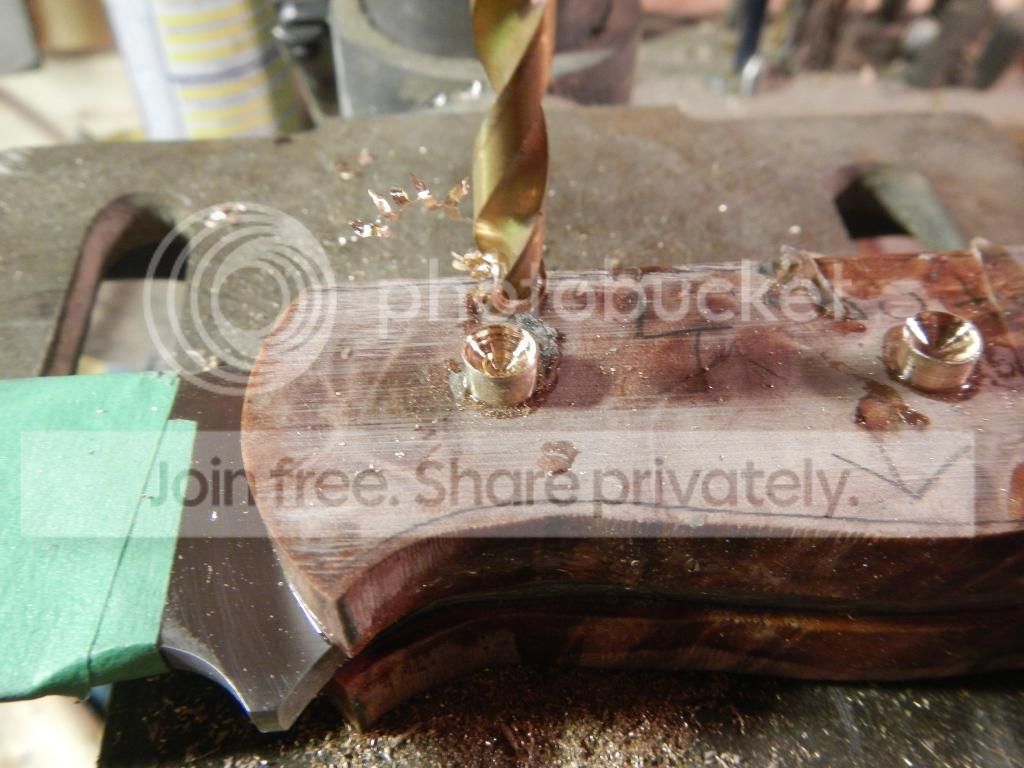
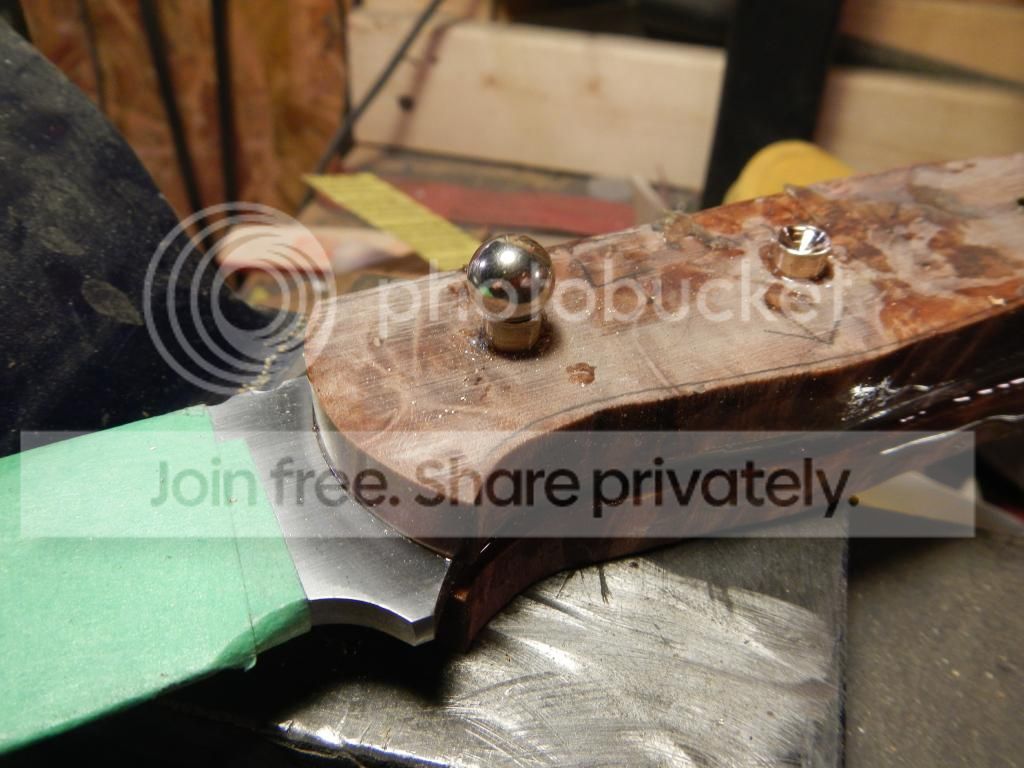
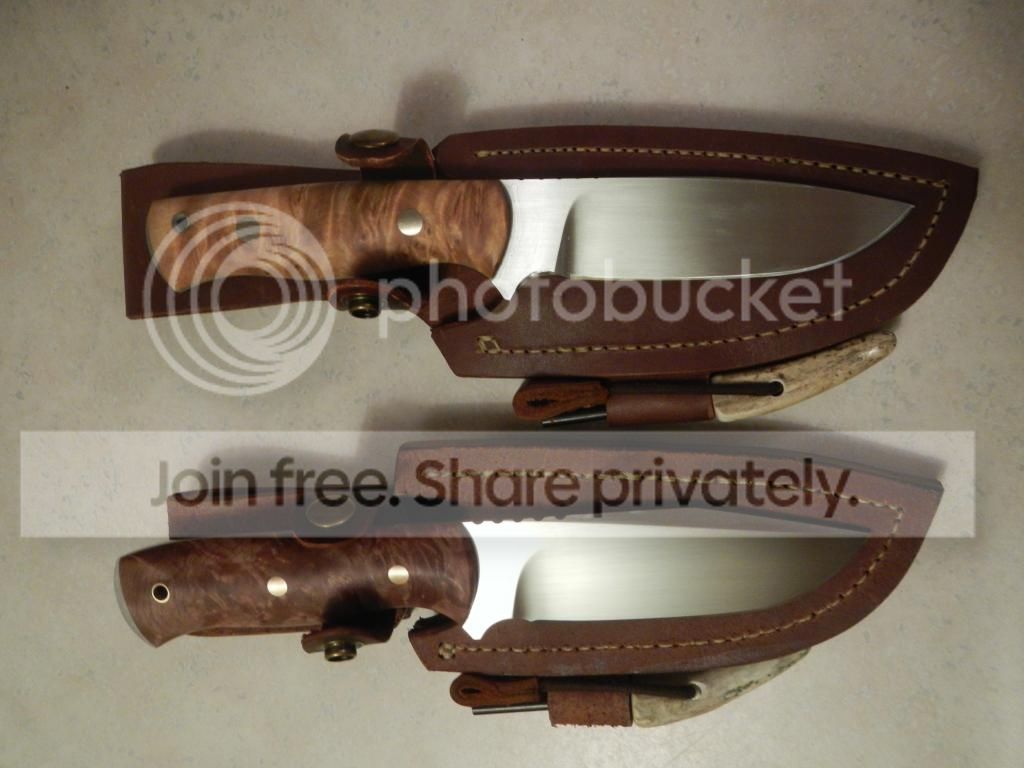
I'm not sure how everyone else does it, but I wanted to create a mechanical fastener by spreading or flaring the pins on this knife, so I did a bit of research and thought this method would do the trick. simply drilled out the center of the rod as shown in pic one then used the ball bearing and a ballpeen hammer to force the material outward while I hammered (one top and bottom) so both ends would spread evenly. seemed to turn out ok. these are the brass pins on the bottom knife. both knives are handled with stabilized maple burl and were Christmas gifts for my dad and father in law.


It works, but it's a lot of trouble. You can do the same thing with a hammer.
 
I had the same idea a while back but never tried it. Your results look good.
 
So basically, you are taking the mating of two flat surfaces (pin and hammer face), making one concave, putting something in the concave portion that then makes the surface (for all intents and purposes) flat again and smacking it with a flat surface (hammer face)?

Just relieve your scales inside and out a little bit around the hole, and smack the pins to swell them in to the relief. Problem solved. Or just use corby bolts. No need to Rube Goldberg it all up.

Good thought process though. Keep experimenting. Nothing ventured nothing gained!
 
So basically, you are taking the mating of two flat surfaces (pin and hammer face), making one concave, putting something in the concave portion that then makes the surface (for all intents and purposes) flat again and smacking it with a flat surface (hammer face)?

Just relieve your scales inside and out a little bit around the hole, and smack the pins to swell them in to the relief. Problem solved. Or just use corby bolts. No need to Rube Goldberg it all up.

Good thought process though. Keep experimenting. Nothing ventured nothing gained!

Totally right on this one... it was a thought experiment and my version of fixing a problem i encountered, which was as you suggested using corby rivets. that was the problem... I didn't have rivets left to fit the holes and i only had 2 days before i had to finish this bad boy, so i decided to swell the pins to secure the handle, and in turn doing just what Chuck said and "made a rivet" not saying it was the best procedure by any means. that's why i threw it out there for you guys to see. I thought about just peening the brass with the hammer as JG said, but i thought it might do it unevenly (having no idea what i'm doing) so i thought I'd use this method to swell the ends out more evenly before peening them with the hammer alone. Thanks for the comments guys. much appreciated.
 
Judging from the pics, it looks like your experiment was a success. If you want to see how well one method works over another, just mock up a material sandwich and try the method without any glue. THEN see how difficult it is to pull them apart.

When I peen pin stock, I simply drill my handle hole, run a tapered reamer, or a slightly larger drill bit into the top of the scale, and then peen the pins with ball peen or a small finishing hammer.
 
Judging from the pics, it looks like your experiment was a success. If you want to see how well one method works over another, just mock up a material sandwich and try the method without any glue. THEN see how difficult it is to pull them apart.

When I peen pin stock, I simply drill my handle hole, run a tapered reamer, or a slightly larger drill bit into the top of the scale, and then peen the pins with ball peen or a small finishing hammer.

I do plan on doing a few expiriments on these once i get the next few orders filled and post the pics for all to see. This was a "quick fix" for my lack of fasteners at the time, but i really like the result so i'm going to see if it holds up well. I just sent off 3 parangs to the jungle for a month with a couple army buddies of mine with a couple different fastening methods to see how they hold up with all the impact abuse they will take, so I'll tell you how that turned out as well.
 
1/4" brass rod. ps: love your tag line.

Thank you!

That's what it looked like. I think that's a pretty ingenious way to peen thick pin stock. Solves the problem of hammer-blow accuracy (which grows with the thickness of pin stock as more force is required) and the related problem of an imperfectly-rounded hammer face, both of which had turned me off to peening my handle pins. I'll have to give your method a try. I'd be curious to know how much of the peened/upset portion is left after sanding.

Both knives look great, by the way. Well-done!

-Mike
 
thanks guys... that was exactly it mike. my peening skills arent to the point where i knew i could do it perfect so i let mechanical advantage do that part... we'll see how well it works when i test it, lol
 
Those are very nice knives. Sorry for the side track but how did you do the gimping on the top one?
 
I have hesitated posting on here because I can't figure out how to do it without sounding negative... But for the sake of my curiosity and open discussion about it, I'll throw this up here and hope it doesn't come off bad.

Looking at the pics, it looks like you did this after glue-up and with a snug fit on the pins, but before shaping the handle scales. If that's the case the pin stock would not have anywhere to swell (as in a countersunk or an over-sized hole), and since it was before the scales were shaped down, any swelling above the scale was ground off.

So I'm seeing it as two steps forward, two steps back... No?
 
I have hesitated posting on here because I can't figure out how to do it without sounding negative... But for the sake of my curiosity and open discussion about it, I'll throw this up here and hope it doesn't come off bad.

Looking at the pics, it looks like you did this after glue-up and with a snug fit on the pins, but before shaping the handle scales. If that's the case the pin stock would not have anywhere to swell (as in a countersunk or an over-sized hole), and since it was before the scales were shaped down, any swelling above the scale was ground off.

So I'm seeing it as two steps forward, two steps back... No?

please Nick, dont ever feel like youre going to hurt my delicate feelings (this applies to all you guys) i post pics and comment on this forum to learn from other people and have them critique my work and methods so i can get better and make the best possible product i can. i did this during glue up (i use 24 hour epoxy) and did kind of ream the hole a little (very little) with the drill bit so im hoping it at least is marginally tapered so its at least keeping pressure on the scale material and im not relying on epoxy. guaranteed i ground most of the major swelling off since all of the shaping was done after 24 hours... thats kind of why i posted these pics to see what you guys thought of my idea and whether i could improve on it.

p.s ladies and gentlemen, ill take critisism over praise anyday... nobody ever got better with people telling them they were awesome!
 
Back
Top