SS foil welding

Phil705

Basic Member
Joined
Aug 23, 2007
Messages
364
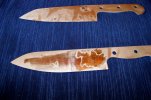
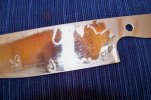
I have a serious case of foil failure, or operator error. After spraying with WD-40, I wrapped three kitchen knives with 309 SS foil, sealed them, then double wrapped with the lesser grade SS foil on the outside. The steel is 154CM.

Full ramp HT at 1950 degrees F., held for 50 minutes, plate quenched with minimal pressure. On unwrapping, two of the knives had serious welding of the foil to the blades, one almost none. I did not peek during HT, but I did remove them one at a time for quenching. Two were plate quenched between aluminum plates, the other steel plates. Not sure which was where.

After chipping away with a chisel, some foil still remains. The pictures are after scraping and some grinding. :mad:

What am I doing wrong, and any ideas on how to remove the remaining welded-on foil??
 

Attachments

  • 092.jpg
    092.jpg
    80.4 KB · Views: 57
  • 090.jpg
    090.jpg
    88.2 KB · Views: 55
First why the double wrap? One layer should be sufficient. I think that you temp was too high and your soak time too long. I harden at 1925 and soak for 30 min. I used to put a small piece of paper in the foil envelope but no longer do and get the same results.
 
Double wrapping does work better, in my experience. Blades just come out cleaner vs a single wrap.  I have never used paper or wd-40 on a double wrapped blade, however. It's a one or the other deal in my opinion. I also prefer 1925 and have never soaked for that long.

I think you need to check the PID on your oven and make sure it's not running hot, the foil shouldn't weld at 1950 either.
 
Any tips on how to check the temperature of my oven? I could not find anything using search.
 
You can use pyrometric cones to see if it's close.

You can also measure the temp your thermocouple reads in icewater and in boiling water, although this is tough to get right and also won't give you a definitive in the upper range, but it will help you to determine accuracy. The icewater needs to be a slurry so that you are measuring near freezing and the boiling water needs to be measured at the boil point, not down against a hot element etc.
 
Are you sure about the quality of your foil?

The soak sounds way too long; maybe that had something to do with it.

I've never double wrapped a blade. Could the second layer of foil have acted as an insulator, and caused the first layer of foil to melt?
 
Hmm, I didn't notice that you used a "lesser grade" on the outside. I don't see how that would weld the good foil though. Is the lesser grade foil rated for this temp?
 
the outer foil is thinner and has a lower temperature rating (not sure exactly what). I was just being cheap, thinking it did not need to be the expensive stuff for an outer layer. I guess I will just have to grind it off and use a lower temp and shorter soak next time.
 
to check your PID/thermocouple set up get some pure silver and set a small piece in a foil cup shielding it and the end of the thermocouple from the coils and see if it slumps holding at 1740f if not go up 5 degrees at a time until it does. It should go at 1765f
 
I still think you'll want to check your oven before heat treating other blades. Regardless of the outer foil's quality, I don't think you should have seen welding.
 
The idea is that the wd-40 will burn off and use the oxygen in the packet before it gets hot enough to decarb. My experience is that double wrapped blades come out cleaner than wd-40 or paper and that single wrapped blades are not significantly different with or without wd-40 or paper.
 
Besides the extra long soak time, the Wd-40 is likely the cause.

Can you elaborate a bit? I wonder why a low boiling oil will cause the foil to weld to the blade?

I am new to all this high temp chemistry and physics, thus I humbly say, please!
 
I used to put in a pinch of tobacco to burn oxygen, since that's what the heat treater did at the shop where I apprenticed.

Seemed to make sense.

Then, I learned that since the foil comes to temperature instantly, the oxygen in the packet binds to the foil, and leaves none present to affect the blades.

Oxygen is long gone by the time the blades come to temp.

I quit doing it.

How are you guys sealing your packets?

With a good foil, and a double crimp, I don't see any advantage to a double wrap...

If you are going to spend that much time and effort, why not just buy good foil packets from Sentry Furnaces?
 
I double fold, usually about 3/4" over on three sides. I use a bic lighter or other smooth plastic to press down/"burnish" each fold. I'm not saying it is or isn't worth the extra time/cost to double wrap, but I am saying that there is an appreciable difference.
 
Can you elaborate a bit? I wonder why a low boiling oil will cause the foil to weld to the blade?

I am new to all this high temp chemistry and physics, thus I humbly say, please!

WD-40 or diesel fuel will help keep the surfaces of steel from oxidizing and let them weld together.
I use this method sometimes making damascus. I have welded billets at temps under 2000f, using WD-40
 
Todays Heat Treat.

Single wrap, foil from Enco, 6" of CPM154, 1925 for 30 minutes, plate quenched in foil, 61-62 Rc.

Guess I am just lucky, as these are typical results here?

IMG_0760.JPG
 
Back
Top