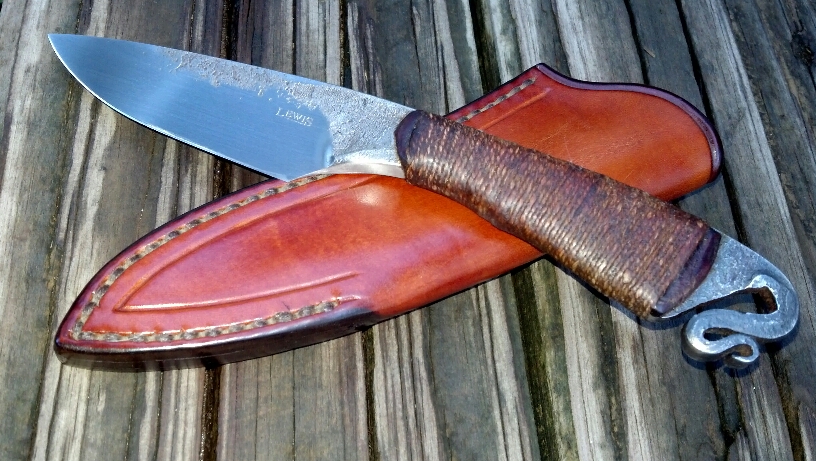
Stag Damascus Hunter Finished

Joined
Aug 16, 2012
Messages
104
Relative newbie here but I just finished my first Damascus blade. This is 1084/15n20 432 layer. It has Indian Sambar Stag scales from Culpepper. Cooper pins and hemp wrapping towards the front. One of my pins got pushed through while epoxy was drying so you may see that boo boo.

The person who wanted this wanted a Dan Winkler style knife that looks antique/used/forged finish so I hope I delivered.

I want to give a huge public thanks to Dan Graves. He helped me tremendously with his input and allowing me to use his facilities. He's a great guy.

My etching needs a little work so please comment with any help you may see I need to work on.

Also Rick Marchand thank you for your help with the hemp wrapping.

d01879afc6b6b157aba1797106357333.jpg
886b7204ec0d25e7d4d1fe6930fcf46d.jpg
4f6ee73bf7d35d77a270268eaa864a7f.jpg
33127ad1f1385e35c5ff3ff8dedc4d5d.jpg
86583a065e59b51875d2c35d5081f6f6.jpg
10/25/91588f8445a3717c6316f6692fdab52d.jpg[/IMG]
 
a7e5f52cc29cccead8f5e110f055f9ad.jpg


One thing I didn't do was etch it too long. My first etch was contaminated so it made a whole bunch of white spots. I had to buy more distilled water and more FeCl. Resand. Then re etch.
 
Looks good! It may just be the picture but it looks like the bevel needs etched a little longer. Anyways, good job.
 
Looks nice. About the only addition I would add is a small choil at the edge/plunge junction. It still can be added with an 1/8" diamond cylinder burr.


TIP:

When doing any partial wrap, file the handle and tang all the way around to reduce it's size and make a shallow step that is the depth of the wrap. That way, when you wrap it the cord will lay even with the handle ( stag in this case). It doesn't need a step at the front if that is the end of the wrap ( as was your handle).
 
Thanks Matt. I appreciate the comments. You're right. The bevel needs to be etched. I unfortunately was not happy with the edge after all said and done and decided to get it super sharp and got a little crazy with it. I may have to carefully apply FeCl by applicator to match it with the rest.

Stacy

Are you saying under where the wrap is that I should have sanded the stag smooth marching all way round? If so I can see your point. I will definitely do this on my next one. Also, would you put tiny serrations in the stag under the wrap so the wrap has somewhere to grab while wrapping before epoxy?
 
Looks good, bud. Thanks for the mention.

Stacy, is talking about carving a step into the stag for a smoother transition to the wrap. Something like this...

 
Rick, that is frickin' wicked!

Clive, I think you achieved your goal, it looks rustic and well used. It's a really cool looking knife, I like it!
 
Thanks man.

Rick,

You're a true artist man. I see what yall are saying now. So that everything lays flatter and it is a more "incorporated" handle.

I tell you it's a bit intimidating as a new person, after everything is all epoxied and dry to take a file or grinder to a set of hard to get sambar scales. I may have to work my way up to that and do it with some cheaper wood. I'm assuming you want to go as deep as the thickness of your cordage.
 
Don't forget, that you would also have to grind a channel in the tang(if it is a full tang)

It is just one more operation to screw up... but the subtle attention to detail makes it classy. Kinda like tapering a tang. It lets everybody know that "you care"... how touching... :sorrow:


Thank's Rick....nice knive. ;)
Thanks. Your welcome.:cool:
 
I think ya done good! ;) I agree with the bevel being etched a bit more to better show the damascus pattern, but other than that, very nice job man, I like it! :)

Rick, that is crazy cool brother! :cool: :thumbup:

~Paul

My YT Channel Lsubslimed
... (It's been quite a while since I've posted any new vids)
 
Looks great my friend! You've come a long way in a short time according to this knife. A bunch of good choices made. I would personally balk at covering Mr Culpepper's stag with cord, but the customer still demands custom right?

As Rick mentioned above, here's another example of a forged knife where the tang was both tapered and inset to make room for flush wraps at either end. I knock them in hot then dress with a small mill file before HT. Not too difficult if you measure and mark well. I don't care so much what it looks like on users but can tell you they will wear much better than those where the cord stands proud. Steel or horsebutt bumpers all around make a big difference in heading off future handle problems in rough use knives.

m0xtb8O.jpg


Again good work here; now go make another one!
 
Thanks Andy. As always you're a plethora of info. I really appreciate all the help you've given me over the years. Any new guys perusing these forums that don't know Andy Lewis, he's a true craftsman and incredible maker. Take his info as gold. I

I hate that I missed you at Dans. I was there the week before picking up my new mill. Hopefully next time I'll get to see you.

Thanks for all of the encouragement and info guys. This is an awesome community. I'll definitely be making more. Especially Damascus. That was my first one and took a bit to get over the confidence hurdle. Thanks again
 
Sometimes I've had etching trouble when mixing up a fresh batch of ferric chloride & water. But if I let the solution sit for a couple days first, the problems go away. Don't know if that's what's happening in your case, but maybe give it some time to "settle down" & see if it works better?

That stag is just beautiful stuff. Like Andy, I would personally have a hard time covering any of it up with wrapping- it begs to be shown off! You see wrapping on real old knives/guns/tools to repair cracks and splits, and keep 'em from getting worse. I don't think they were wrapped when new. But if that's what the customer wants, that's what the customer gets.
 
I can usually look at a photo or the actual blade when there is a problem with the damascus not etching right and say with almost certainty, "That blade was buffed on a buffer." I know, you cleaned it, but if buffed there is a glaze over the surface. The more you buffed it, the harder this glaze is. I have seen highly buffed blades that would not etch at all.

When done sanding and buffing your knife blade, take the blade and grab a piece of 400-800 grit paper. Wash the blade and clean well with alcohol. Wet sand with Windex or soap with the paper for a even matte finish. Wash again and clean with alcohol. Now etch and see how much change it makes. When the etching is done, rinse, wash, neutralize, and dry. Wet sand with 1000-2000 grit paper and then hand buff with 3M papers at 4000 and 8000. It will have glistening high spots and dark, deeply etched lows spots. Repeat as many times as nee4ded to get the etch detail desired.
 
Possum

I agree I would have loved to show the stag off but they really wanted the old world feel I guess. Oh well just got to make another.

Thanks for the tips Stacy. My process was hand/wet sanding up to 800 grit. I then cleaned as much as I could with alcohol and windex. I then etched in a fresh batch of FeCl/Distilled Water. I don't have a buffing machine nor did I hand buff until after all the etching was done. However I only buffed with microfiber and green rouge. How do you usually neutralize the etch as soon as you get it out? Ammonia?

Also, on some of the suppliers sites I've seen those high high grit buffing pads. They come in white, pink, ect. 3M makes them. Is this something that could be useful?
 
Yea, you deffinitely don't want to buff before OR even after etching, even if it's by hand, unless you happen to be going for a very particular look.

For neutralizing the etchant just use some windex that contain ammonia in it and spray the blade down generously.

Stacy is talking about 3M polishing sandpaper that are in very high grits, not sure about high grit "buffing" pads..? Here is a link to one place that sells them (just to give you a visual) : http://www.cooltools.us/3M-Polishing-Papers-Set-p/pol-100.htm

After etching and neutralizing, use the high grit polishing paper (even 2000 grit will work fine), but you want to use a hard & flat sanding block to go over the bevel, like a steel or micarta sander block etc. If you use something softer (like a leather or soft rubber backed sanding block for example) to sand with th polishing paper, the backing and paper will conform to the "ridges" in the damascus layers and would sand out the dark etching oxides from the lower layers, thus taking away the contrast... which is why you don't want to buff afterwards, even by hand with a cloth or pad etc. Stay away from all buffing compounds when working with damascus. ;)

A lot of guys will even cold blue the entire blade after give a nice deep etch, and then lightly sand off the high spots (layers). This will give a better, darker and more consistant dark finish to the low layers. Parkerizing is another great method to get the lowers layer very dark, but is more involved IMHO HOT bluing the blade, like Karl B Andersen does on all of his damascus gives the most beautiful look.. But that's dealing with a complicated setup using caustic materials, so cold bluing is safe and easy, good alternative. :)

Just to show how beautiful the contrast can be, here's is a quick vid of one of Karl's hot blued damascus knives:

[video=youtube;AM5ol4xrOUM]https://www.youtube.com/watch?v=AM5ol4xrOUM[/video]


~Paul

My YT Channel Lsubslimed
... (It's been quite a while since I've posted any new vids)
 
Last edited:
Back
Top