
Standards for finishes

Joined
Oct 4, 2011
Messages
1,043
Hey everyone,

I make mostly kitchen knives - knives that will see every day use, regular sharpenings, inevitable thinnings, and maybe some modifications. Most of the customers for these knives don't particularly care about finish, as long as it works the way as it should and holds up. I'm thinking of having them finished up to a slightly dirty 220 or 320 - they'll look fine, with the scratch marks going parallel down the blade, but with some other lingering light scratch marks maybe showing up different directions.

What are your thoughts? I know we all love the beautiful, practically flawless finishes on here, but for a knife of this circumstances I would rather put the effort into performance and save time and cost in the finish department. Fit would be tight, sharp corners rounded, etc.

Here's an example of a gyuto I did with a slightly dirty 320:
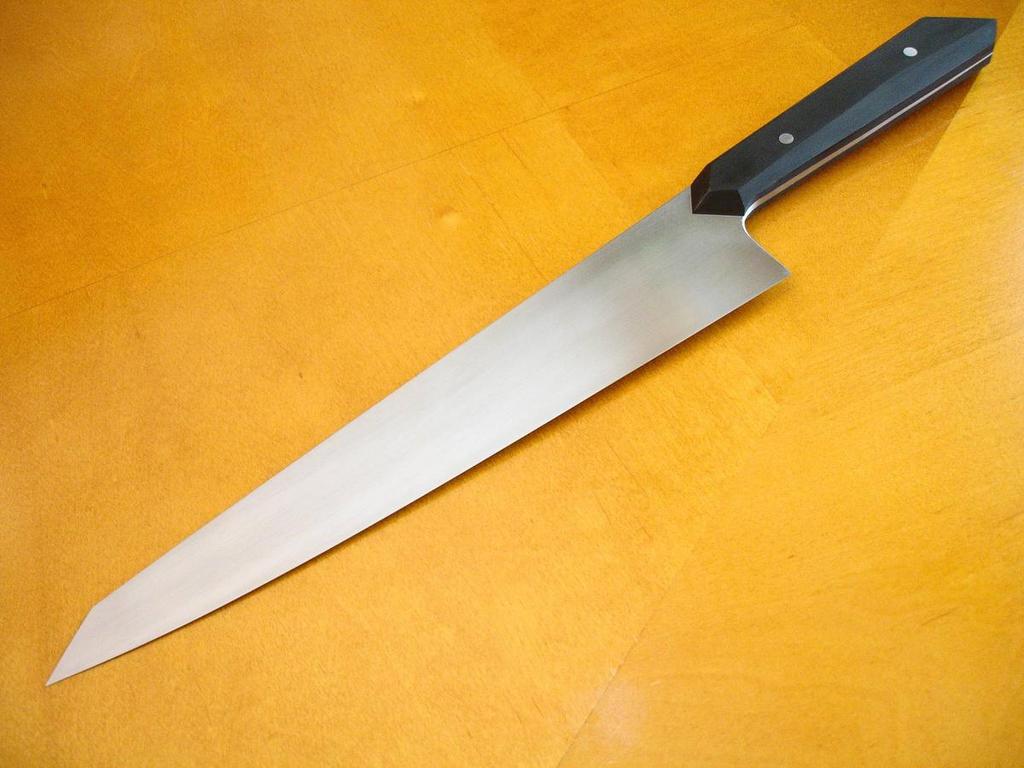
RYCKl.jpg


You can see that most of the scratches go parallel down the blade. If you hold it in person and angle it with certain lights you can see a series of light 220 or 320 going diagonal or whatnot.

I've been told by a lot of customers/potentials that they too agree that the finish doesn't have to be 'flawless', and they would prefer the time and cost savings in the circumstances. Upon any inquiries I would ultimately be clear that the finish would be as I described.

Agree or disagree?
 
Personally, I see surface finishes as a direct reflection of craftsmanship. I think a 320# finish is fine, but maybe a belt finish that is uniform would look better. I am in no way saying your work is sub-par, from what I have seen you do good work, why take a short cut on the finish? Maybe go 220 and then scotch brite?

I understand your reasoning, my wife is a chef, and her uncle (who lives with us) a butcher, neither of them like to use my knives because they don't want to listen to me complain about them messin up the finish on them!

Just my $0.02


-Xander
 
This is something I've been struggling with lately also. I've sanded a lot of my knives up to 1000 grit. And yes, the finish looks good but even at 1000 grit, there's still a scratch pattern. I'd say that if you're seeing diagonal scratches, then you didn't do a good enough job of getting the previous scratches out or they wouldn't be there. This is one reason I started experimenting with other finishes. I'd get done and look at the thing a hundred ways and it would look good in inside or outside light. Then after I finished it, I'd see a scratch or two in a different light. It was frustrating.

I've experimented with Trizact and Scotchbrite belts and I have to say that I don't understand the hangup over hand sanded blades. Both of the belts ended up with a finer looking finish in my opinion. I used up to an A45 and sometimes up to an A30 Trizact and to an extra fine Scotchbrite belt. I found that the Scotchbrite was the easiest finish to get and the best end finish of the three. I took knives finished several different ways and asked my wife and buddies which one they preferred. They actually said the finish was the least of their criteria for choosing a knife, but ended up choosing the Scotchbrite finished knives slightly over the Trizact finish.

So I'm doing more belt finishes now and saving a little time (okay, A LOT of time!). I don't mind hand sanding if it would give me a better finish, but it doesn't. I'm starting to believe hand sanded finishes are desired for their consistent scratch patterns left on a knife rather than any increase in performance they may ad. Kinda like they're a desired cosmetic option for the blade. If I'm wrong, someone please educate me on this! What's the advantage of hand sanding? (I'm not wanting to hijack this thread, but I think this is along the same line as what the OP asked)
 
Last edited:
This is something I've been struggling with lately also. I've sanded a lot of my knives up to 1000 grit. And yes, the finish looks good but even at 1000 grit, there's still a scratch pattern. I'd say that if you're seeing diagonal scratches, then you didn't do a good enough job of getting the previous scratches out or they wouldn't be there.

My opening post was mainly focused on intentionally disregarding those diagonal/other scratches.

I don't mind hand sanding if it would give me a better finish, but it doesn't. I'm starting to believe hand sanded finishes are desired for their consistent scratch patterns left on a knife rather than any increase in performance they may ad. Kinda like they're a desired cosmetic option for the blade.

It's not a better finish, just different. Most people like how a hand finish looks, but they don't really go anything regarding how a knife will cut.
 
Any finish should be consistent. To my mind, the whole point of a handmade knife is craftsmanship and attention to detail. "Leftover" deep diagonal scratches from a previous grit are a sign of the maker not giving a hoot... that's bad. Various shallow scratches from use are just character marks... that's good.

I recently posted a poll about blade finishes in General, and was a bit surprised by the results. Tumbled/stonewashed is the clear winner, followed by basic hand-satin.
 
Don, let me add that your designs are obviously well-thought-out and include all the custom features and craftsmanship we love. I think they deserve a clean crisp finish, whether it's 220-grit or mirror-buffed. :thumbup:
 
Thanks everyone for your thoughts.

James, thanks for the comment! I really appreciate that. I also think the poll results are incredibly interesting - I thought a satin 400-800 would have been top.

I guess one of the thoughts that makes me ask the question is that with a very glamorous looking knife, people are hesitant to use it to its fullest potential. I know there are people out there who use very, very expensive kitchen knives no problem, but a lot of people are intimidated to thin a knife or use it the way they would really want to because of how flawless it was. With regular sharpenings a knife would need to be thinned - I'd be scared to thin a knife with a crisp finish, much less a san mai or damascus/etc. My train of thought was this: if I put in the extra time/work to get the finish crisp, it would increase the cost of the knife and maybe introduce this issue I'm mentioning.

Maybe I'm looking at it the wrong way, and should consider a belt finish/scotchbrite for a quicker option for finish, but not compromise and end up with a sloppy knife?
 
Hey Don... this following is just my opinion, but...

... not all knives need to be finished out to a perfect 3000-grit finish. However, whatever grit you decide upon should be CLEAN. If it's 1500-grit, it should be CLEAN. If it's 280-grit, it should be CLEAN. If I have already taken the time to take a knife to a "dirty" finish at a certain grit (meaning all scratches are at the correct grit but are not uni-directional), then I feel that the extra effort required to make things clean is well worth the results. I would almost always prefer to see a clean finish at a rougher grit than a dirty finish at a higher grit.

Erin
 
I would say it all depends on customer expectations about the finish and your communication with them. Murray Carter provides working class knives that are roughly finished and cut great. He can do a clean finish at whatever grit you desire but many customers do not want to pay the substantial extra for this finish. As long as the customer knows and understands what they are getting, it should all be good.
 
I would say it all depends on customer expectations about the finish and your communication with them. Murray Carter provides working class knives that are roughly finished and cut great. He can do a clean finish at whatever grit you desire but many customers do not want to pay the substantial extra for this finish. As long as the customer knows and understands what they are getting, it should all be good.

He's a good example of what I was thinking of, along with many other Japanese makers. I was holding a knife of his earlier today.

Thanks for the thoughts everyone! I really appreciate it. I figure if I want to offer a low cost option for a finish, a machine finish or forged might be the way to go. If I go with a hand finish, then I will do it right and get it clean.

EDIT: McNealForge - it's black paper micarta. Good stuff for an inexpensive, no-frills and durable handle. Looks good too I think.
 
Last edited:
I find that it does not take that much longer to get a clean 600 hand sand than a dirty 400 hand sanded finish. One point of hand sanding is that if it's done well, changing direction with grit size, no larger scratches are left behind, yielding a finer and more consistent finish that is less susceptible to corrosion. I find that a 600 grit finish is pretty easy to repair any light to medium scratching on as well.
 
Keep your finish level high and I bet you won't regret it.

You can belt finish to 600 grit then hand finish back to 400 for a great looking finish that is both user friendly and good looking. Or 800/600, etc...

One thing to consider is that a higher level of finish will be a tiny bit more rust resistant.

That being said I say do what you want! Your knives are looking great. :cool: 320 is nice especially when clean... clean is a matter of perspective as well.

I hate to see the "polished turd" finish as I call it, high polish with tons of scratches and non crisp grinds buffed to death.

Phill Hartsfield is one of my all time favorite makers and he went for a rougher finish than most, a finish like that will not show wear like a higher grit finish will.
 
Back
Top