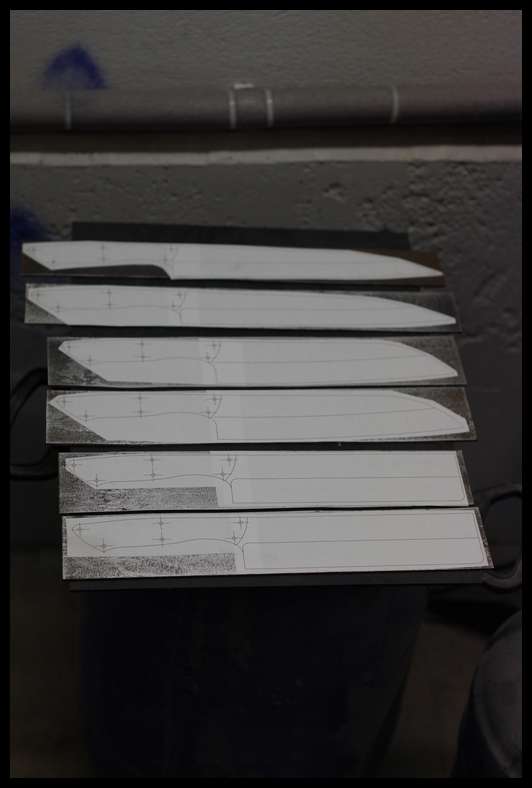
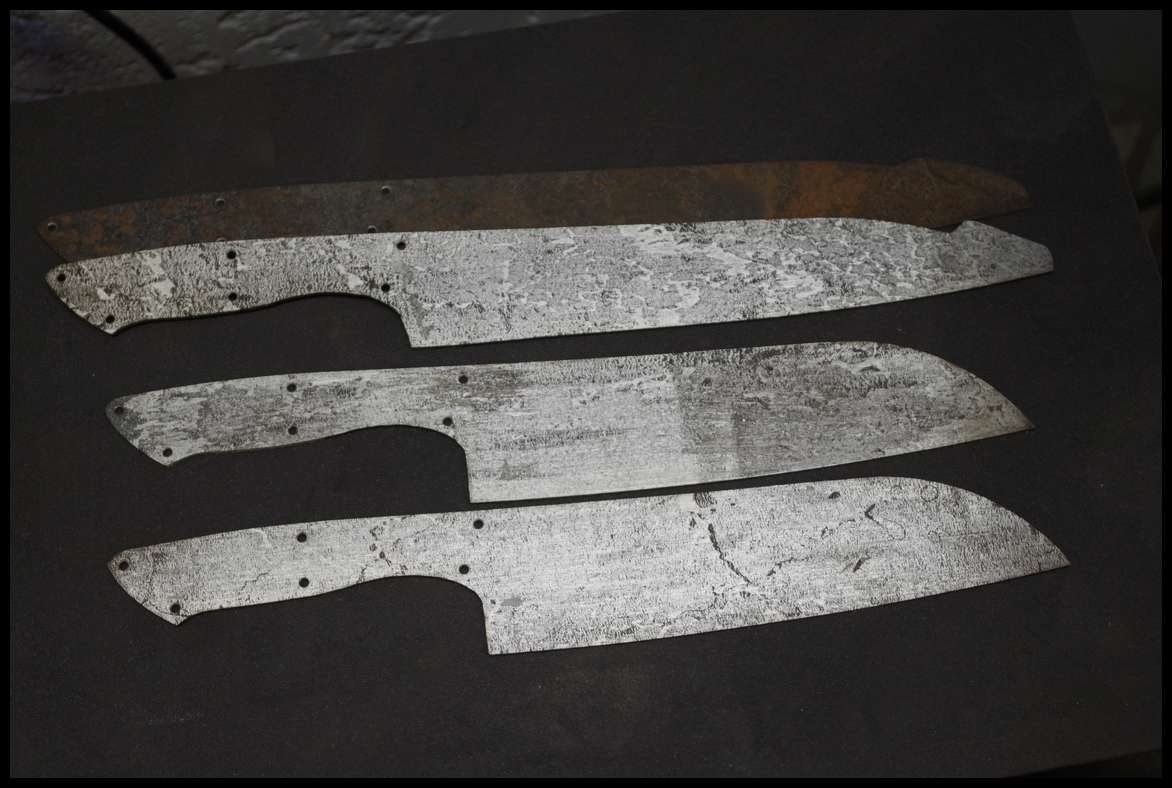
Start to work with kitchen knives :D

Joined
Aug 25, 2013
Messages
1,220
Hello,

From this month I will start making kitchen knives :D

10x 300x1000mm 3mm AEB-L is ordered for the next month.

And now I still have about 1000x800mm 2,6mm NCV1 ( 80CrV2).
Now I started working on 3 prototypes of kitchen knives.
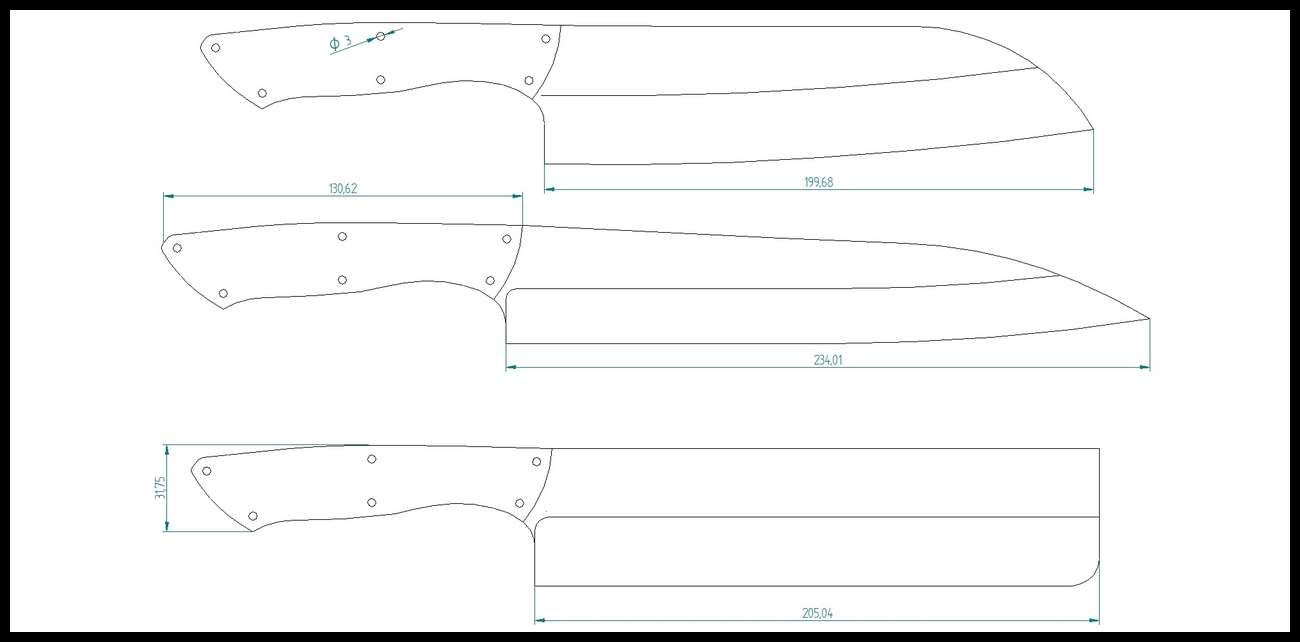
gXNQ4e.jpg


What do you think about that?

And why not hidden tang?
I don't have luck with hidden tang handles :(

Slowly I will post here WIP pics ;)
 
Another critical dimension you should specify is the height at the heel. This is important to alot of chefs. What type of bevel/ cutting geometry are you planning to use? The western handles look nice . I like the more gentle curve profile of the top santoku alot. I find It is nice to have about 1/3rd ast most of blade near heel to be flat. Just my personal preference :) Good luck, kitchen knives are so much fun really :)
 
Timos brings up a good point about bevel/cutting geometry, shouldn't you take your grind all the way up to the spine?
 
The middle one has a very nice style to it. I'm interested in what grind you will use as well. Pics seem to indicate partial flat grind? Maybe hollow?
 
Flat bevel :)

I have too small ( 270mm) serrated wheel .
Maybe in time I will take radius platen with chiller from Nathan :)
 
The heel height on #2 and #3 should be at least 45mm. You might be better off going with closer to 50mm on a nakiri. If you want to get even crazier, bevel the entire #2 knife including the full tang down from 3mm at the spine to 1mm at the edge and then cut in that second bevel on the bottom part of the blade to your final pre sharpening edge thickness. For the nakiri, you might want to thin the whole thing out flat. 3 mm is pretty thick fro one of those from what I have seen. I have seen some made form HAP40 with 410 cladding as thin as 1.6 mm!!!!! That might be a better case for using the .078 inch thick AEB-L.
 
Kosa_pl I like your designs very much and think they will be excellent kitchen tools. Larry Lehman
 
As I've done more kitchen knives, I moved away from the drop in the handle. It looks nice, but is functionally a negative.
 
I have kind of gone with the middle position, fast with the spine top of the handle, but some "drop" on the bottom sometimes. Fillet knives may be the type where you still might want some drop to the handle to go along with the raised tip.
As I've done more kitchen knives, I moved away from the drop in the handle. It looks nice, but is functionally a negative.
 
Hmm About steel for a kitchen knife, what is ok?

Stainless:
1. AEB-L ( ordered 70kg of 3mm thick)
2. Elmax
3. M390
4. N690
5. Damascus AEB-L + N690 / AEB-L + 304

Non-Stainless:
1. Bohler K460 = O1
2. NCV1 aka 80CrV2
3. Bohler K720 = O2
4. Damascus: O1 + O2 / O1 + NCV1 / O1+15N20 ?
 
Hmm About steel for a kitchen knife, what is ok?

Stainless:
1. AEB-L ( ordered 70kg of 3mm thick)
2. Elmax
3. M390
4. N690
5. Damascus AEB-L + N690 / AEB-L + 304

Non-Stainless:
1. Bohler K460 = O1
2. NCV1 aka 80CrV2
3. Bohler K720 = O2
4. Damascus: O1 + O2 / O1 + NCV1 / O1+15N20 ?

Damascus for the kitchen is a concept I've been thinking more about as I've started hammering out some billets. W2/15n20, 1095/15n20, and hitachi blue/15n20 are the top of my list. Maybe 52100/L6? Or O1/L6 keeping similar heat treats together? I did a Pakistani Damascus/W2 experiment that turned out ok, but had a major inclusion in a Pakistani Damascus/15n20/W2 go mai. It looked great until it tore apart in the quench.
 
ok, some knives get back from hardening.

1x Yanagiba and 2x Santoku :)

In monday they will be surface grinded and get bevels :)
 
Back
Top