- Joined
- Aug 27, 2007
- Messages
- 54
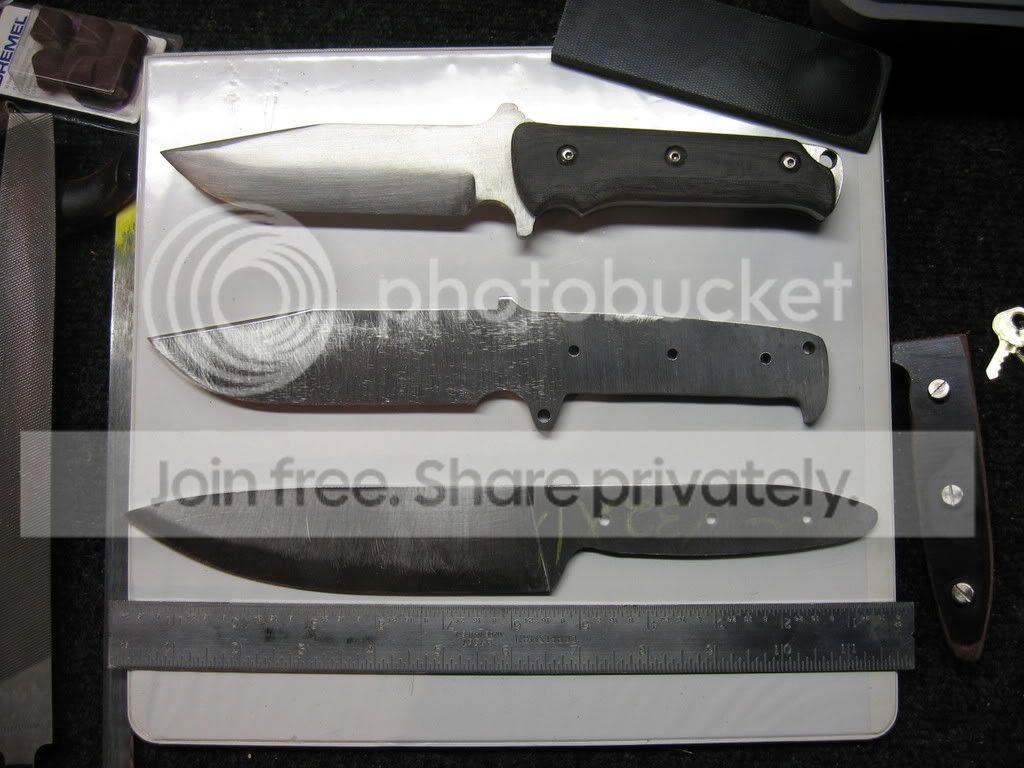
I've been wanting to make my own knife for years, so I finally decided to buy a piece of steel and get busy. I bought a large piece of 1/4" thick 440C and got started. Well, I'm not even fully done with my first knife and I'm already hooked. So I've started two more. The second one is the other half of the original piece of steel and the third is an entirely different piece. So far, I've only been using a drill press, files, and a hacksaw, with a little detail work left for the Dremel. I did just pick up a belt sander and have used it on the bottom knife in the picture and it looks like it's going to work nicely.
The first knife is pretty much ready for heat treat. It has black linen micarta handle slabs and stainless fasteners. It's at 120 grit right now, but I'm going to go to 240 before I send it off. Here's what I'm having trouble with. How sharp (or unsharpened) should it be before I send it for heat treat? Right now, I have no primary bevel on it at all. It is sharp enough to cut string if you really press hard. I'm assuming that I should put a primary edge bevel prior to H/T but I don't want the blade to crack during H/T. If I do put a primary bevel on it, should I leave it fairly dull to prevent cracking?
The second knife is in progress and the third is a kitchen knife for my mother in law. She has a horrible selection of kitchen knives so I told her I'd make her one for a late Christmas present. Now I have a buddy asking for one and possibly another friend that is interested. It's been so damn cold here that I haven't spent much time on them in the last couple of weeks, but I did get out there tonight and worked a little and took pics. I'm new at posting pictures so they might not show up until I figure this out.
Ok, until then...try this link
http://s269.photobucket.com/albums/jj53/flakjaket/?action=view¤t=IMG_0915.jpg

The first knife is pretty much ready for heat treat. It has black linen micarta handle slabs and stainless fasteners. It's at 120 grit right now, but I'm going to go to 240 before I send it off. Here's what I'm having trouble with. How sharp (or unsharpened) should it be before I send it for heat treat? Right now, I have no primary bevel on it at all. It is sharp enough to cut string if you really press hard. I'm assuming that I should put a primary edge bevel prior to H/T but I don't want the blade to crack during H/T. If I do put a primary bevel on it, should I leave it fairly dull to prevent cracking?
The second knife is in progress and the third is a kitchen knife for my mother in law. She has a horrible selection of kitchen knives so I told her I'd make her one for a late Christmas present. Now I have a buddy asking for one and possibly another friend that is interested. It's been so damn cold here that I haven't spent much time on them in the last couple of weeks, but I did get out there tonight and worked a little and took pics. I'm new at posting pictures so they might not show up until I figure this out.
Ok, until then...try this link
http://s269.photobucket.com/albums/jj53/flakjaket/?action=view¤t=IMG_0915.jpg