Steak knives ??

Joined
Dec 25, 2004
Messages
1,363
I have an order from a new customer of a 6 piece steak knife set. I'm planning to use thin RWL34 stock for it (3 mm thickness). However as far as I observed a steak knife is a pointy small knife, thats all I know about it. As I don't have any experience of steak knives I would appreciate some advises, what one would expect from this knife type?
 
Emre,
I would go with 2mm thick and make the blade about 100mm long.Something around 12-15mm wide at the ricasso. The blade should have a continuous taper to the tip, with the last 30mm curving to the spine. The spine is straight with the handle. Distal taper the entire bale.
Stacy
 
Emre,
I would go with 2mm thick and make the blade about 100mm long.Something around 12-15mm wide at the ricasso. The blade should have a continuous taper to the tip, with the last 30mm curving to the spine. The spine is straight with the handle. Distal taper the entire bale.
Stacy

Thank you very much Stacy :thumbup:. That explains perfectly, I was planning to make ceramic handle decorated with some artistic glazes but I'm curious about the weight. I'll try to reduce some weight by attaching a stainless tube inside the stick tang area. Lets hope it will work.. Thanks again for the quick response...
 
I think it's OK for a steak knife to a little bit handle-heavy. The thing that would stump me would be serrating the edge, if that's what your customer wants.
 
The thing that would stump me would be serrating the edge, if that's what your customer wants.

Thats simple, use a round file 15-20º off of the Y axis. (vertical) holding the file about 10-15mm off the spine will acomplish this basically you want to alternate sides very much like doing vine filework on the edge.

Jason
 
Yeah, I get that... the stumpy part for me would be keeping it all even :D I guess I would use a smooth rod the same diameter as the file to keep it spaced right. Or make a jig to follow.
 
yea that would work grat too...what I do is put the smooth jaws in my vice then use dykem and mark off every 5/32 then, I use a chainsaw file and start on the bottom of the presentation side and drop the blade to the next line and start on the next one, on the opposite side. so one and so forth.

Jason
 
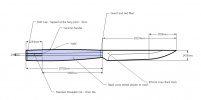
Thanks for suggestions and opinions friends. I have decided finally what to do. Typically it is based on Stacy's suggestion. I won't put any serrations for this project. I'll post a WIP thread if everything goes OK. Here is the plan:
The dimensions are multiplied by 100...
 

Attachments

  • steak.jpg
    steak.jpg
    24.8 KB · Views: 40
Looks cool. How are you forming/shaping the ceramic handles?

In fact I wont shape any mud, I tried to do but it is too difficult to get a clean job. I'll make a wooden handle first for one knife, then I'll prepare a mold out of Dental plaster and I'll pour some liquid clay. It is kind of cheating I know. The best part of it I'll make more copies of that handle from ceramic, these will be presented to the customer as spare handles in case of they brake existing ones' handles in use. I guess 2 or 3 spare handles will suffice..
 
Looks good ,Emre.

A note about serrated edges on steak knives:
They are there mainly because most steak knives are cheap and have fairly dull edges. They allow a knife to be safer for table use, but still "saw" through meat.
If the knife is made like a real knife,with a sharp edge, it will cut through meat like butter. I have made the following comment about custom steak knives before,
" If the steak is so tough that I need a serrated knife to cut it....I don't want to chew it ,anyway."
The dilemma comes in the fact that you are making a sharp knife to be placed openly on a table where inexperienced users will cut with it while talking and being distracted. Most of the steak knives I have hand made have been sharp by request.

On all my kitchen and table cutlery, I put in a owners manual sheet on care, maintenance, and use. The top of the page has big bold lettering,
"THIS KNIFE IS INCREDIBLY SHARP - USE WITH CAUTION"

Stacy

 
Looks good ,Emre.

A note about serrated edges on steak knives:
They are there mainly because most steak knives are cheap and have fairly dull edges. They allow a knife to be safer for table use, but still "saw" through meat.
If the knife is made like a real knife,with a sharp edge, it will cut through meat like butter. I have made the following comment about custom steak knives before,
" If the steak is so tough that I need a serrated knife to cut it....I don't want to chew it ,anyway."
The dilemma comes in the fact that you are making a sharp knife to be placed openly on a table where inexperienced users will cut with it while talking and being distracted. Most of the steak knives I have hand made have been sharp by request.

On all my kitchen and table cutlery, I put in a owners manual sheet on care, maintenance, and use. The top of the page has big bold lettering,
"THIS KNIFE IS INCREDIBLY SHARP - USE WITH CAUTION"

Stacy

Good point Stacy, I'll ask the client if she wants it real sharp I proceed as is, if she want it at the safe side I'll work on serrations but I'll raise my price I guess cause of I'll spend more time to put serrations on them.

BTW, I have been printing out some manuals for my Reed knives, I'll modify it for steak knives. The warnings section of the manual goes like this:
"Warnings:

Our knives leaves our workshop very SHARP. Please handle with caution. Keep the knives out of children’s reach. Be very careful when working with this knife. THIS KNIFE IS NOT DESIGNED FOR STABBING or CHOPPING ACTION, USE ONLY SCRAPING AND CUTTING ACTION: without any hand guards, finger grooves, classic reed knives are specifically designed tools, when used for another purposes, like cutting hard material, chopping or stabbing, the hand is not protected from slipping to sharp edge."


I guess the wording won't change much for steak knives :)...
 
Back
Top