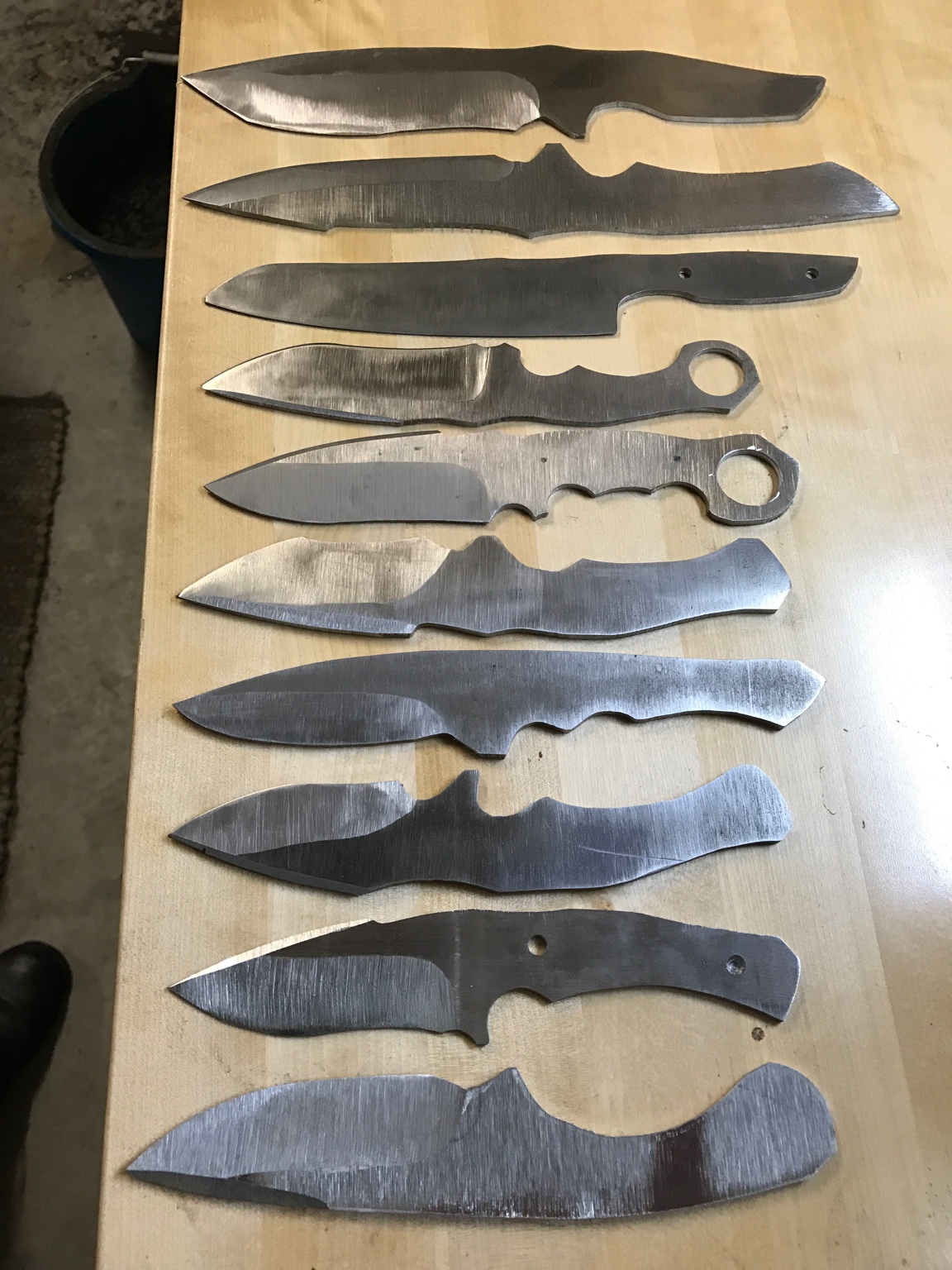
Steel smorgasbord!!!

Joined
Oct 2, 2016
Messages
67
In order of appearance
Cpm m4x2
10vx2
Cpm20cvx3
S90vx3
A few preheat blades.
bbd266859bfcf964786bd5e80ba4da53.jpg
855df18753573d5ec6ae860e3e4fdec0.jpg


Sent from my iPhone using Tapatalk
 
Last edited:
A piece of advice to a new maker;
Instead of trying to learn several steel types and ten styles at a time, pick one steel and one style and perfect it by making ten of that type. That will teach you fit and finish as well as the attributes of that steel. Make them one at a time, too. Each will teach you something. After ten blades in a row, you will have improved much more than the gain from making ten at one time.

Please leave buying/selling and commerce talk out of Shop Talk posts. The question , "Anyone know of a good HTer?" is allowed. The question , "Anyone want to HT them for me?" is not. Any communication between buyers and sellers needs to be done by PM or email. It would be good if you would change your request to the allowable type.

JT made a polite and short reply because he knows the rules ... which I appreciate.
 
I'm not trying to be a smart ass and appreciate your help but I don't understand that. Why would I want to make a bunch of the same knife out of the same steel. Does anyone do that starting out. I want to experiment and see what works and what doesn't. If I make a mistake I don't want to make it 10 times. And as for the different steels. M4 for the harder use. 20cv for something that's going to be in and out of water and 10v/s90v for the edge retention on the smaller blades. If im using it for my intended purpose what does it matter? As I said I'm not doing my own heat treating yet so why not experiment a little.


Sent from my iPhone using Tapatalk
 
Sure it's nice to use super high end steels. But it sure stings to waste it when you screw up a blade, which happens a good amount in the beginning.

As far as making 10 versions of the same blade, I don't think Stacey was nessecarily talking about doing them all at once. If you make the first one and have an issue with the profile or design, you can change it on the next one. A lot of beginners try to do too much in the beginning. IMO, an awesome knife is one that is well made, down the the smallest details. If you look at the master bladesmiths, they make knives that have an EXTREME amount of detail. They're able to do that by focusing, to a high degree, on that one blade. The level of which a person is able to focus in on making something is going to determine the quality of the results. By resisting the urge to bring a bunch of different ideas to fruition at once, you'll be able to focus more, learn faster, and in turn make better knives.

I get it, when I started making knives I had a bunch of different ideas about what knives I wanted to make. I made a handful of different blades at once. It took a lot of time to get them all done and they weren't nearly as nice as they could have been. That was because each one didn't have my undivided attention. My mind would wander around the entire batch of knives instead of just the one. It was distracting, inefficient, and I probably moved slower along the learning curve.

Once you make a good amount of blades you'll have refined your designs to a point where you're happy with them and in turn crank out a bunch at once, assembly line style. If that's what you want to do. Of course, if you're trying to constantly evolve the level of embellishments you're able to do, it's still probably a good idea to do one at a time. That's how a lot of higher end makers do it.

Good luck and nice start!

 
Last edited:
I'm not trying to be a smart ass and appreciate your help but I don't understand that. Why would I want to make a bunch of the same knife out of the same steel. Does anyone do that starting out. I want to experiment and see what works and what doesn't. If I make a mistake I don't want to make it 10 times. And as for the different steels. M4 for the harder use. 20cv for something that's going to be in and out of water and 10v/s90v for the edge retention on the smaller blades. If im using it for my intended purpose what does it matter? As I said I'm not doing my own heat treating yet so why not experiment a little.


Sent from my iPhone using Tapatalk
See I'm a beginner too in knivemaking .So far I've done maybe about 30 knives .From them I learned that every single millimeter here and there makes a difference ......HUGE difference . The shape of the handle and dimension make huge difference too , whether it will be comfortable to use or will make blisters or it will be safe for use .....If you had ten models and eight are not good, you have to make HOW much new knive to improved every single one ? If you go one by one you learn . One by one I mind to make one knife , use them and see were can you improved them .There is also a geometry on blade , different steels need different geometry, different purpose need different geometry .... Do not get me wrong, I'm just trying to help you . Judging by the pictures , I see a big difference between the length of the handles , the proportion is very important detail on knife . On your picture I do not see handle that will be comfortable for use ?
 
Last edited:
I'd have to agree with the "basic" idea Stacy has given you. I know working with different shapes, sizes & steels is fun, but when you start out (like I'm doing now, as well) there will be mistakes made & your insights tend to change as you get more experience & knowledge. You will look at your first blade & notice "a few things" which could have been different. Mine is a monument to D2 steel with an odd hump-back design, a thick edge & too much time after heat treat spent with hours of finishing by hand I didn't need to do. It does have a nice purple heart grip though.....

Just the grip area itself is a major PITA at times to work out. You might see where adding an extra 1/8" would have made a huge difference in how it feels, so doing one, then changing it a bit on the next one helps refine the shape & improve the design. Same thing on the blade shape & size for cutting. Not saying you can't do what you're doing, but things change as we learn more & spend more time working, so it's just a difference in approach & there's no right or wrong here. Not trying to be critical, just sayin' it's a different approach to consider.

Once the heat treat is done, the scales are in place, sharpening is finished & you start with some actual cutting, there will be insights on the design which aren't going to be obvious by drawing out lines on the cardboard or steel. Looking forward to seeing these when they're finished & best of luck with your journey. It's a bumpy road, but a fun one!
 
Sure it's nice to use super high end steels. But it sure stings to waste it when you screw up a blade, which happens a good amount in the beginning.

As far as making 10 versions of the same blade, I don't think Stacey was nessecarily talking about doing them all at once. If you make the first one and have an issue with the profile or design, you can change it on the next one. A lot of beginners try to do too much in the beginning. IMO, an awesome knife is one that is well made, down the the smallest details. If you look at the master bladesmiths, they make knives that have an EXTREME amount of detail. They're able to do that by focusing, to a high degree, on that one blade. The level of which a person is able to focus in on making something is going to determine the quality of the results. By resisting the urge to bring a bunch of different ideas to fruition at once, you'll be able to focus more, learn faster, and in turn make better knives.

I get it, when I started making knives I had a bunch of different ideas about what knives I wanted to make. I made a handful of different blades at once. It took a lot of time to get them all done and they weren't nearly as nice as they could have been. That was because each one didn't have my undivided attention. My mind would wander around the entire batch of knives instead of just the one. It was distracting, inefficient, and I probably moved slower along the learning curve.

Once you make a good amount of blades you'll have refined your designs to a point where you're happy with them and in turn crank out a bunch at once, assembly line style. If that's what you want to do. Of course, if you're trying to constantly evolve the level of embellishments you're able to do, it's still probably a good idea to do one at a time. That's how a lot of higher end makers do it.

Good luck and nice start!
Jason,
Thanks for the advice and putting it in a way that I understand. It's still early over on the east coast and I haven't had my coffee yet. Btw love your work. Your designs are some of my favorites.
Chad Hopkins


Sent from my iPhone using Tapatalk
 
Thanks everyone for the input. I will definitely take note. My ergos are decent. I don't think that's really an issue. I'm a former Newark police officer and navy diver so I know what works and what doesn't as far as real world use. The issue I'm having is finishing. Design and function are ok.
Chad


Sent from my iPhone using Tapatalk
 
When I started out, I made a good number of different designs, all from simple steels as I wanted to do my own heat treating. Once I was confident enough to do some sales to support my addiction, I had one design that i got a bunch of orders for. So I've made maybe 20 of this same design, usually in batches of 4-6 at a time. While it can be a little monotonous, I will say that exercise exponentially increased my skill. I was doing the same steps multiple times which helped me get the muscle memory free hand grinding. Also, making a batch of knives for one person makes you focus on consistency. The way I look at it, if I can make 6 nearly identical knives, that is a mark of my skill as a maker as I couldn't just "make a smaller knife" out of a mistake. It forced me to pay attention to each detail in order of completion. Now, even if I don't have an order, if I'm making one knife, I make 2. This has several benefits for me: 1. It is a little insurance in case I really mess up one, I have a backup. 2. It forces me to try to make them similar= consistency. 3. Maybe it will allow me to have something on hand when I get a request (yeah, right) 4. Perhaps, one day, I will actually have a nice knife for myself, instead of my mistake laden shop knives. At least that seems to work for me. Your mileage may vary.
 
When I started out, I made a good number of different designs, all from simple steels as I wanted to do my own heat treating. Once I was confident enough to do some sales to support my addiction, I had one design that i got a bunch of orders for. So I've made maybe 20 of this same design, usually in batches of 4-6 at a time. While it can be a little monotonous, I will say that exercise exponentially increased my skill. I was doing the same steps multiple times which helped me get the muscle memory free hand grinding. Also, making a batch of knives for one person makes you focus on consistency. The way I look at it, if I can make 6 nearly identical knives, that is a mark of my skill as a maker as I couldn't just "make a smaller knife" out of a mistake. It forced me to pay attention to each detail in order of completion. Now, even if I don't have an order, if I'm making one knife, I make 2. This has several benefits for me: 1. It is a little insurance in case I really mess up one, I have a backup. 2. It forces me to try to make them similar= consistency. 3. Maybe it will allow me to have something on hand when I get a request (yeah, right) 4. Perhaps, one day, I will actually have a nice knife for myself, instead of my mistake laden shop knives. At least that seems to work for me. Your mileage may vary.

This is kinda how I was thinking. See what people like and what I like. Then make a few of the same thing. The reason I do them in batches of 10 is because I was using peters and there's more value doing 10 or more.


Sent from my iPhone using Tapatalk
 
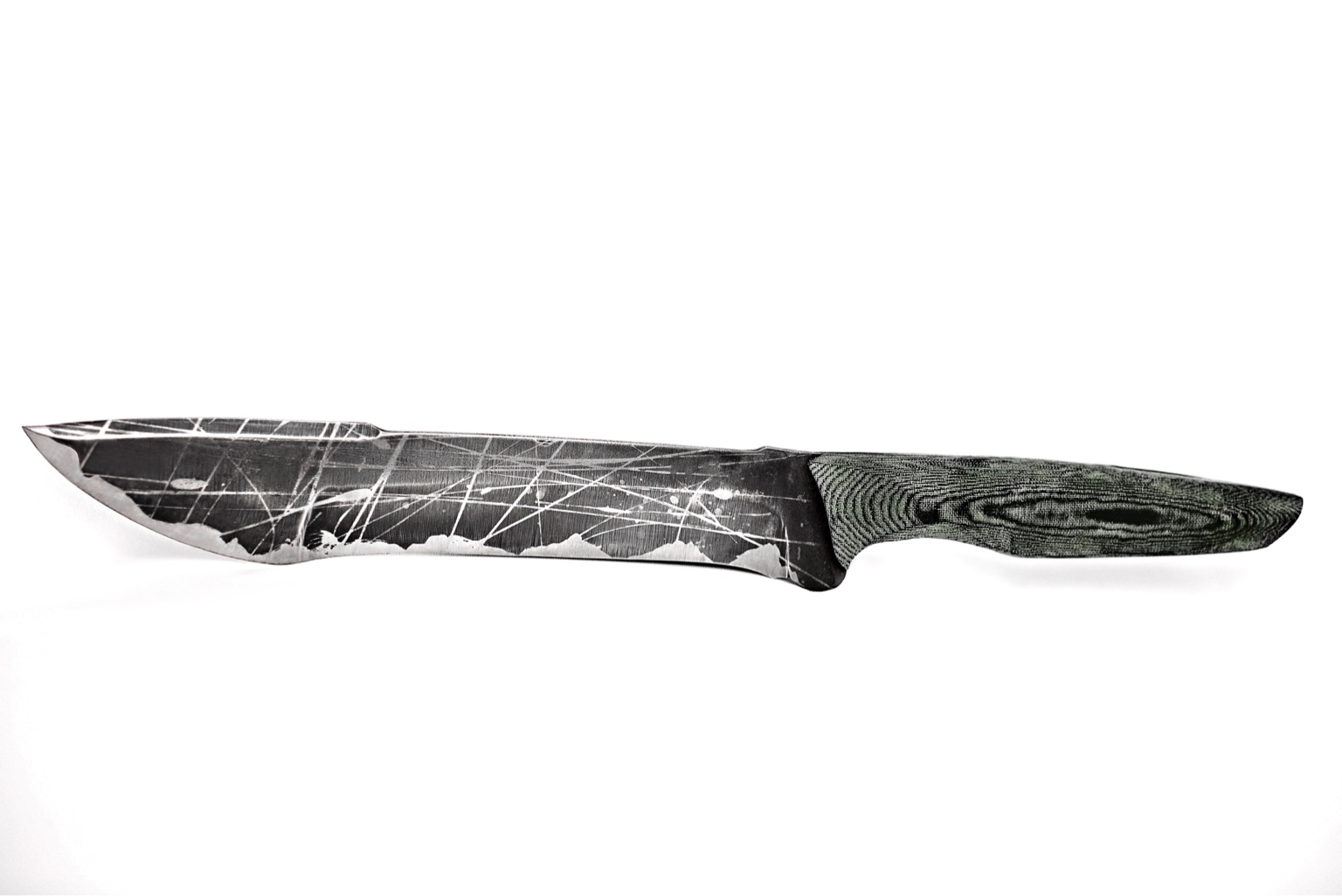
Using your recent finished knife as basis- I agree, these new blades are well thought out and most likely will function well. The santoku blade grind looks a bit thick, post-ht 10v(and other listed as well) will be very difficult to reprofile (major thinning). Bring this up because not in pics - there should be at least 2 pin holes per blade.

Just curious - what hrc/steel are you targeting? and if given 15dps edge, what kind/activities of edge stability/steel are you aiming for?


Thanks everyone for the input. I will definitely take note. My ergos are decent. I don't think that's really an issue. I'm a former Newark police officer and navy diver so I know what works and what doesn't as far as real world use. The issue I'm having is finishing. Design and function are ok.
Chad


Sent from my iPhone using Tapatalk
 
Using your recent finished knife as basis- I agree, these new blades are well thought out and most likely will function well. The santoku blade grind looks a bit thick, post-ht 10v(and other listed as well) will be very difficult to reprofile (major thinning). Bring this up because not in pics - there should be at least 2 pin holes per blade.

Just curious - what hrc/steel are you targeting? and if given 15dps edge, what kind/activities of edge stability/steel are you aiming for?
10v is 64-65 for the kitchen
20cv-61 utility for a friend that kayaks a lot
s90v-61 utility/self defense
M4-62-63 friend that's leaving for deployment in may

T


Sent from my iPhone using Tapatalk
 
I'm not trying to be a smart ass and appreciate your help but I don't understand that. Why would I want to make a bunch of the same knife out of the same steel. Does anyone do that starting out. I want to experiment and see what works and what doesn't. If I make a mistake I don't want to make it 10 times. And as for the different steels. M4 for the harder use. 20cv for something that's going to be in and out of water and 10v/s90v for the edge retention on the smaller blades. If im using it for my intended purpose what does it matter? As I said I'm not doing my own heat treating yet so why not experiment a little.


Sent from my iPhone using Tapatalk

You must have missed this: Make them one at a time.
By making the same knife multiple times, you will learn what changes make what improvements. You asked if anyone makes ten of the same in learning .... yes, it is quite common. In a trade shop or old school knife shop, you might make 100 of the same knife before they let you move on to another style. It is sort of a "wax on, wax off" thing.

As to why use one steel for learning, it is to learn what changes in HT and geometry made improvements. You are sending out the HT, which is good, but the geometry and edge finishing can only be learned by experience and repetition. Even a very slight difference may make a knife cut much better or have a much stronger edge. You won't learn this by comparing many different steels and blade shapes.

Anyway, make them as you want ... I am only offering advice that has been learned by the many makers who have already been doing this for a while.
 
You must have missed this: Make them one at a time.
By making the same knife multiple times, you will learn what changes make what improvements. You asked if anyone makes ten of the same in learning .... yes, it is quite common. In a trade shop or old school knife shop, you might make 100 of the same knife before they let you move on to another style. It is sort of a "wax on, wax off" thing.

As to why use one steel for learning, it is to learn what changes in HT and geometry made improvements. You are sending out the HT, which is good, but the geometry and edge finishing can only be learned by experience and repetition. Even a very slight difference may make a knife cut much better or have a much stronger edge. You won't learn this by comparing many different steels and blade shapes.

Anyway, make them as you want ... I am only offering advice that has been learned by the many makers who have already been doing this for a while.
Stacy,
Gotcha. Yea I missed that. I had just woke up. Sorry and thank you for the advice


Sent from my iPhone using Tapatalk
 
I used 5160 for years and years and did not touch another steel tell I reached the limit of what I wanted with that steel.
 
I like trying new things (and steels) as much as the next guy, but I do find it easier to learn more from less, generally speaking.

Kind of reminds me of certain experiences I've had in various maintenance jobs over the years.

Me: "What'd you do to fix the machine?"

Electrician: "Well, we swapped out the drives, the motors, the photo eyes, the limit switches, and we replaced all of the relays, fuses and contactors. Also, we dumped the drive programs and re-installed all of those from scratch. Now the machine seems to be fine."

Me: "Which of those 127 changes finally got the machine going, and in what order did you do them?"

Electrician: "I'm not sure... We did them all at the same time".

Me: ":grumpy:"


Usually, after so many variables, you're just guessing.
 
Back
Top