George,
The photo isn't clear enough to make much of an evaluation, but here is my take on what I can see.
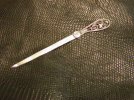
It looks like a project piece that someone cobbled together from assorted parts. Could have been any time in the last 100 years. The "MADE IN FRANCE" is a clue that the marked part was from something made for export, and probably more recent (because it isn't marked in French). The top looks sort of like a project from a class or perhaps an apprentice. The top appears to be added to the blade and the medallion added, also. When taking a silver work/jewelry class, or when apprenticing, this is a common practice. The purpose is to gain soldering and metal working skills. Often old ( sometimes very old) parts and pieces are used as raw materials. I would give students old coins, old silverware, and other odds and ends that were bought for scrap silver, to work with.
The top of a fork or spoon would be given to the student to practice sawing out the pattern into openwork ( coin were made into silhouette pendants the same way). The top of your piece looks to be exactly that. Sometimes they would saw out and embellish an existing pattern, and other times they would draw and cut their own inside the bead border of the handle. The religious medallion appears to be added as a decoration. As I said, I can't see the details of the construction, but it sort of looks like the parts are just placed on top of each other and soldered together. This would be a rather low level procedure, indicating that the smith was not skilled in soldering and welding yet.
A I said, it could have been done by a student in Cartier's studio 100 years ago, or done by BBBBeaver, in a night class at the Boston Parks and Recreation jewelry making class las year.
Hope this helps somewhat. Take care Bro.
Stacy
On a side note, one popular project back in the late 1800's and early 1900's was to give an apprentice a silver dollar to polish the figure off and use as an engraving practice disk. The seated liberty dollars were common at that time ( 1840-1880) and the figure was lady liberty seated on a rock. The students, mostly horny young males, would engrave away the clothing and the rock. They would re-engrave the figure as a nude woman sitting on a chamber pot. The flag in her hand would become a rose after some engraving magic. These were referred to as "Potty Dollars" and still pop up at coin shops and shows from time to time.
Here, I found a photo of one done from a trade dollar:
http://www.coinpage.com/coin-image-8467.html


 Any ideas where I can look??????