...still another kwaiken!!!

Matthew Gregory

Chief Executive in charge of Entertainment
Joined
Jan 12, 2005
Messages
6,526
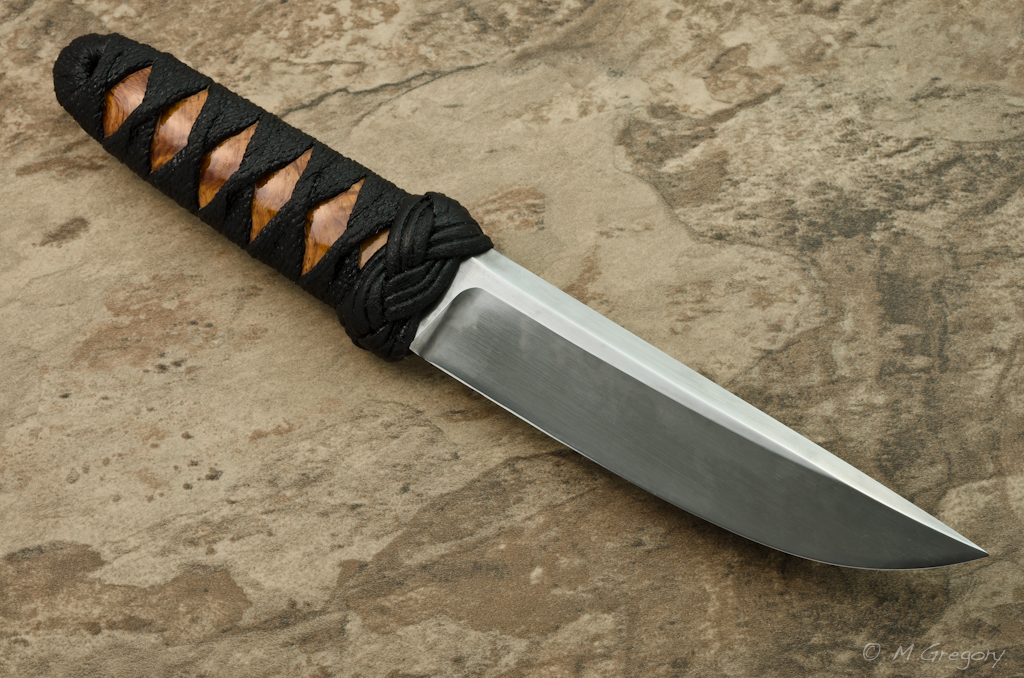
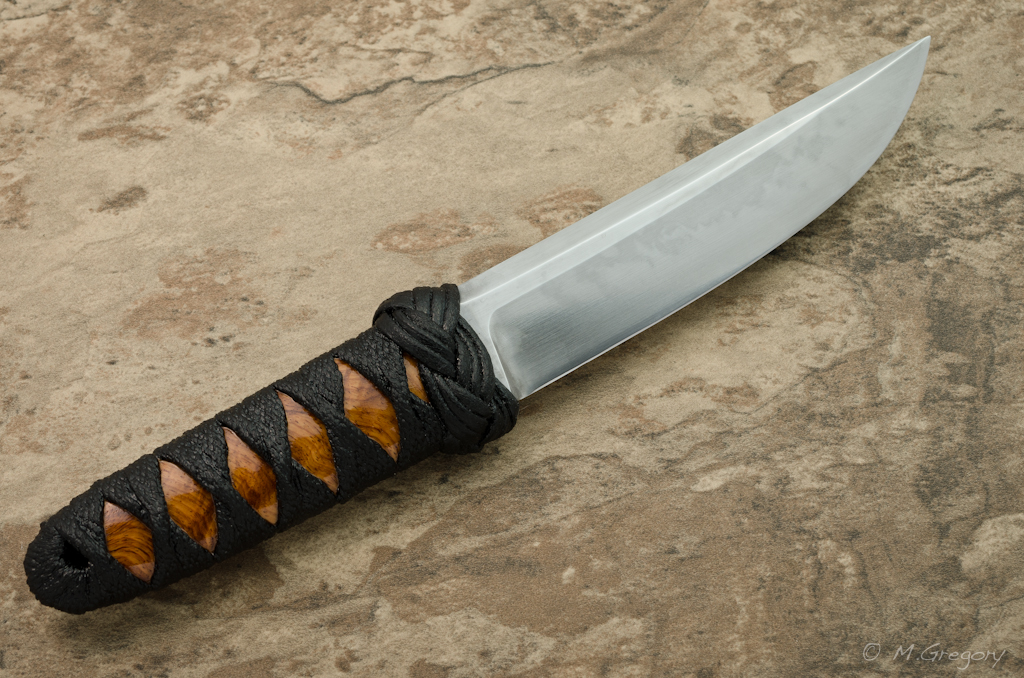
This one's awfully different, though. As much as I love the 'traditional' stingray and Japanese style wrap, I crave the warmth and beauty of fine wood.

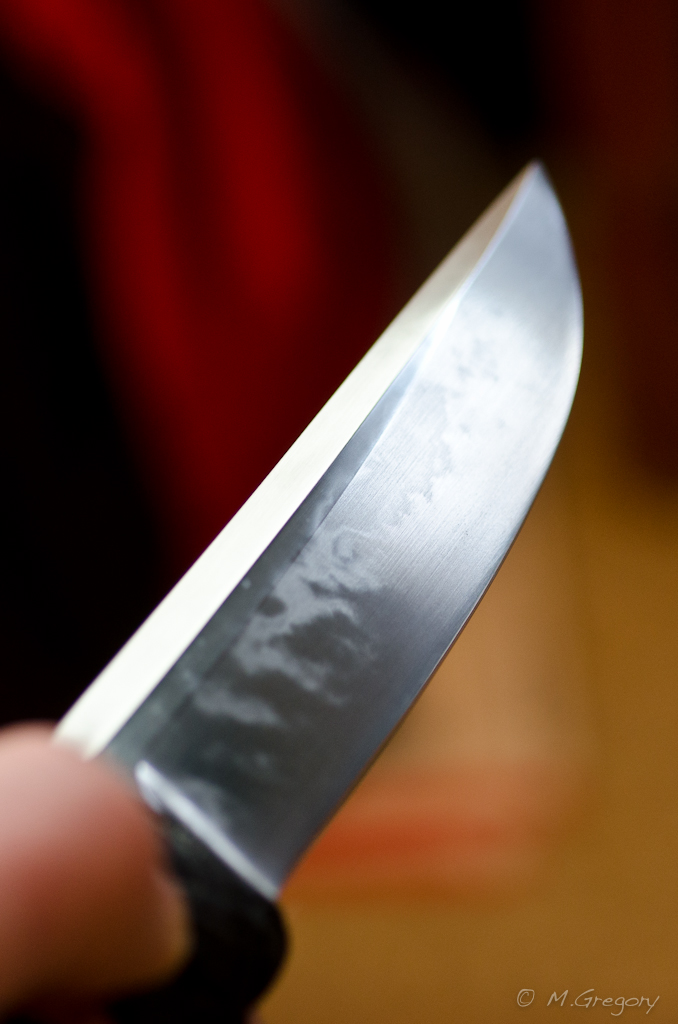
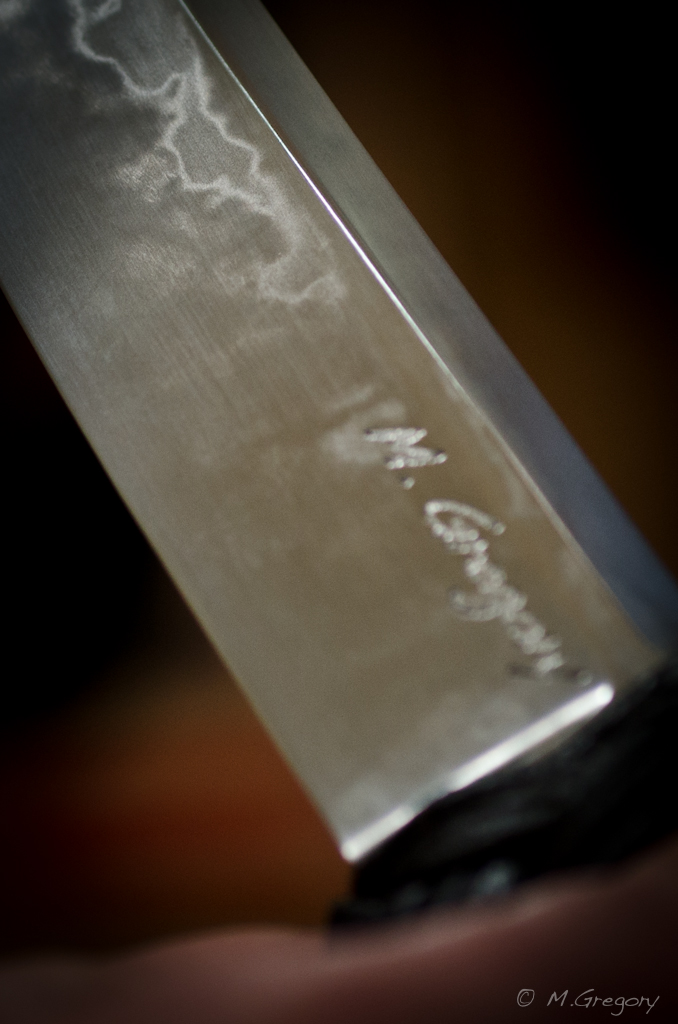
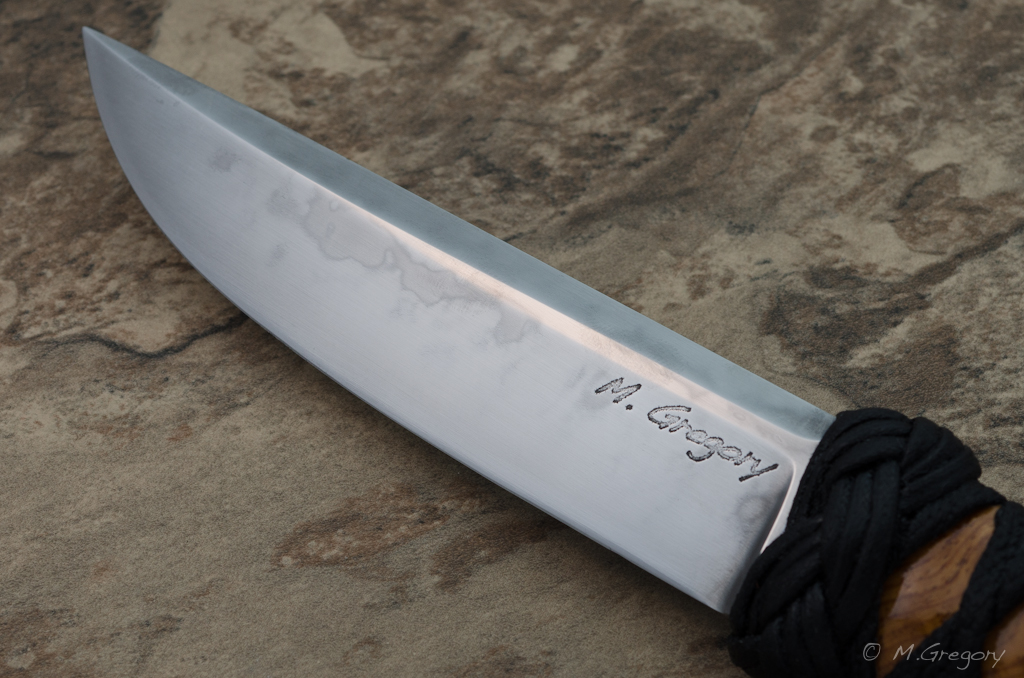
I almost abandoned this blade, as the spine detail I had played with didn't seem right to me. It sat on my bench for months, until I started making the others I showed in a previous thread. For some reason, I grabbed this blade and commenced putting a nearly sharp bevel on the spine (which I've since flattened a bit). Lo and behold, when I continued up the progressively finer grits I noticed a hint or wisp of hamon scattered randomly over the flats. I'd shot for a fully hardened blade, but 1095 usually has other ideas when it comes to this. This time it really worked out, as it adds a really different detail, I think.

The tang is fully tapered, and yet again just a pinch longer than most like this knife to help with wider hands, however it feels completely different due to the ovoid-shaped Amboyna scales under the Japanese style wrap. Fills the hand very nicely, without adding so much mass that it feels slow or heavy. Plus, it's gorgeous to look at (well, I think so, as does at least one other gent I know!).

Pardon the horrible shots of the hamon - no matter how I try, I just can't capture that elusive trick of the light properly with my camera.

Thanks for looking, and all comments welcome.
6705629075_90498afa7f_b.jpg


6705630093_0e0d758c5c_b.jpg


6705630921_60dcd7c6b9_b.jpg


6705631741_0fe831fbe7_b.jpg
 
I think it's gorgeous to look at, too.

Great grinds,good idea with the scales under wrap, and that 1095 hamon's so delicate.

John
 
It looks nice...I would like to see a habaki on some of these "kwaiken".

Best Regards,

STeven Garsson
 
STevie, is a habaki what you use to cook out on the deck with?????

Paul
 
I really like this one. Graceful but also very strong looking. Am I mistaken that the grinds are different on either side? I looks like there's no flats on the signed side.
 
Loved the last one - and dig this one even more. That gorgeous wood and killer hamon put this one firmly into my kinda Kwaiken territory. Ship when ready. :)

Roger
 
Tapered handle looks great with the wood.

Very nice
 
I like the other one you posted, but I like this one more. It seems to me a more traditional blade shape which I find appealing. Nice work.
Darcy:)
 
I really like this one. Graceful but also very strong looking. Am I mistaken that the grinds are different on either side? I looks like there's no flats on the signed side.

A chiseled grind shobu-zukuri?
 
I really like this one. Graceful but also very strong looking. Am I mistaken that the grinds are different on either side? I looks like there's no flats on the signed side.

Hey Stuart! Trick of focus - they're identical on both sides - I've got the aperture on my macro lens pretty wide open as I'm trying to hand-hold the subject and need as much shutter speed as I can eke out. If you look really closely above the 'y' in my last name you can see the start of the flat. If I get a chance I'll snap a shot of that side so you can see it better.

Thanks for all the comments, guys - it means a lot to a hacker like me!
 
This look better, Stuart? I tried to catch it's reflection as best as I could to highlight it - it really does disappear, as the bevels for it are nice n' soft.

6714110619_b104379366_b.jpg


Garsson, I agree - about the nomenclature of this style. Let's come up with a different name for it and I'll run with it! Like you, I prefer things properly categorized, and this is about as distant from a traditional kwaiken as it could be. Let me know if you have any ideas.
 
I'm no expert in the field, but I've certainly seen a great many contemporary knives of similar design described as Kwaiken. Does RJ not use the term on knives not greatly dissimilar?

Maybe someone could post a pic of a traditional piece that is definitively "Kwaiken" and point out the design features which make it so. I ask because I do not know and would like to learn.

As for correct terminology, I don't see anything wrong with describing it as "Kwaiken-insipred" - which it surely is.

Roger
 
I'm no expert in the field, but I've certainly seen a great many contemporary knives of similar design described as Kwaiken. Does RJ not use the term on knives not greatly dissimilar?

Maybe someone could post a pic of a traditional piece that is definitively "Kwaiken" and point out the design features which make it so. I ask because I do not know and would like to learn.

As for correct terminology, I don't see anything wrong with describing it as "Kwaiken-insipred" - which it surely is.

Roger

Perhaps it is a "aikuchi," a tanto without tsuba. Most kwaiken I have seen are without ito-maki. Kwaiken is supposedly very small, for a woman to protect her virtue. It is often described as having a lacquered handle. I maybe completely wrong, since there is little English literature on traditional "kwaiken."
 
Perhaps it is a "aikuchi," a tanto without tsuba. Most kwaiken I have seen are without ito-maki. Kwaiken is supposedly very small, for a woman to protect her virtue. It is often described as having a lacquered handle. I maybe completely wrong, since there is little English literature on traditional "kwaiken."

What little I have read from Googling "Kwaiken" suggests they were carried by both men and women of the nobility and Samurai classes.

Here is a pic of a Kwaiken from R.J. Martin's web site:

http://www.martinsite.com/kwaiken.shtml

Roger
 
Back
Top