im looking into makeing my first knife with the stock removal method and have purchased and read wayne goddards 50 knife shop, and my quesition is after the blade cut out into a blank and grinded does the blade steel need to be heat treated if made from an old saw blade or will it still be strong enough to hold an edge, any help would be awsome thanks

-
The BladeForums.com 2024 Traditional Knife is available! Price is $250 ea (shipped within CONUS).
Order here: https://www.bladeforums.com/help/2024-traditional/
You are using an out of date browser. It may not display this or other websites correctly.
You should upgrade or use an alternative browser.
You should upgrade or use an alternative browser.
stock removal question
- Thread starter inzane
- Start date

- Joined
- Jul 7, 2006
- Messages
- 2,526
If you don't overheat the blank while grinding it (if it turns blue, you've heated the temper out of it and it will be too soft) you might get away with that. I doubt it would really be optimal though; I'm not sure how hard various saw blades might actually be. What the heck, make one and see how it holds an edge.
The experienced guys will have better answers for you.
The experienced guys will have better answers for you.

- Joined
- Jul 8, 2001
- Messages
- 3,623
I know a local guy that cuts the blades out of old saw blades and then grinds the cutting edge in with a wet grinder to keep from over heating them, I don't know what he cuts the blades out with though, but he sells a lot of them. He told me he could make about 40 in a week.
have fun and keep it cool.
Bill
have fun and keep it cool.
Bill

Stacy E. Apelt - Bladesmith
ilmarinen - MODERATOR
Moderator
Knifemaker / Craftsman / Service Provider
- Joined
- Aug 20, 2004
- Messages
- 38,655
You might be able to make an OK knife that way. But you can make a better knife by annealing the blank first, filing/grinding/sanding the blade, and having it properly HTed. Trying to grind a hardened blade from scratch is fraught with problems.
Stacy
Stacy
A while back I was digging up as much information as I could on 8670, a steel used in many saw blades(perhaps more often than L6) According to the manufacturers websites, most of the blades that had carbide teeth were hardened to only the high 40's low 50s RC(one company was claiming a high hardness of 54RC), the one company I found that had steel teeth was around the same for the bodies, and a 58-60 for outside inch or so, including the teeth. While they may be useable for blades as is, you will get more out of them by annealing and re-hardening.
Ken
Ken
- Joined
- Dec 4, 2005
- Messages
- 1,025
I can't find it anymore but when I was first starting out in knives I found a website that the guy talked about how his blades were the best because they preserved the "optimal temper" of the blades, because the blades have to cut anything from wood to glass re-HT'ing it messes it up and you lose it's properties. Thinking back on it now it's really funny but I didn't know better at the time 
Stacy E. Apelt - Bladesmith
ilmarinen - MODERATOR
Moderator
Knifemaker / Craftsman / Service Provider
- Joined
- Aug 20, 2004
- Messages
- 38,655
I read an article (maybe the same one) where the maker stated that he cut his blades from old saw blades and ground then in their hardened and properly tempered state. He stated that they would cut anything. The real laugh was that he cut them out with a torch.
Stacy
Stacy

KnifeHead
Knifemaker / Craftsman / Service Provider
- Joined
- Apr 5, 2006
- Messages
- 5,581
I read an article (maybe the same one) where the maker stated that he cut his blades from old saw blades and ground then in their hardened and properly tempered state. He stated that they would cut anything. The real laugh was that he cut them out with a torch.
Stacy
That's hilarious!
It points to the fact that there is a very small percentage of educated knife users today. Since most kitchen knives need resharpened every time you use them, how many people really know what constitutes a good knife? That guy probably thought his knife was awesome because it was shaped like a knife and could be sharpened. - Joined
- Nov 16, 2002
- Messages
- 9,948
You can buy fully-hardened hacksaw blades (M2 at about RC65) and make decent knives from those. It's a high-speed steel, so you have to work really hard to ruin the temper. There are a few leads for sources over at rec.knives Just don't buy the 0.032" thick stock - it's not fully hardened.
When you try to drill holes in the tang to add scales, you'll wish you took the advice of the knifemakers and used annealed steel.
When you try to drill holes in the tang to add scales, you'll wish you took the advice of the knifemakers and used annealed steel.
MSCantrell
Knifemaker / Craftsman / Service Provider
- Joined
- Mar 12, 2005
- Messages
- 1,213
When you try to drill holes in the tang to add scales, you'll wish you took the advice of the knifemakers and used annealed steel.
That's the truth!
But a carpenter showed me an interesting trick a week or two ago. We were looking at used bandsaw blades, and someone mentioned how tough it would be to drill holes in them.
So Tim the carpenter stood a piece of firewood on end, laid the bandsaw blade on the end-grain, and popped a pretty nice round hole in it with a nail set.
For whatever that's worth

Mike

- Joined
- Aug 27, 2004
- Messages
- 12,957
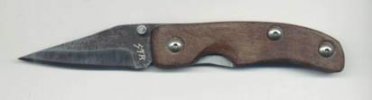
I made a knife for my brother years ago when he was still very young. My dad told me to make it so it was a working knife but nothing too awful serious that he could actually hurt himself bad with which was tall order in hindsight.
I used an old cross cut saw blade that I actually had tested and it came back to be 48 Rc so it was pretty soft for a blade. It looked like a knife, worked like a knife and could sharpen a pencil but it wasn't good for much else, maybe opening mail. It had walnut scales and for all practical purposes was nothing more than a mock up or prototype of sorts but he loved that thing and carried it for years until it disappeared one day never to be seen again.
STR
I used an old cross cut saw blade that I actually had tested and it came back to be 48 Rc so it was pretty soft for a blade. It looked like a knife, worked like a knife and could sharpen a pencil but it wasn't good for much else, maybe opening mail. It had walnut scales and for all practical purposes was nothing more than a mock up or prototype of sorts but he loved that thing and carried it for years until it disappeared one day never to be seen again.
STR
Attachments
- Joined
- Jul 7, 2006
- Messages
- 2,526
STR... my kids (6 &7 yr-old girls) are starting to want their own knives... I just may use your idea of making it sub-standard on purpose :thumbup: Finally a knife might come out the way I intend it to! :foot: Now then, where can I get some hot pink micarta?
:foot: Now then, where can I get some hot pink micarta?
- Joined
- Mar 29, 2007
- Messages
- 5,846
I have been using a lot of crosscut saw blades. Annealing first and then working them on a grinder and a belt, lots of hand filing and sanding.
The propane torch forge works fine for this- I used clay to pack a pipe in some cinderblocks. It's not as good as a insulated forge, but it gets the heat.
Takes a while to get the quench thing down, and you won't (so far I've done 8 blades, 4 completed knives) get as hard as some of the steels I've tested on, but I've got one I just finished that cut a 1.5 inch thick phone book into 10 pieces and shaved hair after, so it's not all bad
The propane torch forge works fine for this- I used clay to pack a pipe in some cinderblocks. It's not as good as a insulated forge, but it gets the heat.
Takes a while to get the quench thing down, and you won't (so far I've done 8 blades, 4 completed knives) get as hard as some of the steels I've tested on, but I've got one I just finished that cut a 1.5 inch thick phone book into 10 pieces and shaved hair after, so it's not all bad
- Joined
- Jul 8, 2001
- Messages
- 3,623
No sir I sure don't, he gave me one several years ago and it's a pretty good knife. There's lots of ways to make knives and this is just one way thats simple and produces a pretty good product for little money. It seemed like he scores them with something and then just wiggles them back and forth until the blade breaks out, then he wet grinds, adds a guard and usually a hunk of elk horn. He also uses mostly the old big round saw mill blades.
A lot of people think his knives are crap, but he gets a lot of repeat business and he sells a heck of a lot of them. He doesn't worry about fit and finish all that much either, he just enjoys making knives this way and does quite well at it.
If I see him in the near future I'll try to get more info on how he cuts the blades out.
Have fun and keep it cool,
Bill
A lot of people think his knives are crap, but he gets a lot of repeat business and he sells a heck of a lot of them. He doesn't worry about fit and finish all that much either, he just enjoys making knives this way and does quite well at it.
If I see him in the near future I'll try to get more info on how he cuts the blades out.
Have fun and keep it cool,
Bill
I made my first knife 20 some years ago using a saw blade from a large radial arm saw from a lumber yard. Cut the profile with a metal cutting band saw and ground it on a bench grinder with water dripping on the wheel, I would say it was a fair knife, you can get it sharp, but will not hold the edge very well. But it was fun to make and I found that I wanted to make knives. I still have that knife, and make some just like it now, only I use new steel. So I would say, make use of what you have and enjoy making it, and no matter how it turns out you will learn something from doing so.