

- Joined
- Jan 9, 2008
- Messages
- 588
I recently forged out an 11" Gyuto at a class given by Bill Burke. I took the forged blade home to finish on my own.
It was normalized three times.
I ground it out and heat treated at 1540 full quenched in Parks AAA.
Tempered at 400 for one hour.
Hardness tested at 60rc
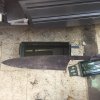
The blade had a distinctive bend in it. I tried to straighten it in my vise with a wide three point straightening jig.
It just continued to spring back. I the went with a narrower three point straightening jig to work smaller sections at a time, and it still just sprung back.
So, I applied a little more pressure and the blade snapped.
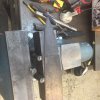
The fine grain looked great!
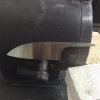
So my 11" Gyuto is becoming a 6.5" Santoku.
Could I have approached the straightening process differently?
Could it be that the process I performed would have worked fine with let's say 1084, or W2, but not with a spring steel such as 5160.
Was the blade not tempered enough prior to attempting to straighten it (60rc)?
I'd rather not repeat this if possible.
Any comments or critique welcome.
It was normalized three times.
I ground it out and heat treated at 1540 full quenched in Parks AAA.
Tempered at 400 for one hour.
Hardness tested at 60rc
The blade had a distinctive bend in it. I tried to straighten it in my vise with a wide three point straightening jig.
It just continued to spring back. I the went with a narrower three point straightening jig to work smaller sections at a time, and it still just sprung back.
So, I applied a little more pressure and the blade snapped.
The fine grain looked great!
So my 11" Gyuto is becoming a 6.5" Santoku.
Could I have approached the straightening process differently?
Could it be that the process I performed would have worked fine with let's say 1084, or W2, but not with a spring steel such as 5160.
Was the blade not tempered enough prior to attempting to straighten it (60rc)?
I'd rather not repeat this if possible.
Any comments or critique welcome.


